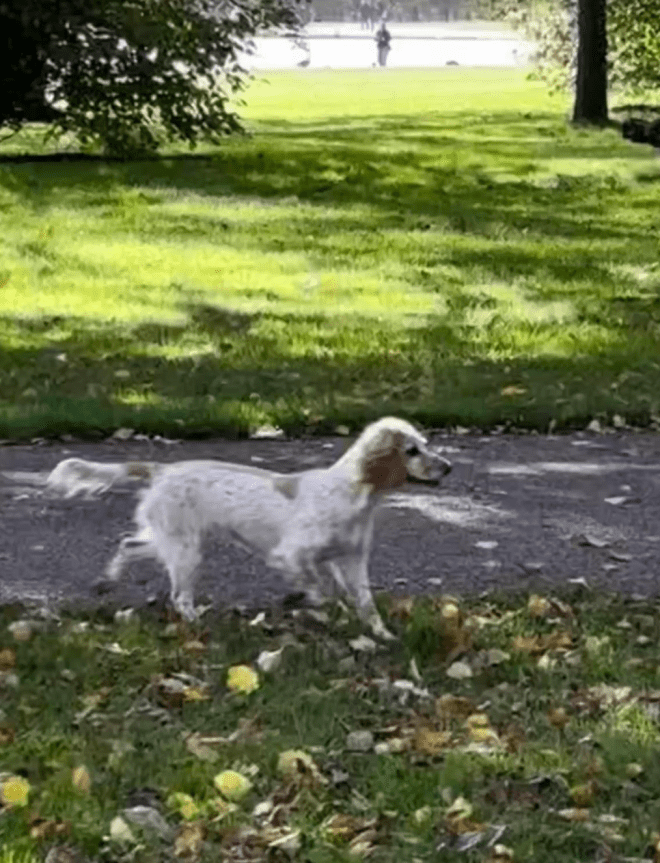
Freya couldn’t exactly remember when she started obsessively taking photos of dogs. It must have begun, she reckoned, sometime back in 2011, when she got her first iPhone. The iPhone 4s, which she had splurged on in mid-November of that year, using, as always, her credit card to buy a “luxury item” she couldn’t afford (including food). But when she found herself voraciously taking pictures of various dogs throughout Brooklyn, she suddenly found that the “excessive” purchase had been totally worth it…at first, anyway.
However, after about six months of doing it—and finding her phone totally out of storage space most days as a result—she became slightly scandalized by her own obsessiveness with dogs. Was it “normal”? Was it “okay” to be this, let’s say, “allured” by canines? But even “allured” was the wrong word, because there was nothing sexual about her “attraction.” It’s not like she had bestiality predilections, she just really loved dogs and thought that every single one of them was so fucking cute—even the so-called ugly breeds, like Komondors. And yes, “ugly” dogs were all the rage during this period of North Brooklyn gentrification, McCarren Park teeming with breeds like the Bull Terrier, the Brussels Griffon, the Neapolitan Mastiff and the Shar Pei. It was all part of making some “grand hipster statement,” one designed to prove, naturally, that the uncool was cool. And that the uncooler something was, the cooler it was.
Of course, the thing that went without saying regarding these hipsters (a presently antiquated word) and their dogs was that it was very expensive to own them. More often than not, however, a coterie of remotely-located parents were footing the bill, catering to the various “necessary” expenses of all these well-dressed dogs. That’s right, well-dressed. They had coats, shoes, shirts, sweaters—the whole gamut of sartorial options that were once generally reserved for humans. After a while, it actually started to annoy Freya rather than “charm” her. Oh sure, she still adored the dogs themselves, but they were beginning to represent something else to her. Something utterly contemptible about the humans at large living in this particular part of Brooklyn.
She supposed that it ended up being one of the underlying reasons that she decided to flee the city of New York for good, opting to take off, instead, to one of its foils: London. Except that, where dogs were concerned, New York wasn’t a foil for London at all. The latter was so much more supreme for dog voyeurism. So much more sophisticated, too. Pretty much exactly like the scene in 101 Dalmatians where Anita and Roger meet for the first time in the park. St. James’ Park, to be precise. As for Freya, she was more partial toward Kensington Gardens, which “flew under the radar,” relatively speaking, compared to other Royal Parks in the city (first and foremost, Hyde Park). Not just in a general sense, but also in the most important sense of all: for the purposes of dog watching. Or “dog stalking,” depending on how one looked at it.
In truth, Freya was horrified at the notion of actually telling someone that this was the extent of her life. Sitting around in public places and waiting for a “hot dog” (new meaning to the phrase indeed) to pass by so she could immortalize its image in her phone. And yes, she was equally as afraid at the thought of somebody one day gaining access to her phone and seeing the extent of her “casual documentation,” which wasn’t really casual at all. So concerned over how her “hobby” would be perceived, Freya didn’t even tell Rhys, the only person she was truly close to in London, about it. She was afraid he might call “the fuzz” on her, report her for being a perhaps even more perverse kind of stalker: a dog voyeur.
Although Freya daily tried to reason with herself that there was nothing really wrong with what she was doing (all in the midst of continuing to snap away her dog photos in Kensington Gardens), she knew that if that were actually the case, she wouldn’t be so reluctant to share her “passion” with other people. To openly admit—even to Rhys—that her love of dogs was beyond what the most ardent dog lover would deem acceptable. Not least of which was because Freya didn’t own a dog, which made the whole thing even weirder. At the same time, perhaps if she did own a dog, she wouldn’t need to be so obsessive about other people’s. The thing was, she couldn’t afford to, neither financially, nor in terms of the frequency with which she left London in order to take her various “odd jobs.” Those odd jobs always being related to low-budget escorting. That’s right, if you needed a “moderately good-looking date” on the cheap (five hundred pounds, plus expenses), you called Freya. These were the types of dates that lasted an entire weekend or accommodated some “international businessman” with arm candy for some special event. Special events that were often out of town, with these “London lads” preferring to take her elsewhere rather than deal with the “scandal” of being seen with her in town. Hence, the “exotic” locations she “jetted away” to tended to be cities like Vienna, Milan, Madrid. “Business conventions” that boiled down to one major meeting/grand dinner and lots of available “down time” in between. Or “being gone down on” time, as it were.
Freya didn’t mind the job, really. It was a living. She had done the same thing in New York, where she actually found that the men were stingier with their “extras”—car service, hotels, meals, gifts, that sort of thing. Maybe it was to be expected since most of the clientele there had been “finance guys.” And how else did rich men stay rich but to remain utterly parsimonious? But it was possible that, in London, the amount of wealth was so much more marked that the rich men could “afford” to be generous, even where it counted most: to their dogs. Or, at the very least, they gave their wives enough money to be generous to their dogs.
Though, from Freya’s perspective, the owners didn’t seem to give a genuine damn about the dogs. Instead treated them like trophies, a mark of prestige and affluence. And that is what dogs are to many people. But not to Freya. Her attraction to them, she knew, was rooted in how unconditionally loving and loyal they were. How pure, how uncorrupted with perverse thoughts (well, save for when they went on a primal humping jag—but that was different than a human man’s “primal” humping jag). She could see the correlation between her dog voyeurism intensifying and the rigors of her job weighing on her more than they had before (the dog photos were her “free therapy”). Maybe it had something to do with “getting older,” but, suddenly, she felt overwhelmed by the idea that this was the only profession she had any experience in. And that, soon, no one was going to want her. The well usually started drying up around one’s early thirties, and she was very nearly approaching that “jurisdiction.” Perhaps it was time to start thinking about “something else.” Some other moneymaking endeavor. And that’s when she decided it would be best to use some of her hard-earned cash to go back to school—to become a vet.
Alas, when she looked up the requirements to become one in the UK, she saw that it would take five years of study and degree approval by the Royal College of Veterinary Surgeons. It instantly deflated her enthusiasm for the prospect. No prospect at all when she peeked behind the curtain to unearth the nitty-gritty details. Thus, she looked into the next best thing: dog walking and pet sitting. Surely that would be an easy “get,” job-wise. But no, as she soon learned, it was highly competitive. Whether she tried to infiltrate Posh Paws, Premier Dog Walkers, Pets in the City—whatever—it was all but impossible to be deemed “worthy.” That’s when another lightning bolt moment hit her: why not start her own under-the-table dog walking business? And then she remembered that most Brits who would pay for such a service were far too elitist to bother with someone so “uncredentialed.” So it was hopeless, really. Not only would she have to keep working until her minge fell off, but she would also have to keep getting her dog fix solely from taking pictures of other people’s. It would be even creepier, she decided, if she asked to pet the animals and ended up overstaying her welcome, so to speak (with the owner, not the dog). Taking pictures from afar was best for all involved. And who was it hurting anyway? Surely the dog owners would appreciate the fact that their “little prize” was being so admired…if they knew about it.
After a couple more years of the “low-but-semi-high-class escort” gambit, Freya did “trade careers.” That is to say, she became a barista at Caffè Nero. Why not? It afforded her the “stability” she was looking for (though not much else). She still couldn’t get her own dog though—not in the flat that she shared with three other roommates. It was strictly forbidden. So she kept taking the photos, looking through her “fresh stock” at the end of each day. Some dogs she would encounter repeatedly, had multiple photos of them.
Life continued this way for Freya until, on one occasion, a dog owner clocked her taking a picture and did not take kindly to it. Freya was keenly aware that such a reaction was long overdue. As such, it was particularly over the top. The owner, a woman, immediately approached Freya and started to physically assault her, mussing her hair and even leaving a scratch on her face after the altercation. That was the moment of clarity for Freya. The moment she realized that, yeah, it was kind of weird, this obsession of hers—this “thing” she had been doing. Besides, she consoled herself as she put some hydrogen peroxide on her fresh cut, it wasn’t as though she didn’t have a vast stockpile of dog photos to keep her “warm at night” for an eternity.
 Literary Bitch