He makes her show him the old Polaroid of herself she stumbled upon while thumbing through some notebooks of hers she hadn’t opened in a while. Even though she really, really does not want to show him because of the way she’s looking so lovingly and devotedly to her ex (who, luckily, is not fully pictured), he convinces her to do it. The powers of male persuasion and all that. In other words, if you don’t do what a man says, you risk incurring the wrath of one of his volatile mood swings. So she let him see it, let him snatch it out of her hand and appraise the person she was several years back. Though not far back enough to warrant Ransom saying, “Nice legs, I’d fuck her.”
Offended by the “compliment,” Elena returned, “What are you talking about? I still look the same.”
“Of course you do,” he replied unconvincingly. “But none of us are the same people after a certain number of years. It’s just scientific fact. The cells regenerate every seven years. You know that.”
Elena did, in fact, know that, though she hadn’t thought about the oft-bandied factoid in a while. Why would she? It’s not as if she felt wildly different from who she was seven years ago. Nor did she feel that she looked all that different either. She was one of those people who didn’t age normally the way others do. She chalked it up to a combination of “good genes,” drinking the recommended daily intake of water and refusing to be stressed about anything. Except, of course, when it came to relationships. Those always tended to stress her out a great deal. Especially when the men she gave her heart to consistently seemed to have a knack for making the worst, most affronting comments to her. Elena mistakenly thought that Ransom would be an exception. But then, with a name like Ransom (as in: the same name as the cad of a character Clark Gable played in Gone With the Wind), what was she to expect?
Maybe this was her fault. She shouldn’t have even mentioned finding the picture to Ransom. However, attacked by a pang of nostalgia she couldn’t control, she felt obliged to share her finding. The thing is, she wasn’t nostalgic about that moment in time or how she looked in the image, but rather, nostalgic for a particular backpack she was clutching in her hand. Upon seeing it, Elena immediately asked Ransom, “Don’t you hate it when you see an old picture of yourself wearing a piece of clothing or accessory you used to love but don’t have anymore?”
Naturally, his reply was: “No, not really.”
Typical. Men are “above” attachment or sentiment not just when it comes to women, but possessions as well. Though, surely, there must be a correlation as so many men do view women as possessions.
Snatching the photo back from him, she stared at it some more, recalling the special details of the mini backpack featuring allover black-and-white photos of Barbie over the years. It might have seemed “puerile” to some now, but, in all honesty, she would still wear it if she had it. In fact, she couldn’t remember why she had gotten rid of it in the first place. Was something wrong with it? Did it have a functional issue? Because, surely, she wouldn’t have chucked it for any other reason, but, at present, she couldn’t recall why that might have been. If she had been able to keep it in some climate-controlled warehouse, she could have “accessed” it at some point again to know for sure if there was something “off” with it. Some mending that needed to be done. In all likelihood, though, it had probably only been tossed out because Elena had needed to leave an apartment (or a town altogether) in a hurry. No time to hold onto anything “superfluous” in her haste to move on to the next “era.”
Yet, in her heart of hearts, Elena knew it wasn’t fair that, because of her “normal” status, she wasn’t allowed to better recall and reflect on previous eras based on the sartorial style she had at the time. You know, the way that celebrities are able to because they’re 1) rich and 2) supposedly iconic. But “normals” have iconic fashion moments, too. Ones that don’t get to be immortalized by way of a barrage of widely-disseminated photos and videos or by being properly stored for whenever the mood strikes a person to go and “visit” the item. Not even necessarily to wear it again, but simply to look at it. In the same way that Elena was now left with the more ghetto option of looking at a photo of the item she used to have, but could not keep. Keeping one’s possessions after outgrowing them, whether literally or figuratively, was, like most things, a rich woman’s game.
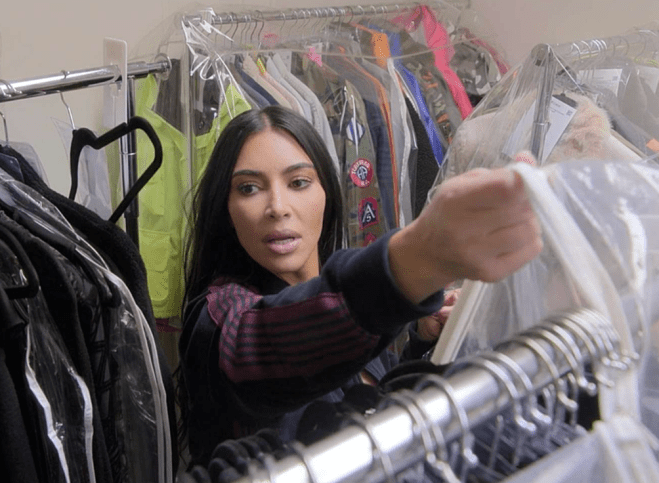
Like that bitch, Kim Kardashian, Elena thought. Someone who wasn’t even really “famous”—not in a respectable manner anyway—but certainly social climbing enough to attend an onslaught of events in haute couture, therefore requiring the storage of over thirty thousand articles of clothing (that number mounting every year, of course). The type of person who had no problems gushing of her personal fashion history, “I have so much stuff, and I’ve had so many different fashion eras. I love seeing all this stuff, so I just want to see kind of where I’ve been and where I wanna go.” In other words, she loves having a giant warehouse to store all of her clothes, shoes and accessories, regardless of whether she chooses to wear them again or not. As anyone would love such a thing. Even “mere mortals” like Elena.
Still staring wistfully at the Polaroid during all this time, Ransom finally waved his hand in front of her face and snapped, “Hello? Are you still there? Jesus, are you that depressed about how you look now? Is that why you keep staring at her instead?”
Ah, leave it to Ransom to always say the right thing, yet again. Elena glanced up at him, letting her expression turn to a glare. “No, Ransom. I happen to know that I’m as hot as I ever was, and I can easily find someone else to replace you if you don’t shut the fuck up right now and let me admire one of my most favorite accessories that I’ve ever owned.”
With that, Ransom at last took the hint to not only shut his trap, but to exit the room entirely. Alas, it was too late for him to recover, for it was after this incident with the Polaroid—hearing the things he said in response to it—that Elena knew she would need to start thinking about leaving again. “Reinventing” herself somewhere else. And that meant jettisoning this “era’s” clothing in order to pack up and ship out efficiently. Because, also unlike rich and/or famous people, she couldn’t afford to have her things mailed to her in some fashion (no pun intended) as a means to hold onto them. For the broke a.k.a. “normal” person, there was no holding onto anything if you ever wanted to leave a place. And, much to the dismay of Elena’s conservationist sensibilities, she was the type of person who continually found herself leaving. Which meant, in turn, losing large and priceless chunks of her “fashion archive.”
But what did it matter to the rest of the world? She was just a nobody. A random girl with a Barbie backpack that someone might come across via a lost Polaroid one day. Long after she had turned to dust. Meanwhile, the possessions she had been forced to part with would endure. Not in a deluxe storage space, but rather, slowly breaking down in a landfill somewhere.

