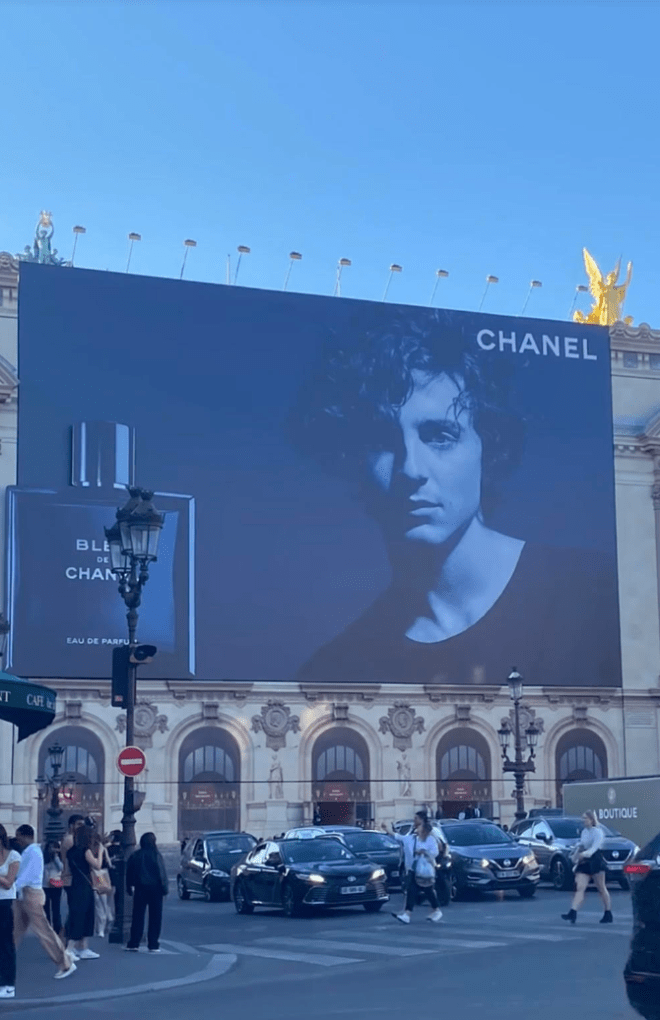
No matter where Timothée Valmont passed on the Place de l’Opéra, he couldn’t escape the dead, yet searching eyes of another Timothée. Chalamet. That wannabe French fuck. Why had Chanel seen fit to make him their spokesperson for Bleu de Chanel? An eau de parfum that Timothée imagined to smell like a dead asshole—if Timothée Chalamet was supposed to embody it. Just a week before, the Place de l’Opéra had felt like a safer place because the giant billboard perched on the front of Palais Garnier’s façade was a Coco Mademoiselle ad featuring Whitney Peak as the face of the campaign. Timothée was aware that most French people would have no idea who she was—hell, most Americans didn’t—but since he was actually kind of into the Gossip Girl reboot, he knew her face immediately. By the time Timothée Chalamet’s mug showed up onto the scene to replace Whitney’s, it was clear to Timothée that Chanel must have been paying for a large bulk of Palais Garnier’s current remodel…ordered just in time to look presentable to the fucks who were going to show up in droves for the Olympics the following year. To Chanel, the repayment in free ad space was priceless. You don’t get much better real estate in all of Paris.
Plus, Chanel undeniably knew that the demography of the ninth was either affluent gentilfemmes or tourists with money to burn. That said, Timothée Chalamet, with his pussy lips, another way to say “duck lips” (not since Ryan Gosling had there been such a set on a man), was catnip to the American passersby. The ones who probably thought he was actually born in France as opposed to New York. That place always trying to be everything to everyone by emulating the European metropolises of London and Paris, yet still somehow coming across, at its core, as a place where more alpha Midwesterners go to “shine.” Chalamet was no French dandy. He was just a boy with a pretty face who had parlayed a TV career into a “serious acting” one. Because, the second you play a gay boy, you’re deemed serious by Hollywood standards. Timothée resented that. He was actually gay, and it never seemed to get him very far. Least of all in Le Marais.
Detrimental to avoiding this poseur of a gay boy, Timothée had lately been forced to pass the Palais Garnier every day, disembarking at the metro there after landing a job at a startup company nearby, where he had gotten some thankless stage as a copywriter that paid nine euros an hour. But he did it as a means to break free from his seemingly endless loop of being trapped in waiter and bartender jobs. He didn’t want to do that anymore. He wanted to carve out a “career” for himself. He knew that sounded embarrassingly capitalist, but he was reaching an age where he had come to the threshold between “having fun” and “being miserable” if he kept continuing down this particular job path. It was all very “thrilling” to do shots with the twenty-something bar patrons when he himself was still in his twenties (or even his mid-thirties), but now it was starting to get taxing. Degrading. He felt like a curiosity to the young gays that came into the Le Marais bar where he still worked. Despite promising himself that he would return home to Bretagne if he ever found himself this “old” and this “unsuccessful” after enough time in Paris.
So he took the stage. The company didn’t seem to mind that he wasn’t a student, or anywhere near a student’s age. Undignified as it was in its own fashion, at least it was behind closed doors, so to speak, as opposed to on full display to the public. The way bartending or Timothée Chalamet was. So willing to parade himself for money. That’s what it was to seek fame, no matter what the medium or “conduit” it was done through. Timothée Chalamet could tell himself he was a “serious actor” all he wanted, but, in the end, he was still shilling eau de parfum. Maybe that’s why the look on his face was so dead-eyed, yet simultaneously searching. Wondering where the fuck he had gone wrong in life to end up as some object in the Chanel stable. Worse still, to sully the Palais Garnier with capitalism over art. Even if, sure, the Palais Garnier wasn’t entirely motivated by “l’art pour l’art” to begin with…
Admittedly, Napoleon III, who had commissioned the structure designed by Charles Garnier, was not a “true patron of the arts,” so much as a power-hungry imperialist dead-set on making the rest of the world see France as a great world power again. Maybe Chanel was trying to do the same thing by wielding Timothée Chalamet. But if that was the best they could come up with to assert French dominance, Timothée couldn’t help but feel further assured that it was all over for France. The country had gone over to the dark side, embracing everything about American politics and “values” to the point where it had lost so much of the rebellious spirit that had once led to a revolution like the one in 1848. The very one that had somehow found Napoleon III in power of the Second Republic-turned-“Second Empire.”
These were the thoughts that riddled Timothée’s brain every time he ascended the stairs of the metro and was met with Timothée Chalamet’s vacant gaze. So vacant and yet…so pleading. “Get me the fuck off this billboard,” Timothée kept imagining him saying. He was starting, more and more, to feel like a character in an Edgar Allan Poe story, ceaselessly plagued by some spectral, guilt-inducing presence. By the time a full month had gone by of seeing and feeling Timothée Chalamet ethereally breathing down his neck, Timothée decided to do something he never would have thought possible: use a large bulk of his paycheck to buy some Eau de Bleu. Maybe, by trying to smell like Timothée Chalamet, he could somehow better understand him. At the same time, it occurred to Timothée that Timothée Chalamet didn’t even wear the fragrance. He just sold it.
At the office, other workers seemed to take notice of and offense at the scent. Apparently, it was such a source of controversy that the big boss called Timothée in one day to tell him that there had been several complaints about (and one allergic reaction to) the eau de parfum he had lately taken to dousing himself with. When asked if he could please refrain from wearing it at work, Timothée replied with a flat and unbidden, “Non.” He could scarcely believe that he had said it himself, as though he were possessed…by none other than Timothée Chalamet.
Whatever the reason for denying his boss’ request, Timothée found himself soon after suffering the consequences as he walked, unemployed, along the boulevard leading back to the Place de l’Opéra. To his surprise, the billboard he had begun to look to constantly for something like guidance and comfort was gone—replaced. With one featuring Lily-Rose Depp instead. A.k.a. Timothée Chalamet’s ex. It wasn’t a coincidence. Both Timothées were being trolled. But it was the Valmont Timothée who suffered the most, ultimately, from losing that billboard. As much as he had initially hated it, it had become like a talisman. No, more than that. A best friend. And now that he had lost his “bestie” and his stage, Timothée took it, at long last, as the final sign to return to Bretagne.
 Literary Bitch