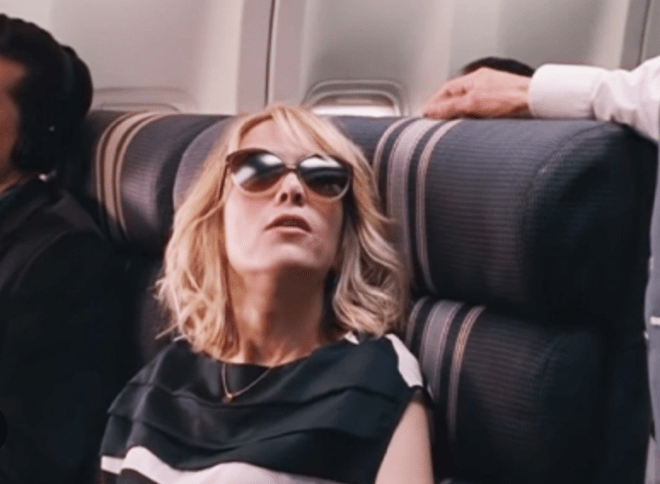
Normalize wearing sunglasses on an airplane. It helps to not see, and not be seen. Why not strut past the aisles like that “middle strip” is your runway? Adding sunglasses will of course make that strut more confident. In addition to helping you avoid appraisal from those who have no choice but to look at you as you walk by. Even if they wanted to avoid it, they couldn’t. There is no escaping the human body on a plane. It’s everywhere—spilling over the sides of seats, screaming in your ear, wafting into your nostrils (should you willingly “choose” to use the bathroom). Sunglasses are part of mitigating the experience. And yet, so rarely does one see people wearing sunglasses on a plane. As though such a “phenomenon” were reserved solely for those who flew private. Another “luxury” of the rich. But it isn’t. I insist. I insist to anyone who has ever questioned wearing sunglasses on an airplane. And anyone who ever will.
Perhaps it is assumed, due to the tightness of airport security these days, that one will somehow get “in trouble” for trying to “conceal themselves” from the “proper authorities.” But no, there is no rule that says, once you show your face to the ID gatekeepers, that you can’t just continue to wear the sunglasses you entered the airport with. Use them as a “burka,” of sorts, for the entire travel experience. And oh, what an improved experience it will be with sunglasses on. Yet, for whatever reason, everybody on the plane will regard you strangely, as though wanting to block out their grotesquerie is somehow “madness.” But it’s not. It’s pure sanity. Utter reason. And meanwhile, as I stare back at them freely without a single worry that they might see me doing so, I wonder how it can be that such a majority of people are undeterred by what it means to travel. Specifically, to travel by air. It is the most insufferable, miserable experience I can possibly think of. At least in terms of actually paying to suffer in such a way. And yet, if someone such as myself, with my various sensitivities (including misophonia), can do it, then obviously so many others can. People who aren’t misanthropes, people who don’t want to burst into flames every time they’re near another person.
But it is incredible, when you think about it. All the obstacles the TSA and the FAA and various governments put into place to make traveling feel so hellish. And how willing, ready and eager the masses are to overcome them. How bad do you want it, right? That’s what they say. Well, the problem is, everyone wants it pretty fucking badly. Regardless of socioeconomic status or psychological frailty. It blows my fucking mind every time I see them all. The hordes, the droves. These people who want—nay, need—to travel. And it begs the question—that rather conservative-minded question—if everyone has “affordable” access to travel, isn’t that what ends up making it feel not only so competitive, but so decidedly unspecial? Not to mention what makes it so generally terrible?
As much as I despise the entire celebrity cabal, I can’t deny that I would take a private jet, too. You know, were I in their same financially fortunate position. But I’m not, and I never will be. So I will continue to hate them and maintain that I am a better breed of human for volunteering to travel on commercial flights. Even if the word “volunteer” doesn’t apply when you don’t have a choice in what you’re doing. Oh well, “semantics.” I guess not having a choice in how to get from point A to point B is the entire crux of how the airline industry makes its billions (billions, goddammit!). If anyone had a choice, though, they would not volunteer for this. And that’s the plane truth (see what I did there?). It is the lack of choice in how to long-distance or transoceanically travel that contributes so much to its insufferability. Knowing airlines can do whatever they want because this is simply “the way it is.” “The nature of the (travel) beast.”
Like going to work, it’s easy to resent because you have no real agency in the matter. No escape. But then, some would say that at least with the journey aspect of travel, there is the reward of leisure at the end of the tunnel (or aisle, if you will). But the punishment for that leisure is the return trip home. You must pay in more suffering for all (if any) of the fun you had on vacation. Any delight experienced must be paid back in pain thrice (The Craft might as well be called The Aircraft in that regard). Oh that accursed Law of Return. The universe demands its “repayment.” And you’ll give it, every time—on the way home. And that’s if you don’t crash, or get detoured by an emergency plane landing due to a sick or belligerent passenger. It’s nothing short of a miracle to make it back and forth each time without death or some less equivalent “inconvenience” (though a significant amount of people might note that death is actually the ultimate convenience). Almost like tempting the Fates with every flight; every violation of the natural order. Because it’s true: humans were never meant to be “up there.”
I suppose we’re “recompensing” the universe thrice in this sense as well. Because, since we’re not supposed to be where the birds are, carbon dioxide emissions will end up being our payback for how gravely we’ve tampered with Nature. Yes, the CO2 emissions from planes in particular are certain to be our undoing. An undoing we’ve overpaid (in the price of airfare) to incur. Complete with baggage fees, the cost of transport to the airport, the additional charges for food and drink (where once they were at least free in the glamorous days known as “pre-9/11”). All the little “extras” they’ve managed to monetize just so we can ultimately bring on the apocalypse sooner through the collective capitalist appetite. Then, and only then, however, will all this intentional suffering in the name of travel cease. And, for a moment, I feel calm, pushing my sunglasses up where they’ve slid slightly down my nose. It would have been a blissful instant were it not for a former high school acquaintance turning around in her seat and noticing me despite (or possibly because of) my “disguise” as she called out, “Raven, is that you?!”
I pretend I don’t know exactly who she’s addressing, but then she has the audacity to actually get up and approach my seat. She grins, “You haven’t changed at all.” I continue to stare ahead, praying she’ll take the social cue that I don’t want to be recognized. That we have nothing in common just because we happen to be traveling to the same destination. Finally, her mood turns sour and she hisses, “Well, anyway, I thought you would have killed yourself by now. It’s quite a surprise to see you.”
As she walks away huffily, the plane’s turbulence intensifies. And it doesn’t stop. Not long after we’re all told to return to our seats and buckle up, the plane crashes. I told you that we take the miracle of arriving somewhere on a plane without incident for granted. Yet, more than being upset about my demise, I was actually miffed by how ineffectual my sunglasses turned out to be for “social protection.” It was far worse (and far more embarrassing) than Annie Walker in Bridesmaids trying to sneak back into first class with her sunglasses on while drunk and medicated on the prescription sedative Helen Harris III gave her.
 Literary Bitch