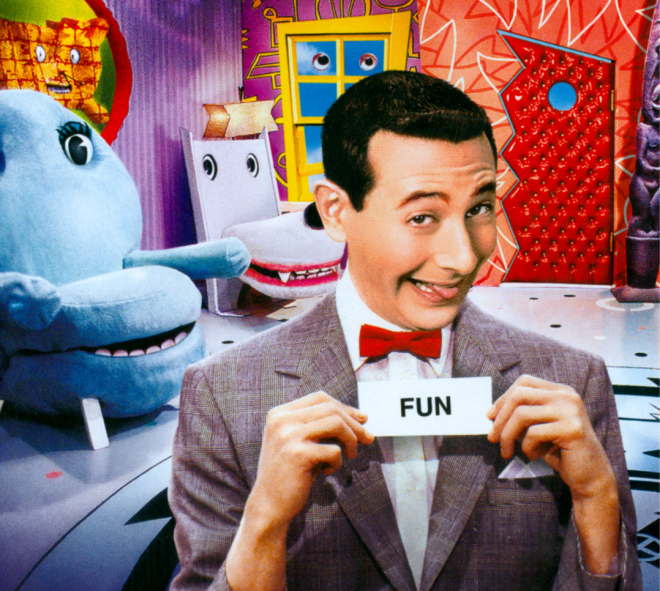
There’s something especially sobering about learning that a person you idolized as a child has died. Almost as though, with them, your youth (therefore, all final traces of hopes and dreams) has also died metaphorically after already doing so literally. Like that idol was the final smidgen of glue holding closed the door between youth and decrepitude. Maxine could remember the exact moment she had fallen in love with Pee-Wee Herman. It was the second Saturday of September 1986, and she had just commenced her first “real” year of schooling as a first grader. She didn’t count those “nothing” years spent in preschool and kindergarten. In fact, if Pee-Wee’s Playhouse had already been on the air at that time, she would have gleaned far more from watching the show than she ever did from her teachers. The ones who deemed memorizing the alphabet as worthy of Maxine’s time. As though she hadn’t already.
Pee-wee, though, was on another level of educating. From the moment she was lulled into submission by the misleadingly slow intro to the first part of the credits, she was hooked. The bizarre combination of puppetry and claymation speaking to her as nothing else on television (or in real life) ever had before. For almost three minutes, Pee-wee reeled her into this alternate universe. And that was before he even actually got started with the show. Sure, maybe it should have been seen as “weird” that this ostensible man-boy was walking around in pancake makeup and a suit with bowtie while making incongruous sounds occasionally posing as laughter, but to Maxine, it felt like the most natural thing in the world. Far more natural than that phony baloney, Mr. Rogers. Now that was a creepoid.
When Maxine had started first grade back in August, she was not expecting much. But the least she had hoped for was not to be ostracized by her peers. Many of whom treated her differently because she didn’t dress like them, or have the same “nice, new” things that they did. In short, they were yuppies-in-training, and she was a ruffian, a girl from the “wrong side of the tracks” like Andie Walsh in Pretty in Pink. She had begged her mother, Ellen, to put her in an ordinary public school. But no, her mother insisted she take advantage of being offered the scholarship at The Hyacinth School in Pacific Palisades. The last place Maxine felt any sense of belonging. The only way it might have gotten worse is if the school were in Malibu. Luckily, Maxine didn’t get into any of the places her mother had applied to there. What sweet relief, to still know she had enough edge to not be “good enough” for Malibu. Yet it was also made very clear to her from day one that she wasn’t good enough for Pacific Palisades either. Did she need to remind them that Dom Deluise was their “honorary” mayor?
What would be the use, though? These children knew nothing of anything. Other than the importance of owning a Teddy Ruxpin and at least three Power Wheels. Things Maxine would never own. It was already enough that Ellen had to subsidize some of the cost of the accursed private school. Maxine would have preferred that the money went to a Murray bike similar to the one Pee-wee had in his movie. The one Maxine didn’t see until after Pee-wee’s Playhouse started airing. Because once she knew there was an entire movie with Pee-wee, she had to see it. Managed to get her hands on the VHS tape by 1989, well after she’d already fallen down the rabbit hole of her Pee-wee obsession. She supposed at ten, she was better-equipped to deal with the more “mature” themes of Pee-wee’s Big Adventure. Though not necessarily the more mature forms of bullying that started to take place as she progressed through the endless ranks of Hyacinth, each grade more torturous than the last.
All she ever wanted was for it to be Saturday morning, so she could escape into that playhouse world. Where it was safe, where she was welcome and accepted. Appropriately, the first secret word ever delivered by Conky was “door.” Indeed, Pee-wee’s Playhouse did serve as a door. A portal to another, better world where the eccentric and the “off-kilter” could thrive. Where, in effect, Maxine could thrive.
In earlier days of catching her daughter watching it, Ellen would try to play the role of “concerned parent” and turn the TV off, citing Herman as “crude.” But the second she walked out the door to her first shift at the restaurant, Maxine turned it right back on. There was no keeping her out of the playhouse. It seemed none of the parents who disapproved of Pee-wee could ever quite explain why. Apart from how there was something both abrasive and “anarchic” about him. Was he putting everyone on with that act? Or was he a sincere “kidult”? A precursor to the average millennial male. Perhaps the answer was somewhere in between. Besides, Maxine wouldn’t think about that question until much later in life, when she convinced her professor at an unnamed Ohio university (where she was pursuing a degree in pop culture) to let her do her thesis on Pee-wee’s Playhouse. More specifically, how it paved the way for “weird” television going forward. Because, as far as Maxine was concerned, it was no coincidence that, in the years after Pee-wee arrived onto the scene, so did the likes of The Simpsons and Twin Peaks. It was all connected. Paul Reubens was the line connecting the dots (la-la-la). Granted, she rarely enjoyed using his “Christian” name to give credit where credit was due. But sometimes, one had to make exceptions.
And among the handful of times she did were in that thesis paper, and then, upon hearing of “Pee-wee’s” death, which, as mentioned, seemed to mark the full-stop death of her own youth. But also something perhaps even worse: the death of a man who embodied the idea that we could live as children forever (defying the Hook version of Peter Pan’s eventual fate of growing up). Or, at least, live with a childlike sense of enthusiasm and silliness. This being evident when he does something like stick some pencils into a potato to make an animal out of it and exclaim, “I was being creative. I used my imagination. You can do this at home, too!” It turns out though, that you can’t really even do it at home anymore either. Not with things the way they are. Designed to drain every adult of all sense of creative will. All sense of passion whatsoever—except for the almighty god of money.
That Pee-wee was born out of a decade when money was unironically worshiped is also telling of how much the world needed him right at that moment. To remind people like Maxine that there was joy in art, in creativity. In, as Kate Moss would say, “Having fun all the time.” And that you were better off avoiding yuppiedom—and yuppie adults—at all costs. Because those were the last people who knew how to enjoy themselves. They didn’t have enough imagination to.
Plus, Pee-wee didn’t begrudge any of the numerous (non-yuppie) adults who also wanted to pop in and have fun at the playhouse (no innuendo intended). In fact, he was the opposite of discriminating Peter Pan, who was technically a “young adult” killer if we’re to go by the line from J. M. Barrie that reads, “…and when they seem to be growing up, which is against the rules, Peter thins them out.”
Although Reubens had no children of his own, Maxine realized that, gross phrasing or not, he propagated children (suffering from adulthood) all over the world with his character’s messaging and approach to life. She knew because she was one of those children. And after a few days spent processing his death, rewatching so many of the old episodes, she came to the conclusion that the last thing he would want is for his death to cause her to surrender that last vestige of her youth, that key part of herself.
At forty-three years old, Maxine was stunned that she could still learn, all these years later, something new and valuable from Pee-wee yet again. Her childhood idol.
 Literary Bitch