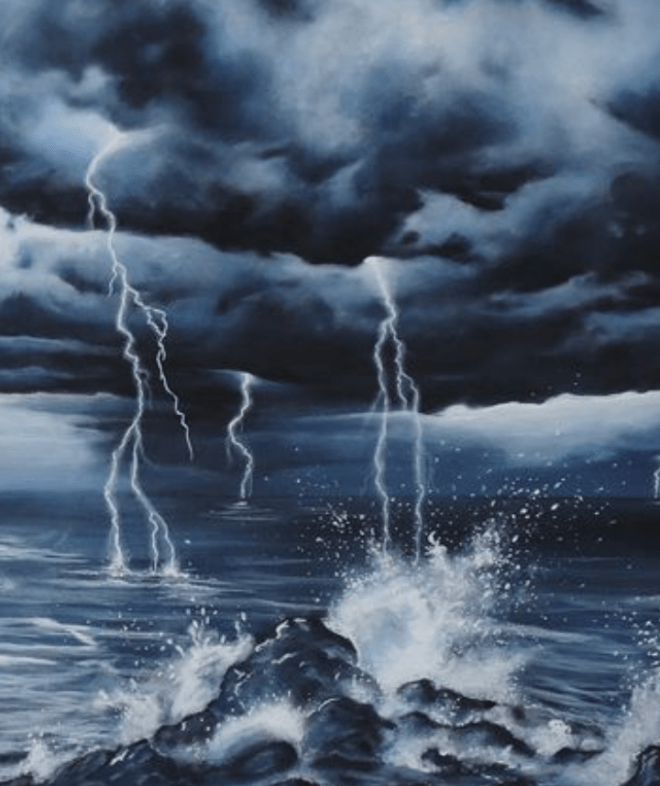
It used to be that you could talk about the weather. That, as a matter of fact, it was the “safest” topic of conversation. Can’t find anything to discuss? Mention the weather. Need to deflect from the political contention that’s quickly making itself apparent between you and one of your family members? Mention the weather. The best and most effective non sequitur to recalibrate a conversation…once upon a time. Now, as Ella couldn’t help but notice, like much of the rest of the sentient world, the weather had become the most political conversation topic of all. For most who despised what big government and big business had done to cause/enable climate change couldn’t talk about it without mentioning that all of this could have been preventable—the scorched earth (ergo, smoke billowing into the atmosphere and causing “Blade Runner 2049 sky”), the hurricanes, the tornadoes (each in geographical locations they were never in before). It was all totally avoidable. If the people in charge had just made the correct decisions instead of continuing to splooge over their precious profits. But no, to change one’s behavior and “risk” losing money (despite already having gobs of it that they would never be able to spend in their lifetimes) was unthinkable. More unthinkable than watching the planet mutate and devolve into this weather-beaten wasteland.
Ella didn’t want to talk about the weather. And she was flummoxed as to why anyone else would want to at this point. Everyone knowing that, on any given day, at any given moment, the weather could tear lives apart. Rip more land and housing to shreds. It had gotten so bad by the year 2036 that the federal government had decided to swap the Department of Housing and Urban Development out for the Department of Climate Change Relocation Solutions.
Of course, everybody knew that any possible “solutions” (read: simply living in the manmade decay that would keep escalating until humanity’s extinction) were only available to the wealthy. Just as it was before climate change came to intensify the already very visible class divides. Whether in the United States or otherwise. Granted, the U.S., for whatever reason, seemed to bear the brunt of apocalyptic weather conditions. Whereas continents like Europe and South America appeared to be more graciously spared by “God” or whoever. In fact, it was easy to see that America was the country that God had forsaken. Or at least definitely forgotten about altogether. And really, could anyone be blamed for wanting to forget about their biggest mistake? The most overt blemish on their record? America undeniably served as that glaring red mark. That ultimate “what was I thinking?” sort of ex. It was the unlovable red-headed stepchild. The “Cinderelly” with no fairy-tale ending—other than the comfort of knowing mass extinction was on the horizon. Not for the elite, of course. But once they were the only ones left, they would finally understand what it was like to be among the “lower” classes they formerly balked at, viewed as “background,” peons. And, make no mistake, life becomes quite hard without its “background players,” after all. Something “good liberals” tried to tell the rich white folks with a movie like A Day Without a Mexican. It didn’t work. “Moralizing” and “pontificating” never did. Except through the rather obvious Trojan horse of Captain Planet.
But even that became just another piece of pop culture ephemera branded as “cute” by the generations that succeeded millennials and found themselves to be endlessly more superior as a result of their amplified jadedness. After all, they had grown up as the Anthropocene was coming to an end, giving way to something else. Something unnameable, but decidedly “post-reality.” Ella hated terms like that though. Ones that tried to distance or discount the fact that this hell on Earth was very real. Too real. As real as the weight of having a child. Which Ella had beared against her will almost sixteen years ago because she lived in a state that still cared more about controlling women’s bodies than controlling climate change.
At first, she hated Jared (it might not have helped that she had named him after Jared Leto, who had started his own cult after getting in a very public fight with Bob Iger, who told him he would “never work in this town again.” Though, to be fair, little remained of the town as it once was). Ella resented the fuck out of him. How Jared had ruined her plans, her dreams of getting out of Twin Falls, Idaho and, at the bare minimum, going somewhere like Oregon or California, where things were slightly progressive. Of course, by the time Jared turned twelve, Oregon and California had all but eroded/been burned off the map. There was no moving there “someday,” when Jared was finally gone…which he never would be. Families who separated only proved to be governmental liabilities. And much harder to keep track of. Better to have as many as possible rounded up in one household, the “gov” “reasoned.” Never mind that it was oxymoronic to put the words “government” and “reason” anywhere near each other in a sentence.
In the future, no one would know there was ever a difference between “before” and “after.” Even by the time Jared’s generation hit their teen years, they were all accustomed to it. “Adapted.” Because that was the thing society asked of you rather than allowing itself to be asked to make any changes of its own. Instead, it was all about bending the people’s will to how things were going to be since we were all very committed to continuing capitalism (they’re painting entire towns white to deflect sun rays for fuck’s sake—that’s not coming up with “meaningful solutions,” it’s caving to never actually attacking the root of the problem). The conditions of climate change had become so normalized—with the progeny of the rich doing what was necessary to sidestep “discomfiture” through paying to live in an elite climate zone that could best evade the dangers of the elements in other parts of the world. It also went forgotten by the next generations not because the information wasn’t constantly passed down, but because they couldn’t remember to be angry about it. That was a mythic life they would never know. They only know this one, and have accepted it. They had never experienced how much better existence was before climate change, back when the weather was a safe conversation topic.
Now, ask someone about the weather and you’ll be met with a river of shit. Apart from the literal river of shit you’re forced to receive most of your water supply from. And don’t even get anyone started on that topic either. In fact, Ella realized that the only thing she felt safe talking about was celebrity gossip. Even though most of them had defected to the moon, the plebes down on Earth could keep watching their “content” (mostly ads for the best Skims-sanctioned “asstro-suits”) from afar. That was one thing that remained a “comforting” constant. And anything was better to ask than, “How’s the weather?” Schizophrenic with a chance of borderline personality disorder.
What did anyone else expect from the weather? It was but a Shakespearean mirror of humanity’s own erratic behavior. Scrambling and chasing, shifting gears and about-facing. Solely in the name of that one thing—money—that was at the core of causing all the weather problems. Normalized into just being “something else we have to get used to.” The reality so pushed under the rug. But those who remember the way it used to be… they don’t want to be asked about the weather. It’s just too painful.
 Literary Bitch