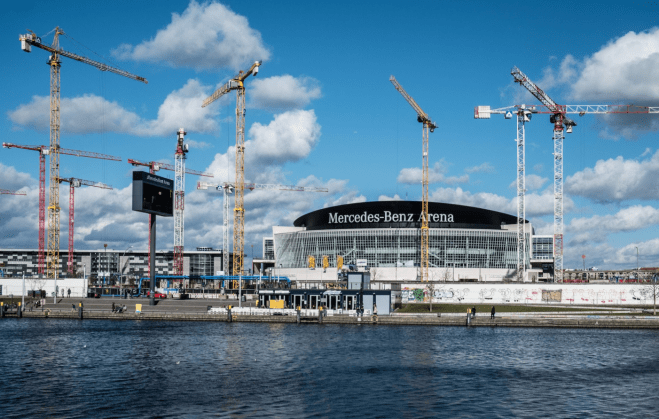
Berlin, Berlin. I remember Berlin. Nights spent lost in a haze, a daze, an endless reverie of good times turned macabre by night’s end. Or morning’s beginning. The Berlin I knew, I wanted to believe, was not so different from the one Bowie did (minus the part where he experienced the height of the Cold War). And maybe it wasn’t. Berlin isn’t as prone to change as, say, New York. It doesn’t feel as much like things are disappearing all the time (even though they are). In fact, a sense of preservation is a key part of the city’s character. The importance of maintaining things that remind the modern residents of the metropolis’ past, often fraught, often troubled. As the various plaques and monuments dedicated to those “lost” (read: unfathomably tortured and abused) in the Holocaust emphasize. To be sure, one of the things I remember most about Berlin are the Stolpersteine peppered throughout the city, there to be “stumbled upon” (the literal translation is “stumbling stone”). There to invade your dark present with an even darker vision of the past. To taunt you with a cold, hard reality that screams, “Your ‘problems’ are infinitesimal!” And mine were, looking back on it. Because looking back is the only time you can ever truly see how easy it all was. How simple and unburdened.
I came to Berlin at the end of my twenty-fifth year. A friend I knew from back in London had told me to just “come out”—no plan, no prospects. He said it would be “no problem” to get situated. To find some sort of noncommittal employment that would furnish me with food and shelter in the hours when I wasn’t busy spending most of my time partying, getting lost in clubland. The alternate dimension that Berlin was so adept at providing. Particularly in 1997, the year when I first arrived. By that time, the city had found its industrial/techno club groove. A landscape that arose out of the ashes of the Berlin Wall’s rubble. And yes, the former obstruction of the Wall is something that residents are never allowed to forget either. For, the year after I got there, in 1998, the Berlin Wall Memorial (or Gedenkstätte Berliner Mauer) was implemented. Like the eventual 9/11 Memorial and Museum, it was a way to lure tourists into the “pleasure” of remembering the pain. The pain of so many who came before them, and who happened to be at the wrong place at the wrong time.
Funnily enough, it’s the Berlin Wall Memorial that charges a nominal fee for a tour, while the 9/11 Memorial and Museum at least remains “free” (save for the price of all that death and destruction that prompted its existence). It would be in “poor taste” to implement the tenets of capitalism there, after all. Which makes it all the more ironic that the historically commie-leaning Berlin would opt for a ticket fee (however petite) to “tour” the Berlin Wall. I myself never made it there during my tenure. I was much too busy getting lost in an abyss of drugs, alcohol and techno.
Later, I would blame Damon—whose name, appropriately, sounds a lot like demon. The aforementioned friend from London who “summoned” me out there. I’ll never know exactly why for sure. Except the obvious reason, which was that he was probably in love with me. Something I chose to ignore during all of those late nights we spent grinding up against each other in former bank vaults like Tresor. I grinded up against a lot of people, see. It didn’t mean anything. Upon reflection, I can say that perhaps none of it meant anything. We just happened to come up in Berlin during its immediate post-Cold War aura of freedom. All inhibitions dropped as East Berlin emptied out, leaving behind ample warehouse (and, as I said, bank vault) space with which to wield solely as sources of fun and debauchery. Something that party promoters like Norbert Thormann and Michael Teufele took to the next level when they eventually created Berghain. But before that, Damon and I would frequent their original club, Ostgut, when it first opened in 1999. Some purists would probably say that “real Berlin nightlife” died once the clock struck midnight at the end of that year and led us all into the void known as the twenty-first century. But I still think the club scene was plenty worthwhile in the 2000s. Except that, by 2006, I had been forced to become my worst nightmare: corporate. It happened, as many unpleasant things do, by accident.
I was walking past the Bahntower one day after being forced into a jaunt at Potsdamer Platz and smacked right into a generic-looking businessman. The blunt force of our impact sent his suitcase flying and a number of important papers spilled out onto the street as a result. Without a second thought, I proceeded to pick them up before they could fly away or get damaged. When I trotted back to the site of our collision to return them to the businessman, he regarded me with no concealed amount of gratitude. Evidently a man of great importance within the company, he then offered me a job at Deutsche Bahn as a way of saying thank you. I didn’t have the heart to tell him it was more like a way of saying fuck you. But I took the offer as some kind of sign. I was getting to be “of a certain age,” and the thought of continuing to keep working at bullshit coffee shops or bars or “art spaces” was weighing on me as heavily as the hands of time themselves. So I decided to take a risk. It was the beginning of the end for me. For it signaled my shift away from clubland and into the land of responsibility. In truth, I think it was that life decision that made Damon lose all respect for me, made him actually fall out of love with me—and just when I was starting to realize that I was in love with him. And as I started to keep more “civilized” hours, he continued down the same erratic path we had been on for almost twenty years. Thus, we drifted apart.
So far apart that he wasn’t even at my going away party four years later. The one I decided to throw in the same shitty apartment I never bothered to upgrade from despite my substantial wage increase. I was now being transferred to the UK, going back from whence I came. Except, instead of London, I would be forced to work out of Sunderland, where Arriva was headquartered. It was officially goodbye to my Berlin days—though I counted them over as soon as I started working this “steady” and “stable” office job.
I knew that plenty of office-type Berliners could still party, but I wasn’t the sort who could juggle two identities, two selves that way. It was all or nothing. And I guess I chose nothing. On weekends, when I go alone to Seaham Beach, this is what I think about. Berlin, Berlin. Nights spent lost in a haze, a daze, an endless reverie of good times turned macabre by night’s end. Or morning’s beginning.
 Literary Bitch