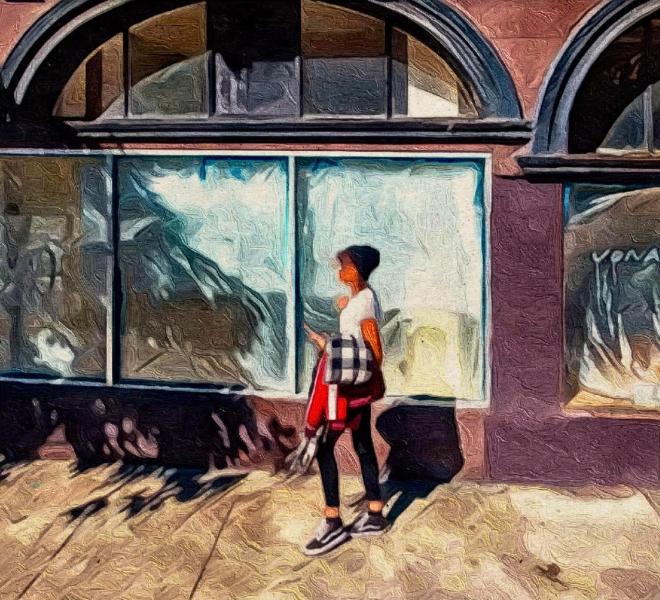
I go to the post office that isn’t there. Except I don’t know that it isn’t there until I’m already there. An existential dilemma indeed. The internet says it exists, but it doesn’t. What can I really trust? What with having placed so much faith and credence in the internet. I know what I see in front of me is nothing, yet still, somehow, I don’t trust it. Well, it’s not nothing, so much as a storefront with nothing inside of it. There isn’t even a faint trace—or a glimmer of a trace—of the post office’s sign that might have once been there. No faded logo, no telltale defunct mailbox somewhere nearby. For all intents and purposes, it’s as though this post office never existed at all. As though the internet made it up entirely. For shits and giggles. Or just to get a good laugh at seeing me waste my time. And I know it sees me.
It sees all of us, everything we do. Probably even knows why I needed (not wanted) to come to the post office. Which was to mail my pleading letter to the unemployment office to extend my weekly stipend. Just for another few months—please, God, please. Although it’s something I should have been able to do online, the archaic nature of bureaucratic institutions insisted upon delivering this communiqué by mail. Ah, what is it about dealing with one bureaucratic institution that inevitably leads to being forced to deal with another contained within the multi-tentacled monster called government? Like They’re setting you up to get caught in their Kafkaesque quagmire. I knew that simply had to be the case—the government’s own sadistic version of Candid Camera (which, I supposed, would be Punk’d). They wanted to see you sweat, being agitated. That, to them, was almost as satisfying as the obscenely cush health benefits and pension they got for being troubled to deal with so many dregs of humanity for decades on end. Not seeming to have any awareness whatsoever that they were the ultimate dregs. Which is why I would have no trouble finding another post office (even if it meant trusting the internet again)—bureaucracy was as pervasive as Starbucks, or H&M.
Thus, I reasoned, there could be no shortage of options for other post offices where I could be belittled, shamed and generally inconvenienced. And I wasn’t wrong. Only about a thousand feet away was another post office option. Maybe it was even the post office’s new location, moved just a stone’s throw from that now-empty building. Its “not too far off” point on the map might have been a consolation prize to those who had been as disoriented as I was by the absence of the disused one. Or I could have been making all of this up to…I don’t know. To soothe myself that places don’t—can’t—just disappear. This notion is important to me. Makes me believe that some order can exist in a disordered world. But I know, of course, that it doesn’t. That my attempt at rationalization for the post office simply being “moved” is all part of the general lies we tell ourselves to convince our fragile minds that there is anything resembling permanence on this Earth. I know, at my core, that this is a different post office that has nothing to do with the other one. But I wish it wouldn’t jar me so much. Wish that I could accept the fact that just because the internet hasn’t updated a business’ existence (or rather, non-existence) doesn’t mean it should still be there.
I suppose this inability to reconcile what I see right in front of me with what I’m told by another, theoretically more “authoritative” entity is the great problem of my generation (and what few generations might come after). And I wonder if it might not create some sort of breeding ground for a new mental disorder in the future. For delusion is undoubtedly embedded in this phenomenon. Deluding ourselves that the internet could never steer us wrong. That it is all-knowing and, consequently, always accurate.
Naturally, the post office “debacle” I went through today wasn’t the first instance of this twenty-first century form of a “disconnect.” In the past few months, it had happened to me quite frequently as a matter of fact. Looking up restaurants, coffee shops or clothing stores “near me” (after all, I had unemployment money to burn) would often result in schlepping at least half a mile on foot (that’s a lot for an American, even a city-dwelling one) to see if the place the internet had suggested was worth a damn, only to be met with the sobering reality that there was nothing actually there. Like the post office I first encountered today, I was led to nothing more than an abandoned storefront. It dawned on me, needless to say, that this wasn’t all the internet’s fault—some cruel byproduct of its “incompetence.” No, this was a symptom of something else. Some larger truth about the failing state of capitalism, late or otherwise.
What business (apart from juggernauts like the aforementioned Starbucks and H&M) could really afford to operate under the current circumstances? In that the companion question to that was: what would-be customers could afford to buy anything at the prices that proprietors claimed they were “forced” to sell at? Particularly with a staunch refusal to increase wages in a manner that reflected the ever-rising cost of living (hence, my plea for an extension on unemployment so that I might find some “viable” form of work before the rug was totally pulled out from under me). Could it be any wonder that a direct ramification was the radical “neutralization” of businesses throughout the U.S.? A country that was becoming, increasingly, nothing more than a graveyard of buildings that once housed the seemingly endless free enterprise-related vestiges of its “Empire” era.
But when your “empire” is founded on a superficial house of cards, of course this is the result. Of course I would find myself walking around like a badly-manipulated puppet from place to place, finding that, more often than not, it no longer existed. This, too, was a reflection of how the world we knew no longer existed. That, in the present one, nothing is promised and nothing can be counted on. And yet, They still expect you to operate as though you do live in the old world. That everything is still just the same as before—hunky-dory, opportunity aplenty for “everyone.” It’s more cost-effective, business-wise, for Them that way.
 Literary Bitch