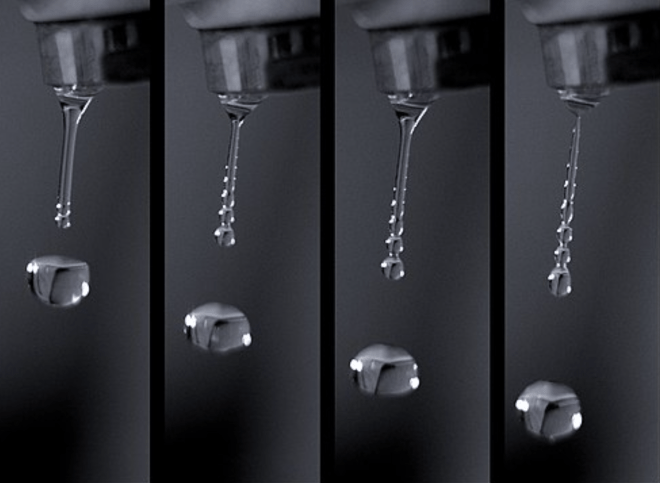
When one thinks of “dribs and drabs,” surely no good image can come to mind. Especially when one has been saying it as “drips and drabs” for most of his life, mistakenly doing so because his own mother, Emily Freylan, always said it that way to him. In truth, it was a phrase he likely never would have encountered at all were it not for Emily, a woman who tended to come across as “prim” and “pretentious”—at least by the limited standards of the town where they lived. Emily, in fact, would never have moved there of her own volition. She only conceded to it because her husband, Hank, had gotten a steady job there. Not a well-paying one, per se, but a steady one. He kept repeating to Emily, “You can’t say fairer than that these days” regarding its steadiness. Unfortunately, it definitely wasn’t well-paying based on the arduous nature of the work: repairing any power lines that had fallen (or were generally imperiled) from a utility pole.
The town that “beckoned” to him was a mid-size one in Central California. The name of it wasn’t important and, once Ryan left, he never bothered to tell the people he met in London where he had really grown up. He would either be vague, or just say Los Angeles. People always did better with what they thought they knew or understood. Ryan could empathize, considering his mother was always speaking to him in a manner that wasn’t relatable. She talked to him as if he were an adult, too. And, as a result, he ended up becoming one earlier than he should have.
Part of that quick growing up process was Emily’s constant complaints about the “drips and drabs” that Hank gave her as an allowance. And that his own paycheck was nothing more than “drips and drabs” as well. Although Ryan had never heard that phrase before, he didn’t need to ask what it meant. The definition seemed obvious based on the words. The sound of them. The disgusting, grotesque sound of them that made Ryan think of taking a semi-constipated shit, with only small turds squeezing out intermittently.
He would have liked to cite this reason, this image to Emily as an incentive for her to stop using the phrase, but he knew it wouldn’t register. Nothing ever did with her. She was in her own world, and had been for some time. Moving to this remote, “rustic” (a euphemism for bumpkin) town only made her retreat further into that world. She wasn’t liable to come out of it just to appease Ryan about the “drips and drabs” phrase, which she kept using with increasing frequency the more she felt that Hank wasn’t giving her enough money.
Ryan never questioned why she didn’t try to get a job to make her own money, or why she even really needed so much “extra cash” in the first place. It wasn’t as though she ever wore nice things or put any makeup on. Or tried to smell sweeter with a dab of perfume here and there. And most of the meals she “cooked” were frozen, not exactly requiring a large budget the way high-quality, natural ingredients would. No, she certainly wasn’t any man’s idea of a “dream homemaker” (with most men still having a false ideal of this female archetype no matter how far away from the mid-twentieth century time got). It didn’t strike Ryan that she would really change her behavior just because she had a touch more dough. Emily seemed set in her languid, disengaged ways, ones that were rooted in an overall depression that Ryan recognized as such early on in his childhood (just another part of being “parentified” too soon).
There was a time, when he was more concerned with pleasing her, that he would make grand gestures to cheer her up. He would vacuum and dust the house, cook lunches and dinners. But these things not only seemed to depress her all the more, but actually made her angry. And she was not shy about directing that anger at Ryan, who she felt was trying to mock her, to undermine her and make her look like some sort of do-nothing, which, in all honesty, she was.
It took Ryan too long (and many years of therapy) to realize that Emily was worse than a child in terms of being useless, a drain. Because most children are at least conditioned to evolve away from that phase. But Emily was perennially stuck in it. Not even bothering to expose herself to the horrors of adulthood, at the very least, in “drips and drabs.” No, Emily wanted to stay as she was in her youth. And it forced Ryan to ultimately abandon his.
All he could be grateful for was the fact that Emily never had other children. Not just because it would have meant emotionally stunting more people, but because Ryan probably would have had to raise them himself. Hank was constantly absent, so he would have been no help either. In fact, Ryan’s father seemed to be perpetually gone more as a means of self-preservation than as a result of actually being “on the job.” Ryan couldn’t blame him; he probably would have done the same if he was married to Emily. Alas, his relationship to her was much more binding than that. The bonds of mother and son can hardly be played out in “drips and drabs.”
One morning, about two months before he would move away for good, Ryan awoke to the smell of smoke permeating his nostrils. Immediately sensing catastrophe, he jumped out of bed and ran toward the kitchen to see what his mother hath wrought. But when he ventured into that space, there was nothing on the stove or in the oven, no sign of any cooking whatsoever. Indeed, it was eerily sterile. A level of clean and pristine that Ryan had never known his mother to employ.
Continuing to sniff out the source of the smoke, he then tried Emily’s bedroom, where he found her sitting upright in bed with her entire body set ablaze. On the nightstand was a still-burning cigarette in her red heart-shaped ashtray, but that wasn’t the root cause of the human fire before him. Emily was more prepared than that, more insistent upon not leaving anything to chance. Hence, the can of empty gasoline right next to her.
Almost as though waiting for the exact moment Ryan would be able to see her last gasp, Emily sputtered out, “I love y—.” That was one of the few times he could ever recall her actually telling him, out loud, that she loved him (even if the utterance remained incomplete).
Emily was fonder, instead, of communicating her love in dribs and drabs (Ryan would no longer make the common mistake of mispronouncing it), and only when she wanted something. Whether it was from her son or her husband. But maybe Emily had an epiphany that led her to this dramatic finale. A revelation that forced her to accept the reality she had spent decades avoiding: there was nothing her son or her husband could give her—in drips, dribs, drabs or otherwise—that might eradicate the void inside her.
 Literary Bitch