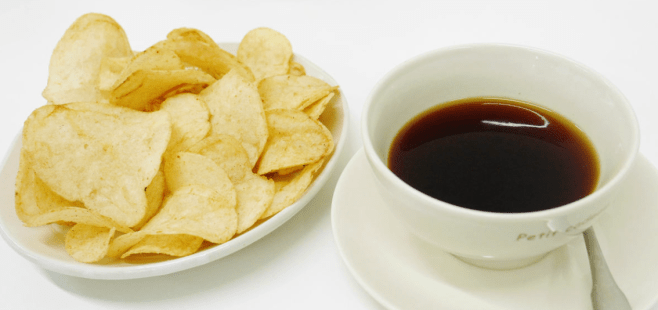
There’s the dinner of champions and then there’s coffee and chips. That’s what Elvania preferred to dine on. Or, more accurately, what she taught herself to prefer without any other choice. Besides, you only nourish yourself with what you think you’re worth. Innit? That’s what her brother, Cecil, would always taunt her with when she complained of this diet that he had “turned her on to.” Forced upon her was the better description.
After all, he was the one effectively in charge of “raising” her. Stuffing her with slop, more like. And Elviana was supposed to be, what, grateful? Presumably, that’s how Cecil, seven years her senior, saw it. And any sign—any slightest sign—of ingratitude on her part could result in the punishment of being starved for days at a time.
She could still hear his belligerent voice in her head sometimes, even now, when she was technically “free” to eat whatever she wanted. “Don’t like the chips and coffee, do you? How about nothing then? Is that preferable? Does that ‘work’ for you instead?”
As it turned out, no. Not really. So Elviana would suffer the punishment, be reminded that it was true, nothing to eat at all was far worse than only ever getting limited apportionments of coffee and chips. With a dash of water thrown in for “don’t die” measure. At one point, Elviana had tried to ask Cecil why. Like, why, of all things, he chose coffee and chips as the things with which to “pump her full of.” Was there any rhyme or reason to it? When she did muster the courage to ask him, his response was to smack her across the face and withhold the coffee and chips for three days, giving her only intermittent rations of water. He wouldn’t want her to die, just suffer relentlessly. That was apparently the only reason he bothered to “take care of her” at all: so he could relish having this “creature” to lord power over. It’s not as if there was anyone else around to do it. Their father had long ago abandoned them and their mother was always “out.” Usually with whatever man she had cajoled into thinking she was special enough to pay her way for a while. The leftover alms she got were passed to Cecil, tasked with “minding” Elvania.
When she got to be eleven years old, Elvania hatched a plan to escape. To become totally independent. Of course, it failed spectacularly, and she only ended up getting stuck further underneath Cecil’s sadistic thumb. She was also now forever cemented as a thin, frail thing—enduring the same kind of malnourishment as Audrey Hepburn during WWII (hence, the actress’ own perennial waifishness). She would always be seen as delicate, a fact that, rather than making others want to treat her as such, instead made them want to desecrate her. To rattle and break her. That inclination within so many men to destroy something fragile. Cecil was her first, and arguably most extreme, case of that reality. It was an experience that taught her to be wary of men, to avoid them at all costs. Because to expose oneself to a man was to be constantly at risk of some form of abuse. It didn’t have to be physical, the verbal kind could be just as bad. Just as scarring. It took Elvania more relationships than it should have to understand that. But after enough botched attempts at “love,” she retreated into herself permanently.
For whatever reason, though—almost like she was addicted to staying close to the origin source of her trauma—Elvania kept subsisting primarily on a diet of coffee and chips well into adulthood. It was her go-to. What she thought she was “worthy” of. Because once this sense of self-worth (or lack thereof) is ingrained in you, it’s all but impossible to shake later on in life. Maybe Elvania didn’t fully understand that as she sat in cafes with her coffee and the bag of chips she would buy from some corner store. Sometimes, it felt as though she truly were withering away. Sometimes, that’s all she wanted to do. She had been made to feel so small for so long that she didn’t know any other way to be. That, in this life, you had to make yourself large in order not to be trampled over entirely. No one would see you otherwise. But Elvania was past the point of wanting to be seen. Even though that’s all she had desired when she was younger, when she was being tortured by Cecil. But after enough years being tortured, all she wanted to do was disappear. A feeling that stayed with her into the present.
For the most part, she had been successful in that easy task. And it was easy. All one had to do to stay invisible was keep their head down, never making eye contact, never doing anything that didn’t render them as inherently “blendable.” This was precisely why Elvania was genuinely shocked when, one day, while sitting in her usual cafe, partaking of her usual “diet,” a man approached her table to tell her simply, “You’re beautiful. And I just wanted you to know that.”
That was all he said before walking out the door. He didn’t wait for a response or use “the line” as some sort of entrée into trying to sleep with her. It was said for the mere joy of saying it. For the pleasure of telling her what he knew to be true. What, up until that moment, she had needed someone else to inform her of. Whether he meant it in reference to her physical appearance or not (which she was convinced “not”), she took it in the spirit in which it seemed to be intended: that he found her very aura beautiful. Her essence. He had “seen” her and he was not repulsed, didn’t think her to be disgusting—a feeling she had been conditioned to believe was real when, in truth, it was a byproduct of her so-called upbringing.
Thus, with those brief but powerful two words delivered from a total stranger, Elvania suddenly felt reborn. And, to honor that rebirth, she took one look at the coffee and chips placed on the table before her, ran to the bathroom and vomited. She would never consume that combination again.
 Literary Bitch