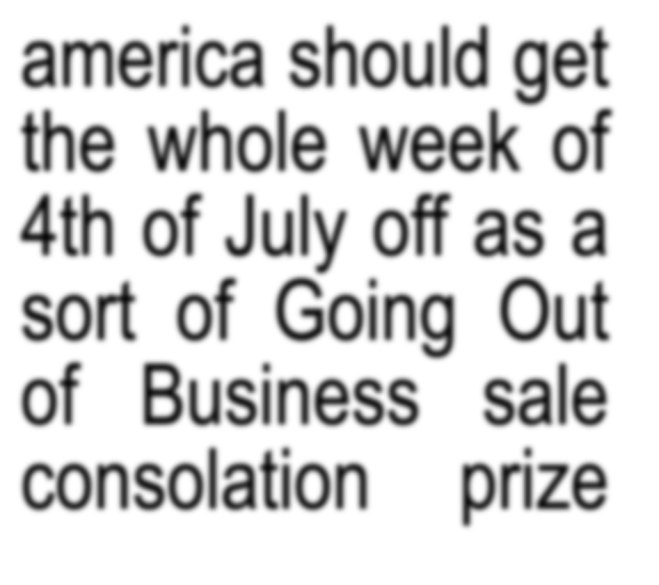
He overheard someone on the train say it: “We should get a full week off for the Fourth of July this year. You know, as like a sort of ‘Going Out of Business sale’ for America.” Eric tried to turn around and crane his neck to see who had uttered it, because he could have sworn he also just saw that very same meme a few moments earlier in his scroll session while passing the minutes until his stop arrived. Maybe the man who said it had also just seen it and decided to take credit for coming up with it himself. Why not, after all? Memes are supposed to be communistic, made for the collective to use and repurpose as it sees fit. Yet something about it didn’t sit right with Eric. Made him feel, for whatever reason, rather uneasy. As though everyone around him was tuned into the same algorithm. One designed to assuage discomfort through sick, brush-off-sadness-and-despair humor. And why shouldn’t that be the primary algorithm of New York, ultimate city of sickness, sadness and despair?
Eric moved to Lower Manhattan when the pandemic finally blew over and things went “back to normal.” Even though they never really did. In a way, that guy everyone hated who wrote his “think piece” called “New York Is Dead Forever. Here’s Why.” was right (and yes, they all hated him solely for writing the damning assessment no New Yorker ever wants to hear, let alone acknowledge). It was dead and continuously dying. But like an ill dog that would keep going, keep staying loyal to its owner by living, it would refuse to actually die until someone put it out of its misery. And like dog owners, New Yorkers would never dream of such a thing, would continue to pump the fucker full of steroids and other synthetic drugs in order to keep it going. The machine had to keep turning. That was the vibe Eric could sense in everyone he encountered. They all had this must keep living here at all costs aura about them. No matter how high that cost kept getting, both literally and figuratively. Eric might have added in emotionally, but he got the sense that emotions were pretty much null and void here, save for that old staple, Anger. That was the one that kept people going most of all—a “coping mechanism,” incidentally, that served as a key plot point in Ghostbusters II.
Interrupted from his stream of New York thoughts by the sight of the man who repeated the meme getting off the train, Eric decided to follow him and his friend. He was like a man possessed, or like a bored housewife from Fort Lee, New Jersey possessed. He simply had to know where they were going—and where else the conversation itself might go. For some odd reason, he simply had this feeling that they were bound to say something else that would disarm him, and he needed to know what.
They disembarked at Astor Place, which was only three stops from where he was planning to get off (Canal Street) anyway. So what harm could it do, he figured. The answer to that came when he saw them sauntering into Barcade. He couldn’t decide which location was douchier: this one or the one in Williamsburg. Maybe it didn’t matter. Everywhere was everywhere. More and more so in NY. In the past, in that town, it used to just be that everyone was everyone (what can be referred to as the Patrick Bateman Phenomenon), but now it had extended to place as well. And Eric realized that was probably worse. He would have preferred it to remain simply as everyone is everyone, because at least the perk of that was blending into the crowd. Not standing out so much the way he used to in his corn-fed town. And the reason he stood out so much was actually for what an ideal of “normalcy” he was.
Indeed, he looked like the quintessential all-American football player: well-built, muscular, tall and with a mountain of blonde, wavy hair atop his head for an added “Football Player Ken” effect. Back in Montana, that stood out. In New York, people simply sized him up as a “finance guy.” That was fine by him—it was a welcome change from the ogling he usually got in his hometown, where he often felt like all the stares were starting to drill holes into his body.
But the high of moving to New York had started to wane around this time when he overheard the man on the train saying America should get the whole week off this Fourth of July. As a sort of “Going Out of Business” sale. The defeat and horror running like a current through the city since the debate between a certain pair of presidential “contenders” had only amplified in the week since it happened. The candidates hadn’t thought it through in terms of taking into account that it wouldn’t exactly boost morale around the Fourth of July, the day when people were supposed to feel “festive” about America. But that feeling had been gone for quite some time, at least since 2020, when the mask around “the social contract” had all but dissipated (in spite of that being the year when everyone was expected to put on a literal mask). Yet still, everyone was going through the motions. What else were they to do? Actually obliterate the system?
Sidling up to the “Going Out of Business” man with a seat at the corner of the bar, Eric listened in. He didn’t need to be “discreet” about it. No one was paying any attention to him. He supposed if this were Montana, they probably would have though. But as he listened in, the strangest thing happened: he could see the man talking to his friend, but no words were coming out of their mouths. It was just the pantomime of talking. And as he looked around, he noticed that the only “background noises” he could truly hear were the sounds of the arcade games. No one was “emitting” any dialogue. Even the bartender hadn’t said anything to him when he asked for a beer, just brought one over rotely in response.
Eric should have known better than to follow this man into this bar. He knew in his gut that no good would come of it. And now, lo and behold, something entirely fucked was going on. He had pulled back the curtain on something he wasn’t meant to discover. Unnerved, Eric started to rise from the barstool, prompting the man to look directly at him and flash a garish, Joker-esque smile as he repeated, yet again, “We should get a full week off for the Fourth of July this year. You know, as like a sort of ‘Going Out of Business sale’ for America.”
 Literary Bitch