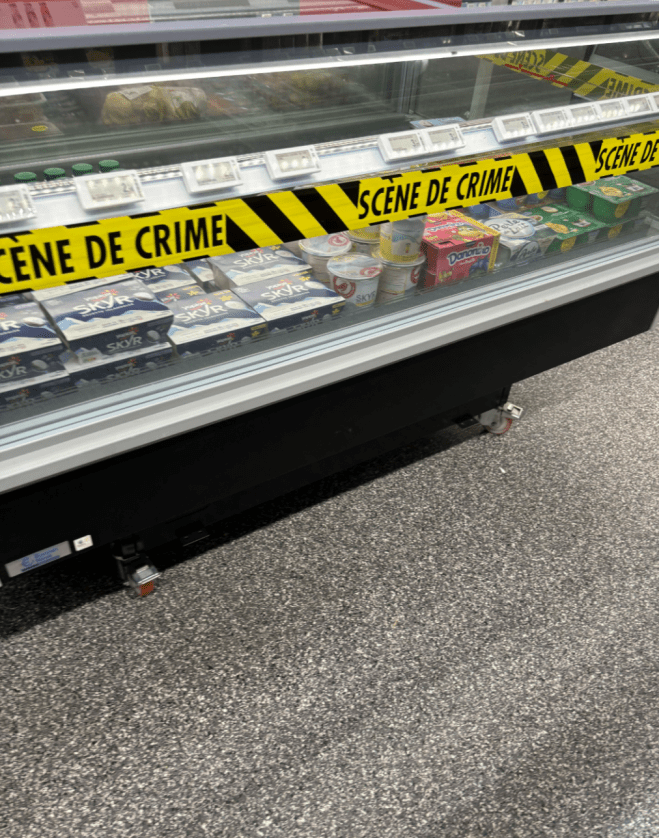
It hadn’t truly dawned on Caroline that it was fall. Not until she went into the grocery store and saw it riddled with “spooky” Halloween decorations. Spooky in quotations because, in truth, they were hopelessly corny. As is the curse of most Halloween decorations. Especially when left in the care of rural folk. Though, technically, things tended to take on an unintentionally creepy aura when left in said demographic’s hands (the whole The Texas Chain Saw Massacre vibe and all that). Not in the case of the French, however, who are far less capable of being creepshows than Americans.
Caroline had moved to this small French town in the southeast after buying an abandoned house for the price of a song and conceding to the not-so-secret money pit it would take to renovate the joint and make it truly livable. And even after all the amendments she had made, she still didn’t feel like it was. Livable, that is. She still didn’t feel “at home” in her own home. Maybe it was the perennial feeling of what it meant to be an expatriate. Never quite feeling like you belong—not in the place where you came from and not in the place where you currently are. So to mask that often overpowering sensation ever so slightly, Caroline cooked. A lot.
Her focus on meal preparation was a welcome distraction, particularly when the cold months started to set in and “hibernation mode” took hold—whether consciously or not. Because, as far as Caroline was concerned, she was cooking normal amounts of food (for one)—or so she told herself—until she realized, fully, what time of year it was upon walking into the grocery store on October 9th (John Lennon’s birthday, she inwardly noted) and seeing it bedecked with Halloween décor. A skeletal grim reaper, fake blood spatters, witches, pumpkins and, most interestingly, crime scene tape plastered over as many viable surfaces as possible. Many of these surfaces being the glass encasements housing the items requiring refrigeration or freezing.
To Caroline, it seemed an odd choice—even if the intent was to be “seasonally spirited.” After all, did this store really want its food products (especially the meat and poultry ones) to be associated with the mark of a scène de crime? A.k.a. crime scene, in case you were too daft to tell by the extremely similar wording. Technically, all that did was accent the notion that most foods consumed by humans were the result of a bodily crime against some other animal (needless to say, the crime of then transforming animal corpses into genetically manipulated, hormone-infused food was greater in America). But, of course, since humans never bothered to implement any significant laws that made it criminal to kill animals, no one thought much of it. Save, of course, for the so-called militants—your staunch vegetarian and PETA types. The ones who were labeled “crazy” for displaying “too much” empathy and compassion. After all, it was the circle of life and blah blah blah. What else can we do? Not callously stamp out other lives in the name of the “food chain.” Though, really, in the name of capitalism, that’s what. And while Caroline was guilty of eating her fair share of meat, she also knew that she probably wouldn’t be all that upset if it weren’t made so widely available for consumption.
As these thoughts crossed her mind within the first several minutes of being assaulted by the decoration visuals surrounding her, she approached the part of the refrigerator section selling discounted wares. The sort of foods that were about to go bad, paired with a random assortment of yogurts (le yaourt being one of the more unpleasant-sounding French words). Initially turning her nose up at the offerings, she couldn’t help but be allured by a pack of cheap veal with a “sell by today” declaration. And, just as she was about to reach her hand out to slide open the top, the most blood-curdling scream she’d ever heard outside of a horror movie was emitted from somewhere behind her.
Frozen in position, her hand suspended in midair, Caroline was terrified to turn around as she heard the startled outcries and murmurs responding to whatever had just occurred. This was more than she had bargained for when she decided to do a shopping excursion. In fact, she forced herself to come out and do it, insisting it was time to try out a new recipe in order to distract herself from how dilapidated her house continued to look despite all of the concerted efforts she had made to renovate it. To live out her “French countryside dreams” (slightly less cliché than “Italian villa dreams”) that had continued to remain more as “intermittent impressions.” Not many of them necessarily “good.” Especially not after being subjected to this forever haunting shriek, one that she would hear echoing in her mind on replay for months in the aftermath of what she saw in that grocery store.
And what she saw, the instant she turned around, was the mutilated body of a formerly pregnant woman whose unborn child had been gutted out of her stomach by the abusive husband she had recently gotten a restraining order against. That obviously didn’t stop him from continuing to stalk her, lying in wait to make his move in this very public venue so as to let all the world know that she could not and would not be free of him. Though she tried to be—had made the very rigorous attempt to be once she found out that she was pregnant with his child. Rather than looking at it as yet another way in which she was “terminally bound” to him, she decided it was the perfect opportunity to free herself of his clutches, and to preempt him from infecting their child with his violence (whether verbal or physical). She was not going to allow the cycle to continue—for her child, whatever its gender, to be influenced and conditioned by such opprobrious values. Unfortunately, the woman’s ex didn’t give her the luxury of making that decision. Ripped it, along with most of her internal organs and the baby, away from her. It was a scène de crime indeed. Made all the more macabre by the fact that, when the police arrived, they ended up using the decorative crime scene tape for the very real purpose of cordoning off the area.
Maybe they were waiting for the “official” crime scene tape to arrive, and simply using the decorative ones in the interim. Maybe it didn’t really matter to them so long as the demarcation was made. But, either way, it lent the scene a further sense of unreality. Like it was part of a shoot for a TV series or movie. Caroline would have preferred to think of it that way. Maybe that’s why she continued quickly picking out the items she needed and then took them to the self-checkout to purchase. She wasn’t the only one who kept on shopping. Clearly, that’s what the store wanted—in addition to effectively “manifesting” a crime scene with that tape. Otherwise, they would have closed out of respect, n’est-ce pas?
But respect was a bygone notion, along with dignity. Instead, incoming customers were simply redirected around the body, told to ignore the blood and guts strewn on the linoleum like the remains of an animal on the floor of an abattoir. Snapshots of the crime scene and the woman in it kept flashing before Caroline while, back at home, she cooked the veal piccata recipe she had been determined to make as soon as she saw the discounted meat in its encasement.
When she was finished, the final result was an ideal seduction of all the key senses when it came to eating. But the taste part of the seduction was never experienced. Caroline found that she was too unappetized, too off-put on every level to bother with taking so much as even a bite.
 Literary Bitch