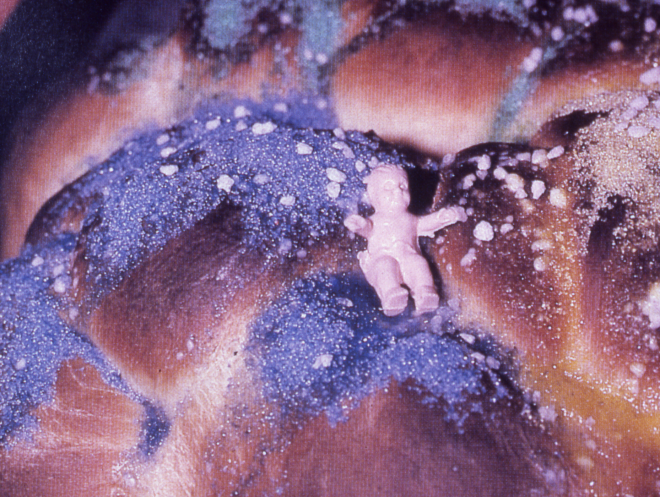
Philippe couldn’t understand why Hélène wanted it. It wasn’t even “the season” for it. Granted, New Orleans’ season for king cakes far outlasted any other environment. Particularly European ones, where the king cake had originated in the first place. In fact, many speculate that it had to have been none other than the French who brought it to New Orleans centuries ago. Others prefer the theory that it was the Basques who shared their “recipe”/tradition with Louisianans and other “Gulf Coast staters” (but really, from a geographical perspective, Basques could be considered French too, as much as Spanish, so what was the conjecture really saying?).
That tradition being, in essence, some kind of cake-like confection (even a pastry) that has a baby (or fève) baked into it. Not a literal one, it should go without saying. But just a little plastic (or what is now plastic) baby shape to indicate reverence for the “king” a.k.a. Jesus during the Christmas season. Which, for Europeans, extends to the Epiphany (a.k.a. January 6th), or the Twelfth Night after Christmas (and yes, Shakespeare did name his play in honor of that time of the year).
Over the centuries, however, Americans would bastardize (as is their way) the timeline and significance of the king cake, making it available well past the Epiphany period and opting, instead, to associate it with Carnival and Mardi Gras, the latter being what concludes the Carnival celebrations. And though Mardi Gras a.k.a. Shrove Tuesday was very late this year, not arriving until the first week of March (perhaps the latest it had ever been in recent memory), Hélène still didn’t manage to make the cutoff for when it would have still been both “appropriate” and “common” for king cake to even be around.
The ones that were, however, couldn’t be trusted. At least that’s how Philippe, her older brother, felt about it. Which is why, when Hélène kept insisting that he buy one the next time he went out, he could not bring himself to do it. He went to multiple locations and found that the pickins were neither “correct” nor burgeoning. Oh sure, they still sold some errant ones, but it wasn’t the focus of any bakery in the “off season,” hence the compromised quality. The seller of a product just isn’t going to care as much about its quality if it’s not “trending” enough to make it worth their while. So Philippe decided to surprise her with a homemade cake when she got home that night. After all, she was the breadwinner between the two of them, and always had been, which meant this was one of his non-monetary contributions to their household.
Were it not for the fact that they had inherited their parents’ Creole cottage in the Faubourg Marigny, Philippe would be much more fucked for his lack of financial contribution to their shared abode. But since their parents had owned the place free and clear, Philippe wasn’t as spotlighted for his “shortcomings” in the money department. Indeed, he was sure to go above and beyond in his, let’s say, other duties (yes, it’s as naughty as it sounds). Which extended not just to cleaning and general house maintenance, but also the grocery shopping and cooking. This being another reason why the procurement of the king cake fell under his jurisdiction.
Of course, while Hélène would swear up and down—if someone had asked her—that she never imagined Philippe would go to all the trouble of actually making the cake from scratch due to his high standards, she knew, without a doubt, that Philippe would do whatever it took to please her. And she knew that he would ensure such satisfaction by any means necessary, without her even having to ask. Perhaps she had conditioned him to act this way, learning from an early age how to wrap him around her finger even though she was the younger sibling. But, to an unversed outsider, it appeared as though Philippe was—the way she bossed him around with such self-assured arrogance. Something that their parents did nothing to discourage. If anything, they both encouraged it; their mother because she didn’t want the burden of trying to raise an unruly son, and their father because he was largely too absentee to notice. Besides, someone had to go out and earn the money that would keep the lights on at the cottage. Observing this dynamic shrewdly from afar, Hélène knew she wanted to be the one to embody her father’s role when she got older. That she never wanted to be anything like her mother. A woman who, despite being the “heart and soul” of the house with her cooking and overall domestic acumen, seemed to spend most of the day drinking martinis and humming along to Ella Fitzgerald in an extremely ominous way.
Consequently, with no “role model” material to be found in her own household, Hélène searched elsewhere for it, finding examples of greatness within the pages of the books she checked out at the library…whether fiction or nonfiction. In the latter category, it was the biography of Lucrezia Borgia that perhaps influenced her the most during her formative years. Not only to learn about Lucrezia’s particular brand of mercilessness, but also to read the “lore” that she had incestuous relations with her brother, Cesare. Learning this made Hélène feel, for the first time in her life, as though she wasn’t totally insane for having “impure” thoughts about Philippe. Of course, if someone had realized the effect the Borgia biography was having on her, they might been able to adequately counsel Hélène on all the ways that she was looking to the worst possible person for “inspiration” on “how to be.” But since no one did realize it—or much of anything about Hélène and her disconcerting predilections, for that matter—the obsession grew undetected, and she was able to adopt the characteristics of her “heroine” as she saw fit, including having her older brother by the balls (and yes, Cesare was older than Lucrezia, too).
Philippe, looking for any varietal of mother figure he could get, was eager to accept Hélène’s attention and affection, however overtly toxic it might have been. Over time, though, it seemed completely normal to Philippe. Particularly when they were the only ones of their “dynasty” left. Without anyone in the house to observe the madness of their behavior, it could go fully unchecked, unreined. When Hélène worked her way toward becoming the branch manager of the Hancock Whitney Bank on Chartres Street (after years of being a teller at the lesser location on St. Claude Avenue), her power over Philippe grew even stronger. She effectively owned him. That’s what happens when you’re the person who pays for everything in a…relationship—including Philippe’s many expensive habits (gambling, strip clubs, designer tracksuits, what have you).
So sure, making a king cake from scratch seemed, to Philippe, like a minuscule task compared to all that Hélène did for him. He figured that, really, it was the least he could do—to oblige this request, however strange and, again, “off season” it was. June 3rd, to be exact. That was the evening when he removed the cake from the oven just as she walked into the door after a hard day at work (for every day was hard at a job where one had to deal with people who were convinced they ought to have more money than they did). And in his haste to welcome her back into the abode with a too-lingering hug and kiss, he forgot that he had left the baby on the still-hot cake, haphazardly placing it on top without thinking. Even though he knew very well that the cake had to cool before the baby could go near it. Plastic, heat…the math wasn’t difficult.
Thus, about two minutes later, when they had finished kibitzing, Philippe turned around to at last notice his fatal error. Now, rather than a delicious king cake, what he saw in front of him was a grotesque mutation. The top had, for all intents and purposes, a flesh-colored plastic frosting. Before he had turned his back to it, though, it was a beautiful, braided confection with a golden brown, cinnamon-spiced finish—and with just the right amount of glaze and colored sugar sprinkled atop it. Presently ruined by this plastic faux pas.
Horrified by his carelessness, Philippe couldn’t think fast enough on his feet to prevent Hélène from seeing it. At first, she didn’t notice that it was tainted, ergo her expression was one of delight before getting close enough to see that it was a disaster. A total and unmitigated failure. An insult to the art of dessert-making. To confirm as much with her sense of touch and taste, she stuck her index finger into it and lightly licked at the bite. Although Philippe tried to stop her, she brushed him off, and then promptly ran to the sink to spit out the small sample.
“Fucking disgusting, Philippe!” she chastised. “Did you actually waste money on ingredients to make this shit when you could have just bought one?”
“I—I wanted you to have the best. The bakeries’ options all looked stale, uncared for.”
She rolled her eyes. “Well they’ve all gotta be better than whatever the fuck this is supposed to be.”
Philippe nodded his agreement. “You’re right. I should have just bought one. I’ll go do it now.”
Hélène merely glared at him in response, which Philippe took as his cue to leave tout de suite. But as he started to scuttle out the door, Hélène called out, “Wait just a minute. Aren’t you forgetting something?”
He turned cautiously, bracing himself to hear about his latest fuck-up. He stammered, “Um, I—I—
She sighed and went to her purse to pull out a twenty-dollar bill, which she then dangled in front of him to come and get. Obviously, he obliged, “taking the bait,” as it were. “Right,” he said as he accepted it sheepishly, an admission of how helpless he was without her, try as he might to make himself come across as the “king” around the house with all the daily operations he executed (as opposed to loyal subjects) on her behalf.
But no, it was in moments like these when he was put in his place again. And, as he walked out the door with “Sissy’s” twenty, he understood that, as far as Hélène was concerned, it was never “off season” for king cake. Because biting into that baby as often as possible throughout the year reminded her of just what a queen she was. The person who ran it all. At least in the Creole cottage where her brother was her lone subject.
 Literary Bitch