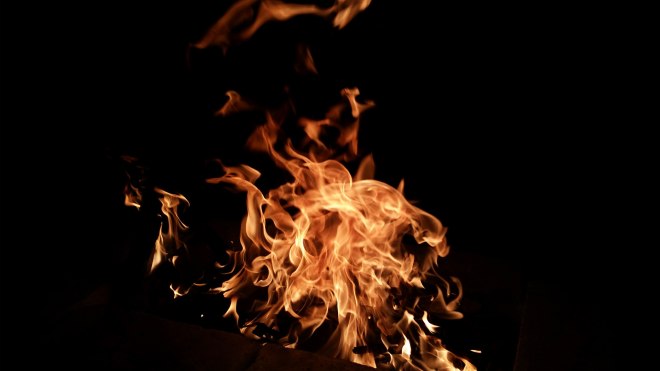
Sabrina had hoped that, after everything, she would at least get a number of likes well into the four digits. That was all Sabrina had ever wanted as the fruit of her labors. And the labor this time was quite intensive. Body-damaging, actually. More specifically, Sabrina had incurred third-degree burns on the right side of her face and the entirety of her torso after making an elaborate video soundtracked to the The Weeknd’s “Dancing in the Flames” (hence, the flames “required” for Sabrina’s own dance). But implementing the adjective “elaborate” had been her first mistake for a TikTok offering. “Elaborate” isn’t what makes content go viral, simplicity is. What the hell had she been thinking?
In truth, she obviously hadn’t been thinking much of anything…apart from: must go viral, must go viral, must go viral. The Jesus Prayer of the twenty-first century. And look at where those mindless, intrusive thoughts had gotten her now. Burned to a crisp, that’s where. What’s more, when she checked her phone at the hospital—after a lot of blowback from both the nurse and her parents for demanding it “at a time like this”—she saw that not only had she racked up no additional likes after the usual hundred or so she usually got, but that a boy in her math class (her least favorite subject, naturally) had commented, “I’m so embearassed 4 u [laughing emoji] [blushing emoji].” The audacity of someone to be embarrassed for her when that person couldn’t even correctly spell “embarrassed” was the least of Sabrina’s irritations in that revelatory moment of reading the critique. For, crude and lacking in sophistication as it was, she could still call it that. That is, in fact, what all online comments—good or bad—amounted to. And that laughing/blushing face emoji made her as red with rage as the angry face emoji—the one that has the expletive bar over it. Not because she was really angry, per se, so much as she was humiliated. Sabrina also felt that this boy had established some kind of damning prophecy (but then, aren’t all prophecies damning?) with his comment. It very nearly made her want to delete the video, but she couldn’t possibly do that considering the physical agony she had endured to create it. As far as she was concerned, this video must remain forever on the grid.
Yet as Sabrina watched the number of likes on the boy’s comment rise faster than the number of likes on the video itself, it was increasingly tempting to give in to the delete option. This thought made all the more enticing by realizing that, when she went back to school looking singed, someone—most likely that math class asshole—would put it together as to why she looked that way, and then call attention to it for the purposes of a public flogging, so to speak. Granted, a genuine flogging might have been preferable to the ceaseless verbal abuse that would result from everyone grasping how she had injured herself. Indeed, that instead, might be the thing that went viral about her. The local news would pick up the story and fashion it as yet another cautionary tale about the very real and very literal dangers of social media. Then, somehow, the national news would pick up the story from the local network, wanting to get a piece of the requisite cautionary tale action, too. Everyone working together and doing their part to stop an entity that could 1) never be stopped and 2) everyone profited from too greatly to ever really want it to stop.
Before Sabrina could allow herself to spiral any further with more imagined what ifs (including: what if I had shot the video on an iPhone 16 Pro like The Weeknd was sure to play up that he did for his actual “Dancing in the Flames” video? Would it have turned out better? Somehow come across as more “like-able”?), the lead doctor on her “case” walked in, and (theoretically) prompted her to put her phone down. A prompting that became a vehement insisting when she wouldn’t, still ever-focused on her doomed fate contained within that phone (damned if she deleted, damned if she didn’t). Finally, her mother, Tamara, had to be the one to oblige the request, snatching the phone away from her only child. And it was perhaps precisely because Sabrina was an only child that Tamara felt so hyper-protective of her. This was why Sabrina had to beg her for months on bended knee to get her this phone—the very thing that Tamara knew would turn out to be Sabrina’s undoing. She just didn’t know how literal that undoing would be, her skin coming apart at the proverbial seams before Tamara’s very eyes.
And now, just as predicted, here she was laid up in the hospital as a direct consequence of this phone. This fucking phone. More accurately, a direct consequence of Tamara getting her this phone. Freely acquiescing to the fallout such a purchase would guarantee. Oh, if only she had just listened to her goddamn maternal instincts and not done it. She knew it was a bad idea, that Sabrina was still too young and immature to own such a thing. But Sabrina’s arguments about how even people half her age were given the “human right” of a phone weren’t inaccurate. However, just because such “statistics” rang true didn’t make it right for Tamara to relent. To let Sabrina “have at the drug,” as it were.
Alas, that was the thing about societal pressure: it always made you concede. Succumb to doing that which you swore you never would. So Tamara got her the phone, albeit the most “rudimentary” model she could. But obviously, it wasn’t rudimentary enough to keep her from injuring herself, from causing irrevocable damage. Part of Tamara couldn’t bear to watch the video that had caused this. Yet she also knew that she had to. Not just to understand, in some way, what happened, but to gain insight into the things that were driving her daughter. Fuck, her daughter’s entire generation.
This is how (and why), after the doctor told them that they would keep holding Sabrina for observation the next couple of days, Tamara went into the waiting room, took her phone out (while still being in possession of Sabrina’s), put her headphones on (as so few people have the courtesy of doing when in a public space) and watched the video. Needless to say, Tamara would despise The Weeknd for the rest of her life, somehow hold him personally responsible. Worst of all, when she dipped into the comments section of the video, she found herself tending to agree with the boy in Sabrina’s math class (though she had no idea he was in that class with her). This was “embearassing.” What had Sabrina been thinking? How could she be so foolish? Deem this video worth everything that it had cost her? But then Tamara’s mind started to wander over to thoughts of how Sabrina was hardly the only adolescent that had been felled by social media. It seemed that at least every week there was some headline identifying a “dangerous new TikTok trend.” At least Sabrina didn’t die on camera while filming herself doing the blackout challenge. Always a silver lining, right Tam? she laughed to herself. What else could one do but laugh at how bleak it had all become to be a teenager? Sure, it’s been said that baby boomers had the bleakest adolescence once the Flower Power vibes of hippiedom turned Mansonesque, but no, it was this lot. Tamara pitied Sabrina as much as she was annoyed by her. By the things that were “important” to her. Important enough, apparently, to risk dying for.
Tamara, like so many adults, was being forced to reconcile with the notion of what “important” meant to these youths. Which was to say, nothing at all. Since everything had been obliterated of its meaning and worth, how could they be expected to differentiate between significance and its opposite? And while entities like TikTok had been a direct cause of this collective inability to understand such concepts as value vs. valueless, indispensable vs. dispensable, etc., they could not be held legally responsible for the damage being wrought. While doing some research in the waiting room, Tamara found that this was because of the Communications Decency Act (CDA), which stated that a company like ByteDance (a.k.a. TikTok) was not accountable for “work” that “belongs to others.” In other words, they’re just the medium, not the messenger. However, going down another rabbit hole, Tamara saw that the U.S. Court of Appeals for the Third Circuit had recently reversed the decision, finding that the jargon wielded in the CDA didn’t apply to social media algorithms that very specifically thrive on disseminating some of the most depressing/soul-crushing bullshit known to humankind.
While Sabrina lay in her hospital bed wide awake, wondering how she could convince her mother to move to another town so she never had to go back to that school again and face the firing squad (so much fire in her life lately), Tamara proceeded to make a few calls and send a few emails. She would be damned if she didn’t get some kind of compensation out of this. But the more thorough she got in her digging, the more she fathomed that Sabrina had only further fucked up in not making a video related to something that was actually trending. Instead, she had only made it because she liked the song. There was no major trend anywhere related to dancing in the flames to The Weeknd’s “Dancing in the Flames.” It was then, around midnight in the fluorescent hallway near the vending machine of St. Albans Hospital, that Tamara started to feel increasingly less sympathetic for a daughter that couldn’t even carefully curate the conditions for a viable lawsuit, let alone the content of her TikTok account.
 Literary Bitch