It seemed like it was back in 2020 that people started saying something to the effect of, “The writers wanted to make this season more interesting” or “No one saw the writers coming up with that plot twist.” As if, by “jokingly” referring to the idea that there’s someone “in control” of the narrative, an “overlord,” so to speak, it makes it all less scary. That, by attributing the increasingly unhinged “plot twists” of this Earth to something—some “higher power” (but not God, since no one serious believes in that anymore)—there’s a greater sense of, “Okay, well at least someone, even if it’s an invisible ‘presence,’ is in control.” Little did these “jokesters” know, if any kind of “writer” was writing this thing called human existence, it probably wasn’t really a writer at all, but merely AI-generated text. That would certainly explain the total nonlinearness, the sheer incongruity…wouldn’t it?
This was one of the thoughts at the forefront of Christina’s mind as she stood inside the car wash looking through the window that allowed her to monitor her car’s progress on the conveyor belt. In recent years, Christina noticed that it had become less common for car washes to let you stay in your vehicle as it went through “the process” (that process being: getting cleaned). Probably because it was some kind of liability and, in the decades since everyone in the U.S. became so goddamn “sue-happy,” all traces of fun and whimsy had been sucked out of everything. Because “allowing” fun and whimsy was what opened people and companies (granted, companies are legally considered “people”—add it to the list of “what the fuck” decisions made in the post-industrial world) to being “liable.” They say, “You’re a little much for me/You’re a liability.” Christina ignored the odd timing of the tailored Lorde song playing over the speakers of the waiting area. It wasn’t exactly the kind of “Top 40 hit” one would expect to hear on KLUC. Still, you didn’t see her making a big “thing” about it, insisting that the algorithm was always listening or some shit.
In any event, that’s why Christina wasn’t experiencing the erstwhile fun of sitting inside her car as it went through the wash, as she might have were this, say the, mid-1990s. Instead, it was the mid-2020s and so she was watching from behind the glass. A visual metaphor for life in the twenty-first century. There was nothing tactile about it. And worse still, there wasn’t even the consolation of flying cars like Back to the Future had essentially pledged. Christina was twelve when she went to see it in the theater with her older sister, Renee, and the promise of, at the bare minimum, flying cars in the future gave her something to hold out hope for. Something to believe in (that’s what everyone needs, after all).
But the eighties came and went and so, too, did the nineties. And there was still no sign of those goddamn flying cars. Christina had been sure they would start to mention them as the twenty-first century got underway. But no. It appeared as though things were actually digressing under the guise of “making advancements.” This didn’t just apply to technology, but also, of course, to politics. And the worse things got, the more everyone seemed to tune out. Which was, obviously, antithetical to preventing worse and worse potential futures from happening. Yet it was almost as though these politicians banked on their constituents not only tuning out, but abstaining from voting altogether. Such was the level of apathy (de facto, complacency) that society had reached. Christina being amongst the bovine masses who had decided that this nation—“America”—was beyond saving. Wasn’t everything around her pure and incontrovertible evidence of that? The very car wash she was standing in? The Chick-fil-A across the street. Structured as yet another “streamlined” and “efficient” drive-through. All of America was a drive-through. No car, no passage. Yes, often “even” in New York, so-called greatest city in the world. Christina fled from there after college, not wanting to linger. Besides, Las Vegas seemed the kitschier choice. She’d probably seen far stranger goings-on in LV than she ever did in New York.
Indeed, at fifty-two years old, Christina had witnessed all manner of change happen. Especially since the year when Back to the Future suggested there might be something like progress by the time humanity reached 2015 (the year of which Doc Brown comments, “Where we’re going, we don’t need roads”—ha!). And sure, maybe the invention of the internet was what was supposed to fill the void where a “roadless” culture might have been, but Christina, along with most others, had long been disenchanted with the internet in its current form. Far-removed from the more innocent, aspirational tack (minus the Pam and Tommy sex tape) it was taking during the period when it was freshly made available to the public. But no one knew at the time that it was the modern equivalent of Pandora’s box, and that all the evils that had been unleashed could not be put back in. Even the “innocuous,” meme-based chatter was fundamentally evil. The kind of chatter that “joked” about how “the writers wanted to make this season more interesting.”
No one saw the harm in such “commentary.” That the more the masses banded together to insist that there was ultimately a built-in kind of “unreality” to everything, the less it all truly did mean. Life itself. Rendered into inconsequential oblivion by the internet and its “assurances” a.k.a. conspiracy theories. Christina was reaching a breaking point for her tolerance of such “theories.” Though that word seemed inappropriate when attributed to what ultimately amounted to people’s unfounded musings. Spouting them left, right and center until every corner, so to speak, of the internet was filled with bile. Madness. Gobbledygook—that Sylvia Plath word (even if she spells it like “gobbledygoo”). Christina had studied Plath of her own volition, starting in high school. That was when The Bell Jar had been assigned to her sophomore English class. The teacher, Ms. Murberry, had made a point of telling everyone, “If you’re going to read an angsty book about a depressive young person, let it be The Bell Jar over The Catcher in the Rye.” So they did. Or at least Christina and some of the other girls did. But she knew most of the boys in the class didn’t get through it, poking fun at Plath for being a “pussy” and a “bored white chick” who “just needed to get laid.” That kind of talk was bad enough in real life, but to see it stew, fester and foment as the internet became an echo chamber for such “commentary” was more than Christina could bear.
Yet here she was, bearing it. Everyone had to. To live a life “logged off” the internet was to not be a part of society at all. Granted, Christina was less and less concerned with that these days. In fact, not being a part of society sounded like a dream come true. Like the Kevin McCallister thought of his family disappearing. But she was too enmeshed in it now; there was no turning back, no “going off the grid.” Not really.
As her car finished its cycle, she put these thoughts “away,” tucked them toward the back of her mind so she could focus on driving, getting back home. This was her day off from working as a “guest service representative” at Excalibur. She’d been working there since 2017 and, unfortunately, started the same week that Stephen Paddock decided to conduct what would become the deadliest mass shooting ever carried out by a lone gunman. Which was really saying something, by U.S. “standards.”
Excalibur was a stone’s throw from Las Vegas Village, the site of the Route 91 Harvest festival that Paddock opened fire on (more than a thousand rounds) from his thirty-second-floor hotel room inside Mandalay Bay. Christina had started working at Excalibur on the Friday of that weekend. The shooting took place on a Sunday, the first day of October. She remained perennially haunted by the event, still hearing the screams, the shots, the sheer pandemonium at random moments she couldn’t control. Yet she felt she had no business feeling this way, as there were people who suffered far more as a result. She didn’t want to be one of those asshole who was only really “tangentially” associated with something and made it seem as though she was right at the center.
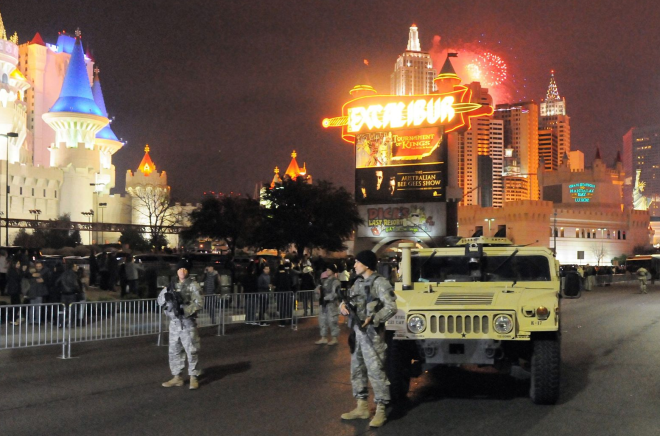
Even so, the horror of this shooting had deeply affected her in ways she still couldn’t predict. Like when, the same year as the shooting, she had an all out panic attack upon seeing a slew of uniformed soldiers, with their guns and LUVs, patrolling the streets under the auspices of “Operation Night Watch.” An “endeavor” that took place every New Year’s Eve for the annual celebration. Though it’s hard to associate a celebration with the National Guard stomping through the streets in order to, along with regular police, “doubly” ensure that things couldn’t “get out of hand.” But they already had. Paddock’s mass shooting was a terrifying, apex example of that.
Driving onto Las Vegas Boulevard to get back to her apartment, the Strip always unavoidable, Christina tried to block out these visions. The visions of dystopian insanity that the internet—the “collective”—had blithely started shrugging off with, “No one saw the writers coming up with that plot twist.” Just a “coping mechanism,” some might say. But Christina knew it was emblematic of something else, something far worse: total dehumanization.
 Literary Bitch