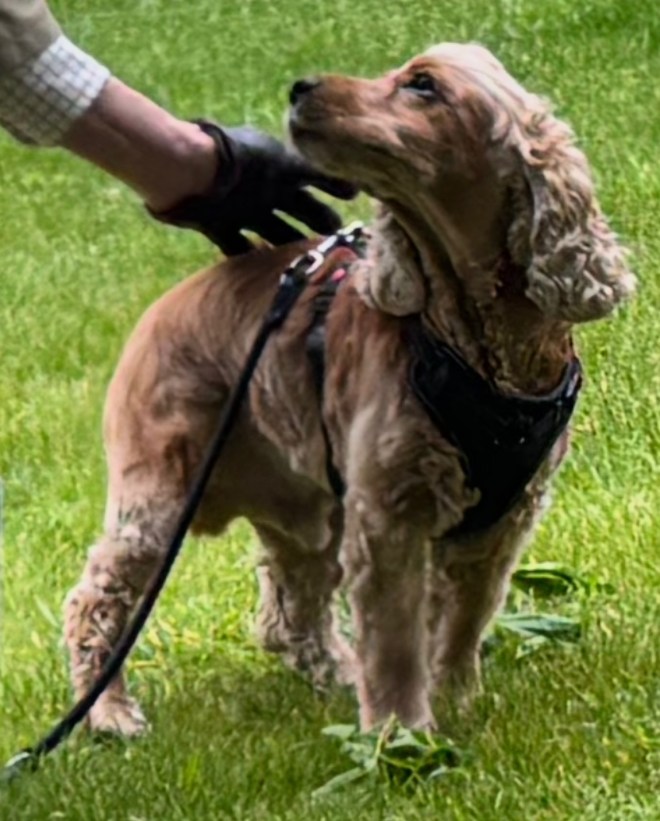
I have always identified with the cocker spaniel. For many reasons. But the one that’s inarguably at the top of the list is because of how reluctantly affectionate they are. Regardless of how much they love and theoretically trust someone. Because, even still, the trust is tenuous—prone to fluctuations if there’s even the faintest hint of “foul play” in the spaniel’s eyes. And a lot of things could be seen as foul play in a spaniel’s eyes. Just as it could be in mine. I suppose that’s why even after Frank told me he loved me, I didn’t exactly let my defenses just “melt away.” I wasn’t stupid. Or naïve. It’s not as if it was the first time a man (or boy) told me he loved me. Maybe if it was, I would have a more “floating on air” feeling. The kind everyone under twenty-five expected you to have when it came to l’amour. But I wasn’t under twenty-five and that was hardly a secret to Frank. It’s not as if he had “DiCaprio’s disease” or something (though most men did).
Still, like the spaniel in human form that I was, just because I didn’t think he had DiCaprio’s disease now didn’t mean he might not miraculously “contract” it later down the line. Like, say, after I turned forty. Men had a real funny way of “not caring about a woman’s age” until then. When the signs of it could not so easily be concealed or suppressed. Take, for example, “the change” a.k.a. menopause. No, men didn’t like it when they suddenly realized there would come a day when you were no longer fertile (that foul word that reduces giving birth as a human to something animalistic). The primal symbol of a woman’s “vitality.” And even though Frank had told me many times during our five-year relationship that he had “no interest” in kids, I knew that, sooner or later, when “the option” was no longer available to him (at least not with me), he probably would start to take an “unexpected” interest in “becoming” a father. As if that were something a man “just” did. With the wave of a wand. Ha! More like with the suffering of a woman.
Well, if it was a child he was inevitably going to want because he could no longer have it (again, at least not with me), then I was going to have to cut him off at the pass (as opposed to just cutting off his balls): by getting a dog. And yes, a cocker spaniel. Obviously. That’s part of why I know so much and identify so strongly with them. Having observed Jekyll’s behavior these past three years (less than one of which was spent living with Frank as, soon after I got the dog, we broke up—and here I thought a substitute baby would make him happy), it was the kind of behavior I recognized in myself. More and more.
I would argue that even my love for Jekyll—unmitigated as it was—remained cautious, measured. Just as his love was for me. And in this way, we had cultivated a kind of “mutual understanding” (and appreciation). We were as close as close could be for two beings so markedly distrustful and utterly suspicious. This, I knew, was why, whenever I raised my hand to pet him, he always appeared, however briefly, a bit fearful. As if my consistent and longstanding affections for him could still change. That, out of nowhere, I could just turn on him for no rhyme or reason. I understood where he was coming from. After all, humans were like that—erratic, prone to sudden and whimsical shifts in opinion and/or mood. Not liable to remain constant in any way, shape or form, least of all in matters pertaining to the “heart.” That more than somewhat annoying synecdoche for a human in love. Or allegedly in love. For it’s all but impossible to gauge whether a person really feels that way—and if they do, if it will actually stick.
This is the thing I despised perhaps most of all about humans, even though it was the thing most everyone else “adored” about them. And that was their proneness to constantly changing. Or what many referred to oh so preciously as “evolving.” This being the term that, in their minds, made it somehow romantic. Noble even. Well it wasn’t. Isn’t. Not as far as I’m concerned. I want something (and someone) I can count on. Something/one I know isn’t going to cite “I’ve evolved” as a reason for wanting to leave me “all of the sudden.” Even though the signs would have probably been there the whole time. But I, in my bid for “staying the course,” would have opted to willfully ignore those signs. That’s how desperate I was to believe that someone—anyone—was capable of consistency. But the fact of the matter was that only dogs could be counted on for that.
Which is also part of why I found it so odd that humans (both men and women alike), when being compared or likened to something bad or awful, frequently wielded the metaphor of dogs as an insult. As in, “He’s a dog” to connote duplicitous or underhanded behavior. Or “She’s a bitch” to indicate a woman acting “rude” or “horrible,” which usually just means expressing herself in a way that isn’t deemed “polite” enough by the patriarchy at large. There’s also “She’s a dog” to describe a woman who is ugly (e.g., “Buzz, your girlfriend. Woof!”).
All of these “turns of phrase” struck me as grotesque falsities, hardly in line with the true nature of dogs: pure, sweet, beautiful. Whereas humans were the total opposite. Disgusting, foul creatures that would sell you down the river for the right price. A dog, instead, would be the one to rescue you as you floated down that river to certain death. And, for as reticent as Jekyll could be, at times, about “allowing” affection to be “administered,” I knew he would save me in such a scenario without a second thought. Not like a human, who, by the time they talked themselves into doing the right thing out of guilt rather than genuine caring, you’d be beyond rescuing.
I was never going to fall for that trap again. The trap of trusting a human to care for and about you. Especially not after experiencing the devotion of a dog. More to the point, a dog like Jekyll. A cocker spaniel. A breed whose suspiciousness of and cautiousness with affection was matched only by the intensity of their love.
 Literary Bitch