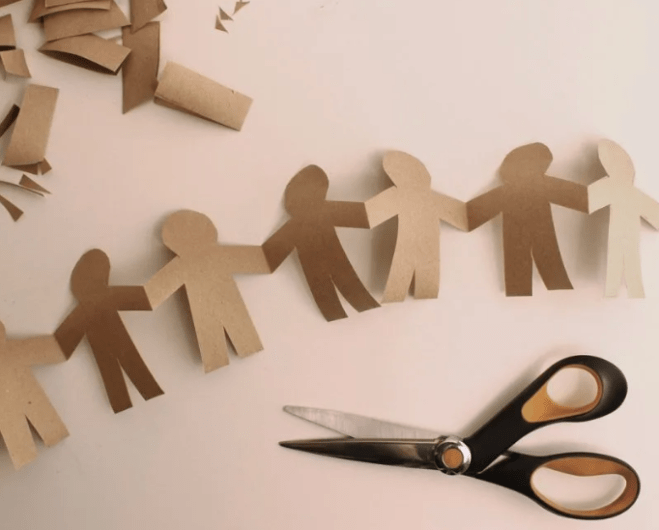
In another age, cutting people out didn’t involve quite as much direct malevolence. Such calculated, surgical removal. It was simply a matter of hanging up the phone if the person kept trying to call you until they finally got the message or became a creepy “IRL” stalker (as opposed to just an internet one). As time has worn on and technology has become a more invasive, “second nature” part of existence, the degree to which one must actually be willing to meticulously focus on and doggedly pursue the total “deletion” of a person has become emblematic of a specific kind of twenty-first century sociopathy.
As for Isla Livingston, she always abhorred the “business” of “systematically eliminating” people from her digital realm. It required the mustering of such additional hatred from within, and something about this aspect of “the cut out” made her feel queasy whenever she had to endure it. Which, in her opinion, wasn’t all that often, but often enough to make an impact, as well as force her to ponder the extent to which modern life rendered all of us a bit more psycho than it did in the pre-social media era.
While Isla fretted over whether or not she should simply “unfollow” someone or block them altogether, her sister, Lynne, had no issue whatsoever with outright “blockage.” One day, a person would be her “best friend,” and the next, they never existed. Such was the ease with which technology could seamlessly invite people into and then just as seamlessly expel them from one’s life. And where Lynne was concerned, expulsion seemed to be the most fun a girl could have without taking off her clothes. Indeed, it was like she courted friendships solely so that she could blow them up after leading the person into a false sense of security. Genuinely making them believe that they were “besties” and then turning on a dime with that sentiment if the person did anything she perceived as a “slight.” And, being her sister, Isla was well-aware of how it only took something innocuous to be deemed a slight by Lynne. A “friend” could do something as ostensibly harmless as borrowing a shirt for too long and it might set Lynne off, prompting her to block the now ex-friend on every app in existence, as well as the ex-friend’s number on her phone.
Because Isla and Lynne had lived during a brief blip before social media took hold of all relationships, Isla could recall the signs of Lynne’s eventual behavior (which was increasingly normalized by a digital society). How she would tell Isla to keep insisting to anybody who called the house that she didn’t want to talk to anymore (for whatever arbitrary reason) that she wasn’t there. Thus, Lynne started to be perennially “out.” And, resultantly, Isla started to become known as “Lynne’s secretary” about midway through junior high. She supposed that was better than “fudge packer,” which had caught on briefly at the beginning of seventh grade because she came to school one day limping after falling off her bike the previous afternoon.
By the time Isla and Lynne, who were only two years apart, got through high school, Isla had witnessed her sister go through upwards of at least twenty “best friends” only to cast them aside when she blew up over something that would be viewed as utterly minor by someone less unhinged (and yes, this went far beyond the requisite teenage girl excuse of being “hormonal”). Isla quickly became the resident “shoulder to cry on” when these events occurred. Mainly because most of the girls realized Isla was useless as a go-between or mediator, for once Lynne made up her mind to “cut,” that cut was made permanently.
As the sisters grew into their twenties and the smartphone, loaded with all its “connecting to others” apps, became like another appendage, Isla watched her sister take on a new form of grotesque pleasure whenever the inevitable “cut out” would come to fruition. As roommates (for who else could Lynne stand to have around for a long-haul type of situation?), Isla had yet another front-row seat to the newfound sick pleasure Lynne took in cutting people out. Because it now came with the ritual of summarily deleting all traces of a person from her digital dominion. She would go through every single app she had ever added them on (including WhatsApp) and gleefully go about the process of her ritual “cutting.” Snip, snip, snip. You’re dead (to me) now. Almost as if, in the present, half the purpose of bothering to cultivate a friendship with anyone at all was for the sole sake and joy of “extracting” them somewhere down the line. Almost as if Lynne were substituting the “painful thrill” of self-cutting with social cutting.
Sometimes, Isla wondered if she ought to point this out to her increasingly delusional sister, thinking of what the best approach might be to do so. But then she would envision the endless river of shit Lynne was capable of giving when she wanted to/was put on the defensive. And that’s when she decided it would be easier to just keep her lip zipped rather than endure the emotional agony. What some might refer to as “peace at any price.” Alas, even cursory historians know how that political policy ended up in 1930s Europe. And Isla should have known how it wound end up for her, too. Shouldn’t have been surprised in the least when her time finally came to roost and Lynne decided that Isla, blood relative or not, was just as cuttable as anyone else. Any schlub off the street.
Maybe, in the end, Lynne had simply run out of people to cut out who could actually make her “feel something” (read: perversely orgasmic), and so she decided to do it to someone as close to her—hell, the only person so close to her—as her sister. After all, her parents still gave her some money now and again, ergo cutting them off would have been legitimately crazy. But her own sister, well, that was still perfectly within the bounds of “reason” as far as Lynne was concerned.
She did it right after Isla decided it was overdue for her to move in with her boyfriend of two years, Noah, and share an apartment with him instead. Obviously, Lynne didn’t take the “slight” well at all and late that very same night, after Isla spent the day moving all of her boxes out without any help from Lynne (who was holed up in her room ignoring reality the entire time), she proceeded to engage in her greatest emotional and digital cut yet: removing her sister from all platforms. Initially, it gave her the jittery high she had been seeking for the past several months, when cutting other people out no longer seemed to provide her with the same buzz as it used to. But after a couple of hours, when the intoxication of the act had worn off and she realized that Isla would see what she had done and not try to dissuade her out of it (seasoned as she was in viewing, firsthand, Lynne’s sense of finality), only then could Lynne see a faint glimmer of the person she was.
Nonetheless, faint glimmers are hardly enough to shock an unreasonable person out of being unreasonable. And it didn’t take much time for Lynne to start putting the now-empty room to good use by renting it out to people she could cut out as much as she wanted, all without the judging and watchful eye of her ex-sister.
 Literary Bitch