Over the years, it became apparent to Jacob that people who were allergic to dogs (or, worse still, claimed to be simply because they didn’t like them) tended to be, well, the worst. And, as he also came to find, they almost always tended to be women. At first, his inherently sexist mind went to the idea that perhaps the naturally “weaker constitution” of “dames” is what made this allergy a more common affliction among their ilk. But, as time went on, and he found that every girlfriend post-his dog ownership eventually presented the ultimatum that it was them or his dog, Constable (citing their “allergy” as the reason), Jacob developed an increasing distaste for and mistrust of people who claimed a health-related “aversion” to dogs. Especially his own.
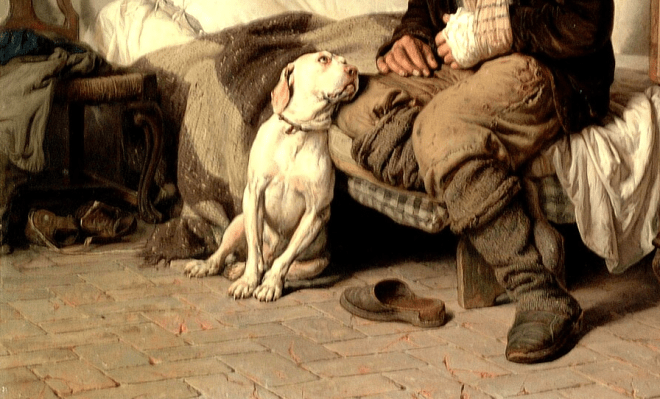
Constable, after all, was just about the sweetest, drollest creature there could be. A medium-sized mutt with a pit bull-looking face, he had a white fur coat with the odd brown or black marking. Jacob had found Constable roaming the streets about six years ago. The first time he saw the clever canine, he was fashioning pieces of cardboard into a little hut that looked like the stray dog version of a homeless person’s “box abode.” That first encounter was how Constable would get his name—for Jacob preferred the definition, “governor of a royal castle” to “police officer.” As he watched the mutt building his “house” like a bird layering twigs on a nest, Jacob couldn’t believe what he was seeing—even for L.A. And if he had been the average kind of Angeleno (that is to say, a driver rather than a pedestrian), he never would have noticed the unusual sight at all.
While some dog lovers might have been eager to snatch Constable up right then and there, Jacob decided to wait and observe. He didn’t want to pluck Constable out of his environment until he knew for certain that it was an unwanted one. So he kept taking the same route to get to Union Station for a few days until, on the fourth, he was surprised and saddened to find that Constable wasn’t there (though his “box house” still was). Nonetheless, he shrugged it off and kept walking. After all, one mustn’t get attached to anyone, human or otherwise, in a city like this. And just when Jacob was fully resigning himself to that disheartening notion, he heard the faintest little whimper behind him. Whipping around to confirm his hope that it was, indeed, Constable, lo and behold, the wayward dog was right there, following him.
So it was true, Constable did need and want a real home. A life off the streets. And Jacob was happy to provide it for him. To give him everything he was lacking and so much more—in short, spoiling him rotten with treats, toys, multiple plush beds and the most expensive harness the vet could recommend. A regular leash was simply out of the question (it placed too much strain on the neck). If Jacob had paused (or “pawsed”) to truly examine why he found himself spending so much money on Constable, he might have gleaned that he was, in some sense, trying to embody a paternal role without the actual irrevocable responsibility of involving a human child. In effect, he wanted to be the father he never had. Even if he was just a “dog dad.”
The women who came into his life as romantic prospects seemed to be instantaneously jealous of that overt fact, wanting Jacob to instead lavish all his attention and money on them, to be their daddy. But it could not be. As far as Jacob (and Constable, for that matter) was concerned, his bond with his dog was as good as a blood one. And for any woman who insisted she “loved” him, that so-called love certainly shouldn’t be leveraged for the sake of trying to oust Constable. And yes, obviously the ousting was more than just figurative, for old “Consty” also shared the bed with Jacob and whoever his girlfriend of the moment happened to be. It could make for some very competitive scenarios—ones that usually involved the girlfriend in question falling off her side of the bed.
It took no time at all after Jacob “picked up” Constable for the allergy excuse to manifest. The first to give it was Erica, a twenty-eight-year-old who was five years younger than Jacob. With the “extra years of experience” he had over Erica, it was only natural that Jacob had lived in Los Angeles for over a decade, while Erica had just arrived. And she had the according “fresh off the boat” quality that so many girls in L.A. radiate. He imagined that’s why it was so easy for him to pick her up at the bar in Silverlake where they first met. She later told him that she thought he was a record producer she recognized from one of the social media accounts she followed. That should have been his first clue to run the other way. But a man’s penis has a tendency to make him ignore all logic and assorted red flags.
Just as it did with the second girl who cried “allergy,” Skye. Although even younger than Erica (therefore, in men’s eyes, theoretically more moldable), she was, to Jacob’s shock, much more vocal. In other words, far less willing to go along with whatever Jacob wanted just because he was supposedly the older, “worldlier” man. But that didn’t mean she had lost all sense of “decorum,” hence telling Jacob that she was “allergic” to dogs. Though she never bothered to put on the airs of sneezing or sniffling to attempt corroborating her story.
In contrast, Allegra (whose allergy medicine-oriented name Jacob found humorously ironic), his third girlfriend since acquiring Constable, made a huge production of pretending to show symptoms of being physically ill whenever she was around the cuddly creature. To the point where Jacob was actually starting to believe she might be for real. But Allegra eventually forgot to put on the show one night after the two got particularly high together on Jacob’s couch, feeling so loose and “warm” toward everyone and everything that she forgot herself and allowed Constable to sit on her lap while she cooingly petted him. It was a mistake she would pay for the next morning, when she had sobered up enough for Jacob to “bequeath” her with a proper breakup speech that detailed how she had only further contributed to his extreme distrust in women. Especially when it came to dating them.
After fathoming that the old saying, “Third time’s a charm” proved to be a bald-faced lie, Jacob decided it was time to take a break from dating for a while. Concluding that maybe Constable was his one true soul mate. Alas, the thing about trying to make “resolute” decisions is that they can be undone by “the Fates” in the blink of an eye. That’s what happened the day Jacob met Angela at the dog park. She was a bleach blonde-haired (making for a halo effect that was befitting of her name) woman two years his senior. But maybe the more accurate way to describe their encounter was: the day that Constable met Angela’s cocker spaniel, Bandit. Needless to say, when Jacob and Angela realized that their dogs shared something akin to yin and yang-like names (even if Jacob didn’t intend for the police officer definition of “constable” to be the go-to), it was practically a fait accompli that they would see each other again.
They billed it as a “play date” for the dogs but, in truth, it was a date for them, complete with a wine-filled picnic basket. As he watched her talk, laugh or just reach for things out of the basket, Jacob felt like everything she did was in slow motion. She had that kind of effect on him as no other woman before her. And he almost wished he had never endured that trifecta of faux-allergic-to-dogs women at all. But if, from the universe’s perspective, it was what he had to go through in order to find his way to Angela, well, then so be it. Maybe all that false hope and pain had been worth it.
Over the next few weeks, Jacob learned the extent of Angela’s love for dogs as he witnessed her eyes redden and water while she blew her nose repeatedly. The truth of the matter was: Angela was allergic. For real. Yet nothing was going to stop her from having a dog, let alone surrounding herself with them. She confessed to Jacob that she had known from a young age that she was allergic and that, although it broke her heart at first, she began to understand that just because she felt a certain level of discomfort around dogs, it wasn’t enough to prevent her from enjoying the extreme comfort of being around them. One that far outweighed her “minor health setback” as part of the price to pay. Besides, she reasoned, there were far worse chronic health issues to have.
As she explained all of this to him, Jacob knew he had fallen in love. And that his instincts had turned out to be wrong: you can trust people who are allergic to dogs. So long as they’re still willing to suffer through those allergies in order to be near them. In fact, he realized, these were the most trustworthy people of all.
 Literary Bitch