In a town that becomes even more abyssal than usual during the summer, it’s even scarier for a woman alone. Something that men never seem to understand (nor do they want to) when you try to explain it to them. This feeling of constantly being ill at ease whenever you walk down the street, just praying that no one with a penis so much as looks in your direction. And it seems, so long as women don’t have gray hair or a fat body, they’re perennially at risk of this foul, “primal” behavior.
It was never Bailey’s intention to be left behind in this freak show of a milieu (as many small towns tended to be despite their belief that “big city folk” were the real freaks). A town that became even more freak show-oriented when summer came to roost, leaving behind only the brokest of the broke and the weirdest of the weird (sometimes one and the same). Because somehow, some way, most everyone could finagle a means by which to leave for vacation. It wasn’t the type of environment, in short, that anybody would voluntarily stay in during the hot, desolate months of June through August. Anyone who had the choice of leaving would be either a fool or brain-dead to stay. Unless, that is, they wanted to emulate Jack Torrance’s vibe in The Shining. That was the kind of “cabin fever”-level madness this town could instill in the summer.
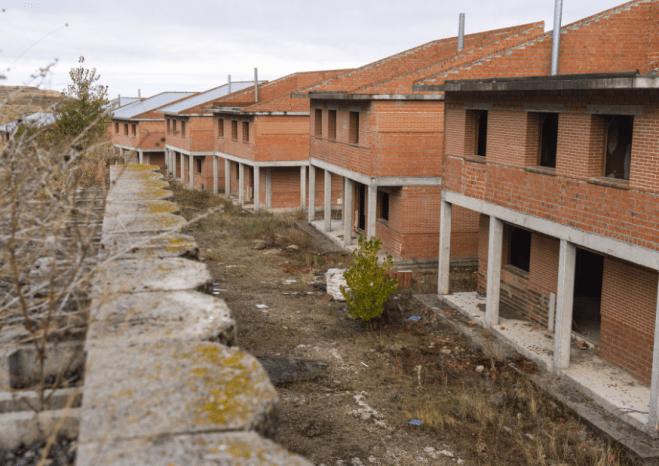
That’s certainly not what Bailey was going for when the time came for her to experience the crippling, isolating loneliness of Yermo, a practically nonexistent place smack-dab in the middle of southern Spain. Nowhere near the beach, of course, which might have offered at least some respite from the creepy, empty feeling of Yermo when the majority of the already scant population drained itself into other places (whether the various seaside towns of Spain, or out of the country altogether). To add insult to injury, the very name “Yermo” meant wilderness in Spanish. That’s exactly what it was. An enclosure for the exiled and cast out.
Bailey never thought she would end up in a place like this. In fact, she vowed long ago, when she was the teen version of herself that she never would. That she would “make something of herself” in the style that required a cosmopolitan atmosphere. Needless to say, her teenage self would want nothing to do with the woman she had “let” herself become. As though any of us really had a true choice in the matter. As if it wasn’t all cruelly preordained in advance. Which, surely, it was. Bailey had never really believed any different once she grew into an adult, shedding all former sense of naïveté. Working a job you hate and living in a place you can’t stand will do that to you.
Like many women, Bailey had ended up in a place—emotionally and physically—that she didn’t want to be because of a man. The man, in this case, was Spanish. Hence, Yermo. The town where Andrés insisted that he and Bailey move after originally meeting her in Madrid and assuring her, after she had already fallen in love with him, that he had no intention of ever leaving “the big city.” Obviously, that turned out to be a goddamn falsity, a bald-faced lie. And by the time Bailey got wise to the lie, it was too late: she was down the rabbit hole of amor. El amor, to be more precise. Because there’s clearly a reason the Spanish word has a masculine article in front of it rather than a feminine one. Like everything good—or that should be good—it was ruled by men. They made the decisions, they took the lead, their voice mattered most in a “concern” such as this. Only they weren’t even half as concerned as women when it came to amor of any kind.
Bailey was, in fact, concerned enough over losing Andrés forever to concede to moving with him to Yermo when he got a government job there. Securing a coveted bureaucratic position was enough reason to upend his life in Madrid in order to be set up for the rest of his days, biding his time until the pension kicked in. Which it did when he was sixty-two to Bailey’s forty-two (you know how men prefer women half their age and all). And, unbeknownst to Bailey, Andrés had been making plans for a while about how he would spend his retirement, time-wise and money-wise. It goddamn well wasn’t going to be in Yermo, but along the Costa del Sol. Marbella, to be exact. That he hadn’t expressed this wish or intention to Bailey was a concrete sign, in retrospect, that Andrés had never been the man she thought he was…the man she had projected entirely in her mind.
When he left her at the beginning of June that summer (it went without saying that he had another, younger woman waiting in the wings), it didn’t take long for Bailey to go a bit, well, mad. Sure, she had spent a few weeks alone in Yermo during the summer before, but always with the promise of being able to go on a vacation somewhere else, meeting Andrés along the coast by the middle of July once her days off from work were confirmed. But this summer would offer no such reprieve—only the cruel reminder that she had wasted the best years of her life in a town she hated with a man who was ultimately using her for small-town companionship until something and someone better came along. This, paired with the leering, lecherous looks of the gross men left behind in Yermo, was enough to make her lock herself inside of the apartment for weeks at a time.
Indeed, madness descended upon her like a ton of bricks by the beginning of July, when the full weight of what Andrés had done fully sunk in. What was Bailey to do now? Keep living her life in Yermo? It wasn’t as though she had much of a choice. She had put too many chips (few as they actually were) on the table to start over somewhere else. Besides, her middling jobs were here: grocery store cashier and cleaner for a local company that also specialized in renting out properties on Airbnb (in the rare instances when people were willing to settle for this bumfuck geographical location in order to be close enough to a more desirable part of Spain).
Maybe the worst thing about it all was that, when Andrés left, he took the car with him. That little cabrón. It was the only lifeline to escaping from this wretched, godforsaken place. Where even the stray cats seemed to abandon the town when summer rolled around. And, without an alma in sight (apart from the types that God forgot), Bailey’s own deteriorated. Along with her mental health. If anyone ever happened to remember that she was alive and tried to knock on the door of her apartment that fateful verano, they would find nothing more than a newly-minted psychopath rocking back and forth, crying ceaselessly over a life so wasted that it caused her to end up here, in this lugar olvidado por dios.
 Literary Bitch