In the past, Aunt Joan had been known for being what her sister politely called “a bit daffy.” What she meant by that word was, instead, “totally batshit.” “Not quite ‘with it.’” When Aunt Joan’s niece, Cara, had been younger, she didn’t fully understand what all these euphemisms about Aunt Joan really meant. She just assumed there was something “off” about her aunt. Only she didn’t know what. Because the child version of Cara couldn’t see anything wrong with being taken out for ice cream on a cold winter day. Or having her aunt show up two hours before school was over to pick her up for a “dentist appointment” and then, in actuality, take her to the racetrack to bet on a horse she just knew was going to win (but, of course, never did).
Aunt Joan swore her to secrecy every time she did these types of things. And every time, Cara obeyed. Not sure why she was so concerned about protecting Aunt Joan’s secrets, but knowing somewhere inside of herself that, if she ratted her aunt out, they might not get to see one another anymore. Cara didn’t want that. Because, even for as much as she internally questioned Aunt Joan’s behavior, she couldn’t deny what fun the two always had together. Aunt Joan wasn’t like other adults—least of all her parents, who seemed to only know how to say the word “no.” As Cara grew into a teenager, she learned very well how to push back on that word and turn it into a yes. Mainly by directly violating their “edict” that she wasn’t allowed to do something.
Perhaps her sense of rebellion had ultimately been gleaned from Aunt Joan after years spent watching her not only do things she clearly wasn’t supposed to, but by taking Cara along with her for the ride (often literally). Her parents probably should have known better than to let Cara spend so much time with an “iconoclast” like that. But who can bother to consider such things when the tradeoff is free childcare? Hell, they would have probably handed Cara over to Aunt Joan even if she was a molester, so long as they took the kid off their hands (no molesting pun intended) for most of the day. And that she did. With the consequence of Cara’s teenage years and twenties being outright dissent against anything and anyone that tried to tell her one thing that most certainly made her want to do the exact opposite.
By the time she was in her mid-thirties, however, Cara had “stabilized.” Had become a “functioning” adult. Which means to say, “naturally,” that she had a job and could pay her rent and bills. It was also by this time, however, that she had fallen almost entirely out of touch with Aunt Joan. Like most things, it was gradual, then sudden. In her teen years, she still kept up with phone calls at least every two weeks to Aunt Joan. Then, once she entered college (a New York state school where her rebellious streak was more tolerated than it would have been at, say, an Ivy or other private school), the “falling out of touch” phenomenon began. Too many nights out partying led to her never answering Aunt Joan’s calls and too many hungover mornings and days led to her never returning the calls either. Over the years, Aunt Joan grew tired (as one often does the older they get) of being the one to make all the effort. So she stopped. And when she did, it still didn’t compel Cara to reach out until this point of “stabilization” in her mid-thirties, when it all suddenly dawned on her what an asshole she had been in her “early years.”
Merciful and understanding, Aunt Joan welcomed Cara back into her life with open arms, no judgments and no questions asked. So it was that the two picked up where they left off. Only this time, Cara was the one encouraging Aunt Joan to be “unconventional” with her behavior, insisting they still eat ice cream on a cold winter day and go to the racetrack to place a bet in the middle of the afternoon (though the loophole was that Cara’s workplace was actually quite close to the racetrack, for she had a job at a suffocating office in Queens, close enough to “pop over” to Belmont Park Racetrack). Little by little, the relationship not only started to repair, but also began taking on new depth, growing and flourishing in a way that it never could with her own parents. Indeed, she felt, for all intents and purposes, estranged from them—and had felt that way for almost a decade now.
Aunt Joan, too, had few dealings with her own sister, least of all her brother-in-law. But perhaps if Cara had been closer and more communicative with her mother, the latter could have told her that all those years of hearing about how Aunt Joan wasn’t “all there” weren’t for nothing. In fact, they should have cautioned Cara about just how “daffy” Aunt Joan could be. And it all really started in this “part deux” era of their relationship with the “bequeathment” of a “new” purse. Or, as Cara saw upon actually opening the box it was contained in, a new old purse. For it seemed to have been something that Aunt Joan had forgotten she possessed (and had ostensibly received as a gift herself), perhaps tucking it away on some rarely-trodden shelf or in some scarcely-opened drawer, only to realize she didn’t want it, but could possibly pass it off on someone else. In this case, Cara.
To add insult to injury, Aunt Joan had handed her the offending item after she already made a big production about leaving Cara’s apartment (for Cara had invited her over to share in some Chinese takeout from her favorite neighborhood restaurant down the block). She said goodbye, collected her own purse and walked out the door. Five minutes later, she was knocking on it again to say, “Oh goodness! I forgot. I brought you a little something. Nothing special really, just a small token of my affection for you.”
Cara regarded the unmarked, rectangular-shaped white box that Aunt Joan thrusted at her with suspicion and curiosity.
“Open it when I’m gone. Ta!”
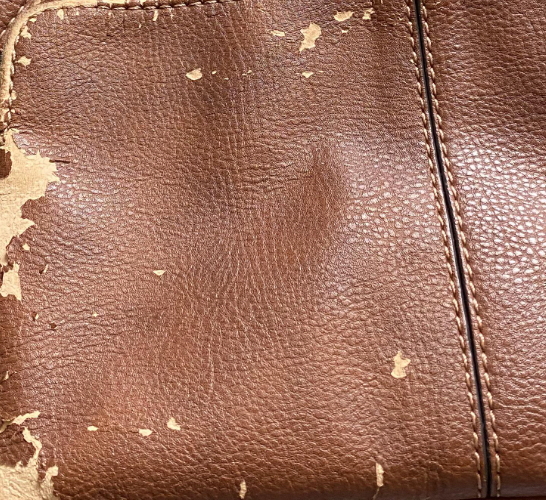
And that was that. She was out the door again. Leaving Cara the opportunity to see what exactly this “bounty” was: a faded-brown clutch purse with a deteriorating detachable strap and small laser-cut flowers on the “flap side” of it. Even if it had been mildly intact and not flaking off (doing so all the more when she so much as lightly touched it with her hand), the thing was hardly her style. Shouldn’t Aunt Joan have known that? After all this time, during both “phase one” and “phase two” of their relationship? Shouldn’t she have gleaned some sense of Cara’s personal tastes? Because, yes, tastes might somewhat change over time, but, ultimately, a person’s fundamental personality that makes up those tastes remains the same. That was how Cara felt about it anyway. So for Aunt Joan to pass off this rather disgusting, “in tatters” entity at her was as much of an insult as it was a testament to her parents having been right all along: that Aunt Joan really wasn’t “all there.” Wasn’t even “there” enough, evidently, to notice that the bag was no longer “new,” but offensively old from disuse. Could she honestly not have seen its state? Its desiccated, squamous exterior? The more she looked at it, in fact, the more galling it was.
Perhaps it was possible that the “gift” was Aunt Joan’s idea of a joke. But then, no, Aunt Joan barely had a “regular” sense of humor, let alone a sick and twisted one. This was a “gift” intended seriously. Without any “haha!” or “gotcha!” intent behind it.
In the days that followed, Cara didn’t hear from Aunt Joan, nor did she go out of her way to try reaching out to her. Because something about that purse had left her feeling both averse to and uneasy about Aunt Joan. As if she had been putting her life at risk too frequently by hanging out for such large blocks of time with an unhinged person. The extent of whose “unhingedness” she hadn’t fully grasped until the handing off of this peeling purse.
When a full two weeks had gone by and Cara still hadn’t heard from Aunt Joan, that’s when she started to feel guilty. As if she had activated the same pattern as before, from the last time they had fallen out of touch. This wasn’t what she had wanted to happen at all, she presently realized. She just wanted Aunt Joan to pick up on the fact that what she had done was weird—offensive even. Alas, it appeared that her attempt to somehow “teach Aunt Joan a lesson” had backfired, and now she wasn’t talking to her at all again, thereby putting the ball in Cara’s court to reinstate communication, which would thus draw unwanted attention to the fact that Cara had caused yet another rift between them by failing to reach out and thank her for the purse/mention what she thought about it.
And yes, she was now starting to understand that Aunt Joan, in response to Cara’s refusal to acknowledge the purse (and, more to the point, express gratitude for it), had taken offense to the offense. Thereby flipping the script on Cara, manipulating the situation back in her favor. When she considered this, Cara also took pause before immediately breaking her silence to call Aunt Joan. Maybe she ought to call her mom instead. Someone who could advise her on this matter most chiefly because, technically, she knew Aunt Joan better. More intimately. Because that’s what happens when you grow up with someone. For, regardless of how far you grow apart from your siblings over the years, that core childhood period of inhabiting the same space with someone and being raised the same way assures that you’ll always know them more keenly than anyone else ever possibly could or will.
When Cara pulled up her mother’s name in her phone under “Ellie” (she hadn’t addressed her by “Mom” since she was about twelve), it took nine rings before she answered. Already a bad sign. Because, usually, when it takes someone that long, it means they don’t want to talk to you, you’ve caught them in the middle of something or a terrible incident has just occurred and they’re not yet totally sure they want to talk to anyone. As it turned out, it was the latter.
As Ellie informed Cara, Aunt Joan was found in her apartment just two days ago, after a neighbor called to complain about the smell that was emanating through the walls next door. Evidently Aunt Joan had chosen to overdose on a bottle of Valium and chased with plenty of vodka (a classic “woman’s thing” to do). Not because she was “depressed,” but because, as it turned out, for many years now, Aunt Joan had been suffering from a slow and then rapid buildup of plaques in her brain. Plaques that caused her to do strange things. Display “inappropriate behavior.” Have “poor impulse control.” All of which Aunt Joan had started to show greater signs of, culminating in giving Cara that disgusting purse. It seemed, according to Ellie, who had known about the plaques all along, that Aunt Joan decided it was time to stop letting her brain deteriorate any further and do away with herself before she became a burden to anyone.
After coming to terms with her rage and sadness (rage over the long-standing secrecy and sadness over the loss), Cara couldn’t help but feel the purse now had sentimental value. To the point where she actually decided to wear it to Aunt Joan’s funeral. It was held a week after the body was discovered. And to think, it was just a week earlier that Cara had wanted to burn that purse before throwing it in the trash. Now, it was her most treasured item. The last thing Aunt Joan had given her, therefore the most precious.
When she came home from the funeral reception later that evening, she tossed the purse on her metal kitchen table and noticed that it landed with an unusual kind of pinging sound. Something Cara found quite strange considering she had only put her lipstick and a few dollar bills inside of it, refusing to take her phone or wallet to the funeral events (something about it feeling “disrespectful” to her). She approached the purse, looking at it curiously. Picking it up again, she started to shake it violently, causing even more of the material to flake off. Yes, there was definitely something else in there.
That’s when Cara went to the kitchen drawer, took out a serrated knife and proceeded tear open the lining. Once she did, she could see that, tucked inside, oh so carefully, were three pieces of 24-karat gold jewelry: a bracelet, a necklace and a ring. And that’s when she knew: there had been a method to Aunt Joan’s madness. She wasn’t really “crazy” or totally demented. There was some part of her, all the way up until the end, that wanted to express her affection for her only niece. Either that or, well, she had no idea these jewelry pieces were still even in the purse when she thrust it upon Cara. But no, Cara chose to believe that, despite the plaques, it was the former reasoning that had won out.

