The British king’s visit to Paris was, as expected, marked by much absurd fanfare. Most of which resulted in oodles of unnecessary traffic, backed up from Invalides to as far as Sacré-Cœur—a ripple effect of privilege causing the rest of the city to suffer for being little better than plebeians. At least in the eyes of the king. Indeed, he insisted to his various advisors, as well as easily swayed officials at 10 Downing, that visiting France at a time when royalty had never been more despised was a fantastic idea. This in spite of how he had been told that it was better to, instead, keep a low profile. To stay totally out of sight so as not to remind people of how completely useless he was. Not to mention a total drain on the nation’s financial resources. Resources that could so obviously be getting funneled into something more worthwhile, you know, apart from bankrolling a man to occasionally make appearances with his little scepter and crown.
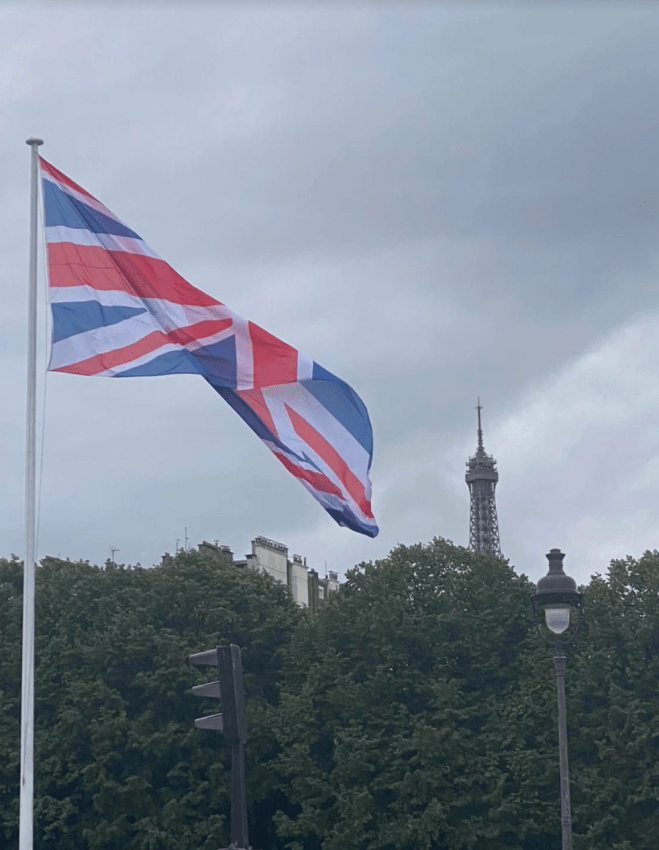
He wouldn’t be wearing either for the visit to Paris, but, nonetheless, the government saw fit to roll out the literal red carpet for him. Not only that, but they even whipped out the Union Jacks they had on hand to fly loud and proud next to the French flag. Even going so far as to place one right in front of the Eiffel Tower, as though to scream, “We invite you to colonize us!” And yet, perhaps the reason the French were so comfortable with “bowing” to the arrival of the British and their “master” was because they themselves shared certain philosophical “ideals” in common.
After all, the purpose of the visit, the king’s PR team announced, was to “celebrate our shared histories, culture and values.” Although many a French person would cringe over the idea of being put on par with a British one, to the point of colonization, the two countries did share much in common. France, at one point in its bloody (literally, not the British meaning of “bloody” as an obscenity) history, had infiltrated seventy-two countries, most of them African. The British, of course, one-upped just about every other “civilized” country by invading and establishing a military presence in one hundred and seventy-one countries. That leaves only a handful of UN member states untouched by the trauma of the exclamation, “The British are coming!” Including the French themselves, who suffered, among other “fracases,” the invasion of the Brits in 1230, when Henry III tried to reclaim “family lands” in France. The military campaign was, in the end, a total embarrassment, and resulted in Henry III calling a truce with Louis IX. Because that’s the other shared commonality between Britain and France: someone named Henry or Louis was always in charge. But this current king, well, let’s just say he seemed fit to be on that 80s sitcom, Charles in Charge.
Even so, he had waited long enough to “ascend” to the throne, and he wasn’t about to have any of those long-awaited privileges taken away from him. Though he did, at the very least, concede to rescheduling the trip to Paris from its original dates in March, when more riotous chaos than usual took place due to the French dissatisfaction with the president’s unwanted pension “reform.” That is to say, he raised the age of retirement without taking a vote from Parliament. Almost as though he, too, viewed himself as a king. Beyond the powers or “input” of others. Making executive decisions as though it was his “divine” right. And, in effect, it was. Nobody was stopping him, were they? That was the magic of a “title.” The hoi polloi eventually always adhered to it, even after all their “spirited” protests. In the end, of course, those protests had to die down in favor of getting back to maintaining the status quo a.k.a. making money to support their far-less-posh-than-a-king’s lifestyle.
This was something the king and the president laughed together about and clinked glasses to at the Château de Versailles, of all places. That’s where they thought it was appropriate to conclude a day of pomp and circumstance, complete with fucking up everyone else’s day by backlogging all of Paris with traffic as a result of the many blocked-off roads so as to “accommodate” the king. And his little walk along the Champs-Elysées. Where the president touched him far more than he was expecting. As though a “tactile display” was what the photographers and journalists wanted to see. Obviously, the president had not done his research on the king (as the king expected everyone to), or he would have known that the fading royal loathed being touched. Particularly by those he saw as beneath him (which was just about everyone).
No matter, really, for he was soon to be on to the next region of France for his “grand” tour. And, although climate change and sustainable living were purported to be among the topics discussed between him and the president, the king took no issue with riding on a private plane from Paris to Bordeaux, a mere hour-and-fifteen-minute flight. And yes, it bears noting that the French government, in its bid to “go green,” had only recently banned all such short-haul flights where a train alternative of two hours and thirty minutes or less was an option. This did not apply to the king.
Despite the brevity of the journey, it gave the “beleaguered” monarch time to collect his thoughts and reflect on what had occurred. To the outside observer, that would have been a fat lot of nothing…other than horn-blowing, so to speak. But, to the king, he saw something troubling in how welcoming the French were. As though they were simply placating an old man with hollow gestures of “tradition” and “honor.” He would have preferred some signs of stronger resistance. Some indication of contempt, rather than all-out capitulation. For, to him, it signified that he posed no threat. That his country was something to be waved off with flags and trumpets before the former were summarily removed and put into storage for the next obligatory ass-kissing fest. It saddened him. To know that the real issue at hand was that you couldn’t colonize a colonizer. That was why Henry III had failed in 1230, and why so many other British monarchs would fail in their wars against France.
There had been such a great lot of them. Forty-one, by the king’s count from the Anglo-French War to the Hundred Days War. Napoleon might have lost that last one (and then gained further humiliation by being exiled to a British island), but, by and large, the French had proven to be the superior power, winning twenty-four of the forty-one wars that the king had in mind. It was enough to make him want to submit to his natural instinct to invade them again, when they least expected it. But by the time he and the queen landed in Bordeaux, pleasant thoughts of cheese and wine pairings had obfuscated his sense of “true royal duty” to Britain (which was, of course, to: assert, dominate, colonize).
 Literary Bitch