All of Los Angeles is filled with irony, but some neighborhoods have it more than others. Pacific Palisades is one of them. After all, this was a “plot of land” bought by the Southern California Methodist Episcopal Church in 1921 that soon after became a haven for Jews escaping from their ultimate doomed fate during the Holocaust. Of course, had the land been bought by Catholics, it might have been a bit more challenging for Jewish people to assert their cultural influence over the neighborhood. But what with Methodism being among the blander Christian religions, it was easy to “install” the Jewish identity in Pacific Palisades after enough of “their kind” (as a Karen type might whisper) emigrated to the area.
Even so, the overarching stoicism of the Methodists lingered, perhaps most notably in the form of a ban on the sale of alcohol in the Palisades for many years. Eventually, liquor prevailed (quelle surprise). As did a rich Jewish community (both in spirit and in purchasing power). But before they came along, it was the Methodists who founded the first “right proper” newspaper, eventually to be called the Palisadian-Post (before that, it was somewhat ominously referred to as the Progress). At the outset, the main “news items,” if such items can be called newsworthy, were matters related to the church, social events (likely church-related) and real estate goings-on. Because, yes, Pacific Palisades is a place where real estate has always reigned supreme as a subject matter. The first editor of the Palisadian-Post when it was just a monthly news sheet, Thomas R. Gettys (a last name somewhat too close to J. Paul’s and his eventual Getty Villa, which opened in 1974), couldn’t have known that one day, his “little rag” would become far more polished, and even exist on this thing called the internet. Or that, in lieu of constant talk of church events, the newspaper would turn, instead, to constant talk of the threatening elements unique to this particular geography.
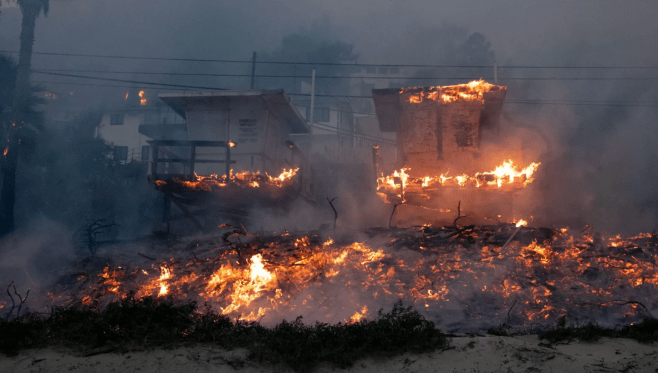
At the beginning of the new year, the elements wasted no time in making themselves a source of headline news for the Palisadian-Post. Spurred, as usual, by one of Joan Didion’s favorite topics, the Santa Ana winds. As even non-Southern Californians know by now, the Santa Anas can be held responsible for all of life’s woes in this region of the Golden State. Specific only to the southern area, perhaps causing the northern residents to blame those winds for how much more “cuckoo” this part of the population is (though the Southerners would argue that it is the Northerners who are the batshit ones—except they don’t even have a special wind to blame it on). Causing shifts in mood and temperament as fast as a fire can jump over a freeway. Or, as Lana Del Rey puts it in a song called, what else, “California,” “Changing like the weather, oh, that’s so like you/The Santa Ana moves you.” Being moved, of course, doesn’t necessarily infer “in a good way.”
However, for Rina Lentner, she was moved in a very good way the first time she accidentally drove through Pacific Palisades, just one day before the fire broke out. And all because she took a wrong turn somewhere from Westwood. Being a relative novice to the city, it wasn’t out of the ordinary to get diverted, turned around and lost—to the point where Rina ended up in a neighborhood roughly twenty minutes and ten miles from where she had started out. Maybe it was a matter of still being too caught up in the movie she had just seen at the Landmark (to her dismay, she had missed the chance at seeing a movie at Westwood Village or the Fox Bruin Theater because both had just closed at the end of December). It was the 3:45 screening of Maria, and Pablo Larraín/Steven Knight/Angelina Jolie’s vision for the “character” of Maria Callas had really stuck with her as she proceeded to space out thinking about the film while driving. That was at least part of the reason she had gotten lost.
The other part was that she didn’t know L.A. all that well. Was still “green” (or “virginal”) when it came to navigating its many thoroughfares. A day later, when all the roads leading to Pacific Palisades were blocked off, Rina was glad for the directional “mistake.” One that so disoriented her that she actually got out of the car to stop at a place called Caffe Luxxe. As usual, parking was a bitch, but she managed. It was as she sat down at one of the outdoor tables that she caught sight of a left-behind copy of the Palisadian-Post. The name of the publication immediately caught her eye, for she had no idea that people who lived in Pacific Palisades could be described as “Palisadians.” She assumed that some part of her also gravitated toward the alliterative sound of the newspaper. Even though the “puh” sound was her least favorite in any language.
As she sat there drinking her cappuccino (the safest yet “fanciest” order, she figured), she could see that there had been a time when Pacific Palisades had perhaps been less corporate. Mostly in its early Methodist years. But even though it was (she was surrounded by things like a Chase bank, a Wells Fargo bank, a Gelson’s and an Erewhon), she could feel it still had that distinct “small-town charm” nestled in the depths of a big city. Even if its high school, the Pacific Palisades Charter High School, still bore that hyper-whitewashed, “camera-ready” aesthetic that only schools in West L.A. seemed to have. That was why seeing that the truly iconic (a word not just bandied in that casual way that so many people use it in the present) school was one of many buildings that fell victim to the Palisades fire was almost as upsetting to Rina as learning that the Getty Villa, which she had hoped to visit soon, was also touched by the fire. She supposed that, at the very least, the school would forever be immortalized in films like Carrie, Freaky Friday and Project X. So even if it did look unrecognizable after a “revamping” (or “facelift,” to use L.A. parlance), it would always be remembered for what it was thanks to the wonders of cinema and its ability to document, to preserve.
That was yet another irony about Los Angeles. That despite the fact that the very nature of it—or rather, the very nature surrounding it (wind, water, fire)—made it prone to constant change through destruction, the industry it was built on served to forever immortalize it on film (whatever iteration that took shape in, whether celluloid or digital). When Rina drove back home after sitting for a while at Caffe Luxxe to “get her bearings” and mentally prepare herself for at least another twenty-plus minutes in the car, she found that life outside of Pacific Palisades didn’t feel as peaceful—as “la-di-da”—as other parts of L.A. And she kind of missed it. That feeling of tranquility and remoteness that must have attracted all those refugees (apart from the town not being under fascist rule) in the infancy of the town’s modern (read: colonized) existence.
Rina, whose name in Hebrew meant “song” or “joy” or even “song of joy,” was feeling neither joyful nor musical when she saw the news about the fate of the Palisades the following day. And here she had just been getting to know it. Though she reckoned one could take comfort in the fact that “at least” the fire hadn’t been started by an arsonist (as was yet another common reason for out-of-control fires in high-density brush areas of California). No, it was a “routine” brushfire propelled by those fifty-plus-mile-an-hour Santa Ana winds. Always seeking to destroy. But, as Donnie Darko once pointed out (by way of Graham Greene), “Destruction is a form of creation.” Even if it seems that, less and less, there’s anything “new” left to extract from the ashes, the constant ashes.
And all the governor could say is that it was “a hell of a way to start a new year.” Though it might have been more positive for him to just quote Donnie, since L.A. is, after all, a sucker for a film reference. But then, Donnie Darko was filmed at Loyola High School, so it wouldn’t have been as apropos as quoting, say, Carrie. But somehow, citing a line like, “I ACCEPT IT, MOMMA! I ACCEPT, MOMMA, I accepted!,” regardless of being applicable in its own eerie way to the weather patterns of Los Angeles, just wouldn’t work as well as quoting from a movie that didn’t heavily feature “Pali High.” Yet another structure burned to the ground, waiting to be photographed for scenes that would no doubt be included in the next issue of the Palisadian-Post. The post-apocalypse well-documented many times in L.A., but more rarely in the Palisades.
 Literary Bitch