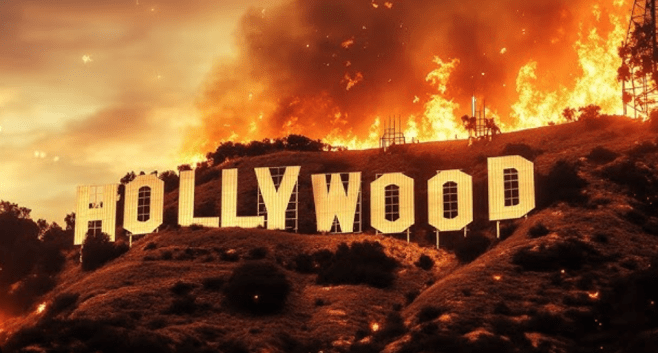
A fire breaks out. At first, it seems normal, garden-variety. For L.A., anyway. Oh well, another fire, big deal. Life goes on, etc., etc. (or rather, “the show must go on,” to be more entertainment business-specific). That was the reaction that had been instilled within many a Los Angeles resident, conditioned to shrug off the sort of environmental events that most other “normal” people would be quite fazed by. But they couldn’t possibly understand unless they lived there—how easy it was to become blasé about catastrophe when it was the standard. The convention.
Yet it didn’t take long to see that something was different about this latest eruption. For a start, it was affecting Pacific Palisades before Malibu. Malibu, of course, was no stranger to wildfires. That was “expected,” precedented. But an ignition in “Pali” was slightly more alarming. So alarming, in fact, that the movie premieres of the day are canceled. No sense going forward with them if no one was going to show up, whether due to the fires themselves or a fear that attending a movie premiere would be “in poor taste” for the current conditions.
Besides, it wasn’t as though these were “features” that anyone was really all that invested in: a remake of The Wolf Man just called Wolf Man (what was Julia Garner thinking?) and a movie with J. Lo in the cast. With the fire blazing, everyone cares, frankly, less than ever about such banal attempts at art. The gravity of the situation is being felt not only by the entire community, but the entire world. Because they can see that “even” celebrities are being affected too. Paris Hilton watches her home burn down on live TV, while others don’t have a second (or third or fourth) home from which to observe their residence get torched in real time. It’s a new level of elucidating class disparity in Los Angeles.
An actor whose star has long ago faded helps out, getting interviewed on KTLA only to go unrecognized by the news anchor speaking with him. He tries his best not to seem surprised by the interviewer’s lack of recognition, but you can see it there in his face, just for a split second: he’s disappointed that no one realizes who he is, therefore how momentous it is that he’s deigning to stick his neck out for the neighborhood, like he’s a “regular” person or something.
The agents and studio executives, from their perches above, wonder if maybe this is finally it. The last straw for continuing to try to make the case for L.A. as the hub of their industry. Maybe they should consider packing it all up and moving to Texas like Elon Musk and Mark Zuckerberg. The conservatives, of course, are drooling over these images of apocalyptic destruction, using it to “make their case” for all the ways in which California has failed…and been failed by “liberals” (side note: the rich liberals of California are divided from the conservatives solely in matters of being pro-choice and pro-LGBTQIA+). They didn’t seem to understand that the only thing these fires were “making a case for” was that their pro-capitalism, pro-big business policies were decimating the planet at an increasingly alarming rate.
California wasn’t the only “poster child” for this phenomenon. It was just the most promoted because of how much people extracted a certain kind of schadenfreude from watching it burn. There were many probably “secretly” thinking that L.A. “deserved it.” That this was its comeuppance not just for the hubris of building homes and businesses in a direct line of literal fire, but for the “den of sin” that L.A. represented. Ever since it was first called “Babylon” in the 1920s. When, in order to “accommodate” the pearl-clutchers of the world, who were outraged by all the debauchery Hollywood “promoted” (read: reflected back to society), the studio heads cut in a hall monitor like Will Hays. With his fucking censoring Hays Code that took effect in the 1930s. But this panty-sniffing type didn’t understand who he was dealing with: screenwriters that knew how to get around the code by still being suggestive as all get-out. If anything, it was the creative challenge they needed to prove that art can’t be legislated or tamed. Not really.
Just as, unfortunately, fire can’t be either. Told what to do or how to do it. The same goes for the Angelenos being engulfed in it. For, despite knowing, however deep down, that this was not an ordinary weather-related event (the Santa Anas and their gusting, indefatigable winds), some of the residents couldn’t help but maintain their usual aura of cool. Some might even call it their usual aura of nihilism. Surfers continued to surf and shoppers continued to shop at various outdoor malls throughout the county, the plumes of gray and black smoke looming above them like unignorable harbingers of doom. But, as any Californian could tell you, harbingers of doom become desensitizing after you see enough of them in your day-to-day life.
That’s probably why, at a screening of 24 Hour Party People in Los Feliz, most of the audience is fairly “whatever” when the power goes out. Just another symptom of the fires, the winds, the monopoly that PG&E has over the entire state. The audience remains committed to staying in the theater, hoping against hope that the movie will start up once more, and they won’t have to face the total lack of party people outside. Eventually, the movie does come back on, and the sight of Steve Coogan playing Tony Wilson, the illustrious owner of the long-ago defunct Factory Records, is a relief to them. An unanticipated balm to take the edge off what’s happening beyond the walls of the darkened theater. And somehow, that’s when everyone sort of looks around at each other for a brief moment, as though coming to a collective realization that, yes, things must be pretty bad if they wanted to “escape” to Manchester.
The rest of the world is unsettled by Los Angeles, by the people in it. The people who keep choosing to stay, to rebuild. Knowing full well that it’s all bound to burn to the ground again, sooner or later. In this odd way, perhaps they’re jealous of this unique combination of resignation and tenacity on the part of the Angelenos. Or perhaps that’s a delusion. That, to borrow a phrase from Janis Ian in Mean Girls, Angelenos (a.k.a. “you Plastics”) “think that everybody is in love with them, when actually, everybody hates them.” Be that as it may, it doesn’t change the fact that Los Angeles is the place where dreams—a.k.a. movies and television—are made. And you can’t burn a dream any more than you can censor what’s really being said with the Hays Code.
When the premieres of Severance (a TV series, not a movie—but still) and The Last Showgirl are canceled as well, however, that’s when the cinephilic Angelenos know that it truly must be dire. That this isn’t like all the other times, all the other fires. Because even the top-shelf shit is being kiboshed for the sake of “an abundance of caution” on dates that are still in the “distance.” But it’s obvious the audience committed to seeing 24 Hour Party People as the fires blazed in the background would have been only too down to go to either of those canceled premieres. Wolf Man or Unstoppable, though…not so much.
 Literary Bitch