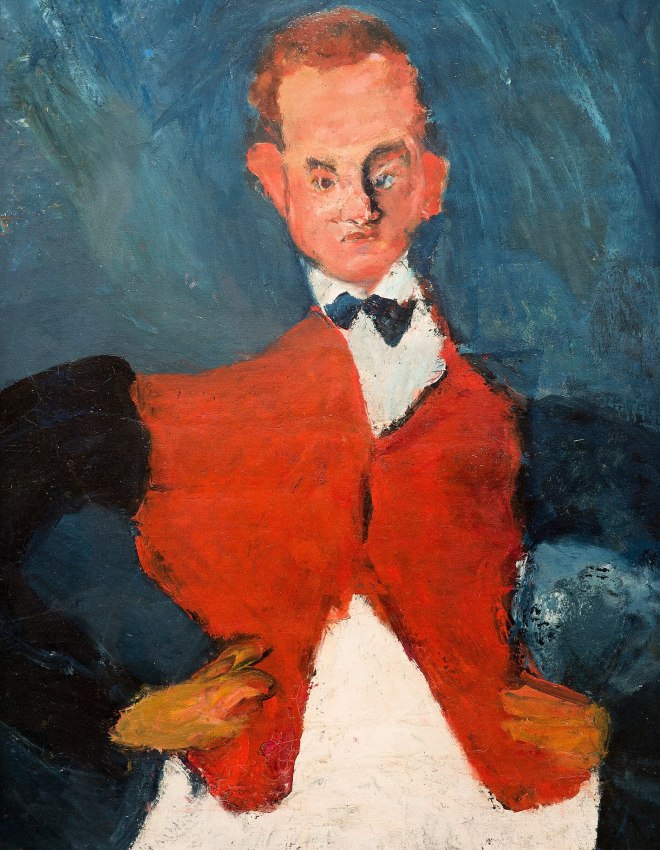
To a certain extent, maybe it could be assumed that a waiter on cocaine would be more efficient (a.k.a. quicker) than “just any old” waiter. Or even a waiter on some other substance that wasn’t cocaine. But no, the truth was that “being faster” and technically more mentally alert did not equate with efficiency. As most of the customers at Le Manège Café (not to be confused with the word “ménage”) often found out when they had the misfortune of being assigned the cocaine waiter. Known to those closest to him as Toto, a nickname that derived from his first name, Antoine. But since so few were close to him, “Toto” rarely came up as an addressment.
When Antoine was younger, of course it was never his ambition to become a “career waiter.” Then again, he really had no ambition at all. The only things that he was truly “passionate” about were the same things that all boys his age enjoyed: sex, drugs and partying. Ideally, all three at once (though, in truth, that would take far more skill and coordination than Antoine had to offer).
So perhaps it should have been no surprise to Antoine (for it certainly wasn’t to either of his disinterested parents) that when the time came to apply to a university, he didn’t have the necessary grades to gain entry. And that was about the time he started skulking around different cafés along Rue de Rivoli to make various “inquiries” about available jobs. By the end of the day, Le Manège Café was the only place willing to offer him a position—as a dishwasher.
A few months later, he was a bus boy. Then, a few months after that, at last, the most coveted position of all: a waiter. The job a thousand Frenchmen would kill for. After all, it was a role that had more job security than most positions in Paris. Even better, there was no ageism in the field. Waiters could keep their job until they dropped dead for all the management cared (which they didn’t—they were usually even more apathetic than the waiters themselves).
Granted, Antoine definitely wasn’t thinking that far ahead. He just assumed that somehow, some way another opportunity would “fall into his lap.” Much like the bags of cocaine that did every night when he went to the various clubs that beckoned to him. And he wasn’t discerning about which arrondissement he went to either. So long as one of his friends summoned him somewhere and assured him it would be a good time, he was there.
And that was the pattern for a while, roughly a few years after the average college age. Then, slowly but surely, the invitations to go out started to fall off, with more and more of his friends landing “steady” jobs (a.k.a. of the office variety) or girlfriends or both. And so, the night was no longer “calling to them” the way it still did to Antoine. Who suddenly found himself all alone in the bathroom stalls of these clubs blowing rails like there was no tomorrow. And maybe, in some sense, there wasn’t. Not for Antoine, who knew somewhere further up than deep down that he didn’t have a future. Not really. He had already squandered it by fucking around when he was young. Which, as far as he was concerned, is what a young person should be doing. But he had been wrong. Had lived out his adolescence as if he were from a bygone era—like the 1970s. A decade when things might still “magically” fall into place for someone with bad grades and no “proper skills.”
In truth, Antoine couldn’t even say he had skills as a waiter. For he sleepwalked through the job entirely. Even if he was extremely alert because of all the coca he was snorting. And though he used to be able to wait until he was off the clock to do it, the past year had turned him into a, er, full-blown addict. Unable to function without that precise rush at work. Of course, it didn’t take long for various co-workers to walk in on him “secretly” stealing a snort in the back area. Yet none of them would bother to rat him out to the ostensibly clueless big boss. Because they all knew this job was the only thing Antoine had. The only thing still “kind of” keeping him together. If he were actually “let go,” he might descend completely into the abyss he was still half in, half out of.
So no, his co-workers wouldn’t be the ones to draw attention to Antoine’s waiterly incompetence. Instead, it would be one of the impatient, at-their-wit’s-end customers. The vast majority of them being tourists. And, worse still, American tourists. Just like the one that homed in on Antoine one fateful Tuesday after five p.m., when the café went from having a lull to picking up steam because of the happy hour prices. In other words, due to the busy time of day, Antoine was already damned when he came face-to-face with Patsy, a fifty-something Missourian, and her husband, Frank, clearly just along for the ride. Just there to follow and agree with whatever his wife did and said.
Which is how Frank ultimately became the one to urge Patsy to speak up about Antoine’s ineptitude. This after Patsy ordered a tiramisu and was instead presented with an English trifle by Antoine. The trifle was misleading in its appearance, however, in that it had a chocolate base rather than a custard one. So Patsy was allowed to be bamboozled for most of her “eating session.” And part of the reason she was, she insisted, stemmed from being made to wait thirty minutes for the dessert to be crudely plopped down in front of her. Even though she had ordered something so simple, it had taken Antoine that long. Despite it being a menu item that only required him to pull out a premade dessert from the refrigerator. But even for as simple of a task as it was, he still couldn’t be bothered to select the correct one. And that mistake, even more than taking thirty minutes to deliver the offending item, was fatal. Largely because Patsy’s pride had been wounded.
Not grasping that the dessert wasn’t tiramisu at all until about halfway through eating it was what bothered her the most. Even more than waiting. Because honestly, as she told The Manager, she—and other customers like her—were putting their trust in this establishment to give people what they ordered so they wouldn’t have to second-guess themselves when the item came. The power of suggestion, of assuming you got what you ordered is, after all, not to be underestimated. So it was that Patsy had been trying to convince herself with each fresh bite that it must be a “French take” on tiramisu, and that must be why she didn’t fully recognize it.
But no, the deeper into the dessert she got, the more she realized she had been led down a primrose path. That this waiter had done her wrong. And here she had done him the solid of pointing out to him the dropped ten euro bill he had let flutter away out of a stack of cash he was carrying around in his apron pocket. She should have pretended not to see it and just picked it up for herself instead. That might have at least been sufficient reimbursement for her faulty twelve-euro dessert. Since she didn’t do that, however, she decided she was going to be “compensated” for this faux pas one way or another. Which is when she insisted upon seeing The Manager, in true middle-aged white woman fashion.
To every employee’s surprise, including Antoine’s, The Manager did appear to hear her grievance. Something that was very out of character for him, seeing as how he often repeated that, Ces touristes peuvent se mettre leurs plaintes où je pense. But, for whatever reason, he was amenable to listening to this tourist. Almost as if he wanted a reason to find fault—or, more specifically under French labor law, faute grave—with Antoine. And the more he stood there and listened to what Pasty was saying, the more he was given reason to take Antoine aside and demand to search his pockets.
Needless to say, the small coke bag he unearthed was still full enough (but only because Antoine had already snorted the first one and disposed of it) to be quite incriminating as a faute grave. Giving The Manager the grounds he needed (and had so desperately wanted after months of getting similar complaints, but never quite to this bombastic extent) to “dispose of” Antoine so that he might achieve his true potential: full-time addict. Which, like many jobs, people aren’t given enough credit for because they’re not paid.
The Manager didn’t feel bad for Antoine. He knew that it wouldn’t take him long to convince some other desperate manager to hire him, not knowing Antoine’s history. He would bounce back. Keep on going to become a cocaine waiter somewhere else. That is, if he didn’t snort his face off beforehand while he “waited” in an entirely different way. Waited for something in his life to come together, to make sense, to have meaning. In that regard, The Manager knew, we were all cocaine waiters.

