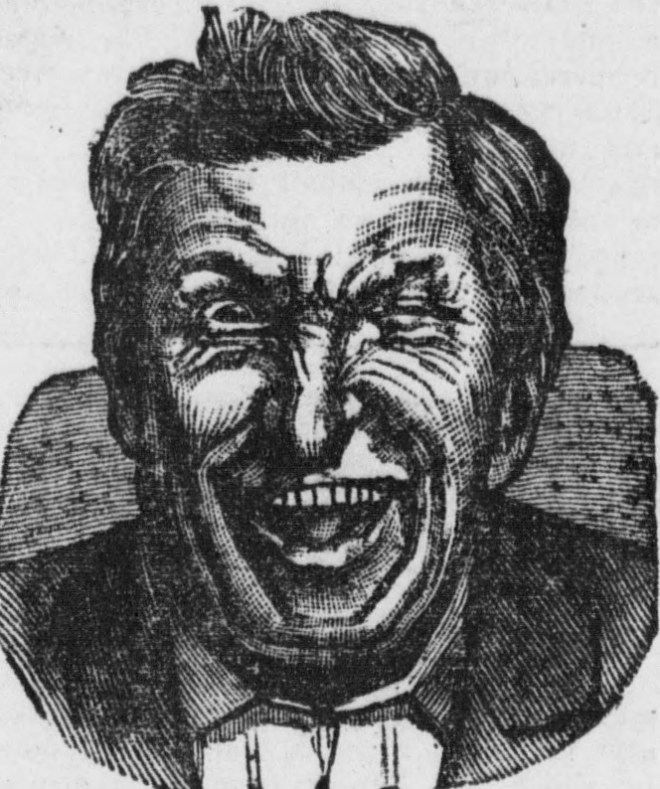
Every time she went in, no matter what time of day, he was there. Always just there. Looming, lurking, lying in wait. A so-called security guard with nothing to actually guard, which rendered him into little more than a “grocery store greeter.” Indeed, it struck Sabine as odd that the store should even bother to have a guard, as everyone knew that the town was full of nothing but every corporation’s most beloved form of clientele: the rich and the old (often one and the same). This meant that the chances of something “untoward” (e.g., shoplifting) happening were approximately zero. And yet, by the same token, it was the rich and the old who felt most “assured” by the presence of a “guard” (and probably would have felt even more assured by an armed one).
Sabine fell into neither of those categories, and had merely found herself living in this hellhole of an idyll because she had made a career out of cleaning the houses here. So it was that she found one of the few available apartments in town to rent (for everything else was “house property”), spending a modest sum each month that, to her, made it worth it to remain in this strange place where she stuck out like a sore thumb. Especially to this wretched, overtly lecherous man who stood sentry at the entrance to the only grocery store in town, posted up there like some kind of glorified hall monitor. Except that, at least with a hall monitor, Sabine would have been quickly reported to “the administration” and then able to immediately move on with her day. With this “guard,” however (whose name tag indicated he went by “Jerome”), Sabine was forced to “engage.” Even though everything about her body language and facial expression should have told him that she didn’t want to. That she was absolutely cringing with disgust. And yet, either he was simply “too oblivious” to notice (the number one copout for most men) or he really just didn’t care. In fact, maybe it was a kind of schadenfreude for him to see her looking so uncomfortable around him.
After all, what other form of “amusement” did he have within this context? It wasn’t as if he could be lascivious or annoying with the other types of “usual” customers who came in. The richies and the olds. He had to be “respectful” toward them, otherwise they would actually complain to management. Whereas Jerome seemed to instantly understand that Sabine would never “bother” to complain about him. That she was too, let’s say, docile. In other words, she didn’t want to deal with the awkwardness of “reporting” him to someone, knowing full well that he would probably never be fired because, honestly, who else could they possibly get to do a job like this? Save for maybe someone like Sabine herself. Of course, that would never happen either, as the entire reason she preferred cleaning houses to anything else is that it allowed her the joy of never having to interface with the public. To do a job like Jerome’s would, for her, be almost as unpleasant as having to interact with Jerome every time she went into this godforsaken shop.
Initially, Jerome’s whole “small-town friendliness” shtick had been “okay,” at best. Sabine would have never said she “liked” it, per se. But she could tolerate it…for about the first ten times. After that, she severely lost steam, enthusiasm and will for stroking this pathetic man’s ego with a smile, a laugh or even a vague acknowledgement. For that’s what it was all about for him, fundamentally: his ego being catered to. And since it had clearly been so long since anyone like Sabine had ever lived in this quaint town, he wasn’t going to miss his near-daily chance to get it from her. Assuming she would always deliver on her unspoken promise to “be nice” in return to him. Even though what he was doing wasn’t nice at all. It was entirely self-serving. A pitiful way for him to feel like he “mattered”—while simultaneously making Sabine want to crawl into a hole and…not necessarily die, but at least hibernate for a while. What kind of genuine “people person” would actively try to make another feel so ill-at-ease?
The answer, Sabine knew, was that Jerome wasn’t a “people person” at all. He was just a sad man whose world had become minuscule enough to make her the center of it. He was like a stalker who had no need of doing the actual work of stalking, for she came right to him. Had no choice but to. This was the only grocery store game in town. Just one of the many drawbacks of living “pastorally” instead of “urbanly.” Something that Sabine had to put out of her mind whenever she was feeling particularly hateful toward the town, trying to remind herself that living outside of a city was ultimately more valuable. Ultimately more “money-saving.” And that was the most important thing in life, wasn’t it? Or so she—and most everyone else—had been conditioned to believe.
How could she not? If it weren’t true, would she really be living in this “realm”? This place she had sold herself on as being “scenic” and “unspoiled” when, in fact, there was absolutely nothing here. Except a sporcaccione who would never leave her alone. Had nothing better to do in his miserable life but harass the only youthful, single person in the area. And yes, she was aware that everyone knew she was the only youthful, single person in the area. Which also made her contemptible to the many ruddy-faced, plump wives who viewed her as a threat. Some emissary of Satan sent to fuck all of their husbands (and even though they themselves didn’t want to, they also didn’t want anyone else to either).
Between the nonstop dirty looks of these women and the over-friendly—yet somehow in an ominous way—“conversation” (if that’s what one-sided, unwanted comments could be called) of the grocery store greeter pretending he was a security guard, Sabine began to feel like a rat in a cage after about a year. An amount of time that felt triple that in a place as claustrophobic and “everybody knows everybody’s business” as this. But what else should she do? Where else should she go? Obviously, if she could have afforded to move into the nearest city, she would. And oh, how wonderful it would be to feel anonymous again. Totally invisible. She had forgotten what a luxury that taken-for-granted gift could be.
Then, one day, after reaching a final threshold and bludgeoning the grocery story greeter with the plastic basket she filled with mostly the same items about four times a week, she remembered anonymity. For she had chosen to run from the townspeople (who she figured might as well have had pitchforks and torches in their hands as they chased after her) and into the woods. The only “attracting” feature of the town. At least, for those who were “nature lovers,” as the real estate listings were sure to mention in their mostly copy-and-paste descriptions. These woods were abyssal. Seemed to go on and on until the end of forever. That’s how far Sabine ran to escape the consequences of no longer being able to tolerate small-town existence (in other words, being driven to bludgeon the grocery store greeter). Trading it instead for a primordial one as she spent the rest of her days in solitude. Drinking from and bathing in streams and picking berries or certain edible plants for sustenance. Learning to reclaim her anonymity.
Yet, back in the town nearby, Sabine remains a legend. A scary story told to the children who would dare to venture too deeply into the woods. A suicide mission, they’re assured, that can only result in them being eaten by the witch who posed as a cleaning lady all those years ago.

