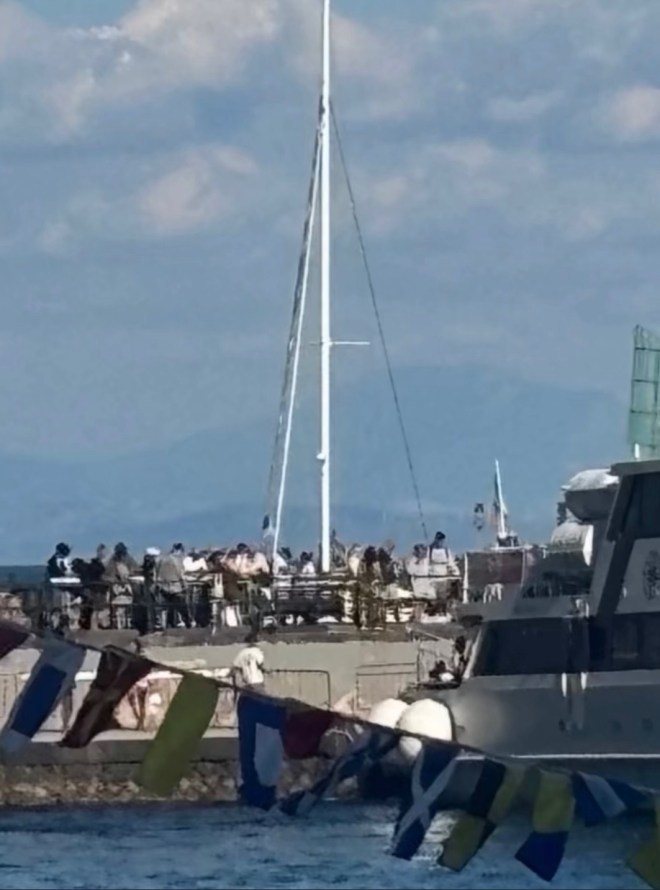
The tourists came by the boatload—literally. No amount was “too outrageous,” apparently. And even the locals didn’t seem to have the authority or wherewithal to fight it. To say: “Enough is fucking enough.” More than e-fucking-nough. But that was the thing about capitalism, no? Its core tenet is that enough is never enough. It’s all about more, more, more. Me, me, me. I, I, I. And as for that article, “I,” it specifically applied to the phrase, “I want more.” More decadence, more luxury, more ways to prove, “I matter.” All while simultaneously trying to insist that nothing and no one else does. And essentially proving as much by engaging in what amounted to total destruction.
This coastal Mediterranean town was just one of many that such tourists, like the Smith family, treated as their glorified toilet. A place to speak loudly, blaring their innocuous opinions about every little thing. The prices, the “duh-liz-ee-oh-so” limoncello, the lack of available public bathrooms, the lack of luxury in such a luxurious place. That is, of course, by their “pristine” standards. Standards that couldn’t possibly be met by anything Europe had to offer, let alone Italy. A country that, just recently, managed to surpass Greece as the most indebted of all the eurozone members. In other words, a country that, for all its richness in beauty and resources, was still somehow deemed “poor” by a system that only valued money, convenience (those two things being inextricably linked).
But what Italy “lacked” on those fronts, it more than made up for in other regards. Progressive thinking or a functional government? No. But it placed value on the sort of things that Americans never could or would. Caring about other people, a sense of community—for example. These were baseline human characteristics that had been stamped out by the merciless, grinding wheels of capitalism in American culture. A culture, unfortunately, that acted almost like a pandemic—infecting any and everything it came into contact with.
Just as it had done to the Amalfi Coast, increasingly infiltrated, decimated by the hordes with each passing year. The droves, the masses descending upon it without any limitations or guardrails. As if they should be waving a giant American flag like the tourism colonialists they were. This was the climate in which Claudia Maletti tried her best to function in every day as a longtime resident of the town of Amalfi.
At a certain period in her life, Amalfi had seemed paradisiacal. But that was many years ago now. In fact, as late as the 1980s, Amalfi and the Amalfi Coast had seemed, well, more tolerable. And most importantly, more filled with actual Italians as opposed to people like the Smiths. This doesn’t only refer to the specific Smiths mentioned above, but also the Smiths in a generic sense. This being the best “term” (in the form of an all-too-common last name) to describe the ilk that converged upon Amalfi primarily from April through September. The ilk that, with each new season, Claudia was forced to wade through as if these throngs of grotesque, often out-of-shape people were dense, muddied waters she had to navigate. Even though the only literal waters she wanted to navigate were the erstwhile clear, blue ones that she was able to access with far more ease in the days of her youth. When she was still a preteen and teenager in the 80s. Now, in her mid-fifties, Claudia could barely remember a time when walking through her town was anything resembling “effortless” or “pleasant.” Though she wished desperately that she could.
In the present, however, the only desperate wish she had was to escape from Amalfi. This paradise-turned-inferno. If someone had asked her or her parents (from whom she had inherited the small, ultimately “nothing to write home about” apartment that was nonetheless valued at one million euros) forty years ago if she would ever consider leaving this place, Claudia would have laughed right in their face—the very thought of it both incongruous and unimaginable. But, the way things were currently worsening, Claudia was ready to wave the white flag and surrender to the American flag that had penetrated and permeated every square meter in Amalfi and the surrounding costiera.
She knew, of course, that once she committed to her desire and decision to leave, it could never be “undone.” Sort of like Orpheus looking back at Eurydice: the consequences would be irrevocable. And Claudia wanted to be very sure indeed that she was willing to leave such a prime location behind. After all, she asked herself, wasn’t it at least somewhat livable once the fall and winter months arrived, and no one cared as much about going to the “most coveted” beaches anymore? But how enjoyable were those months, really? When the coldness and the humidity combined to make a unique kind of sickness known as the colpo d’aria.
While “outsiders” (otherwise known as non-Italians) might not believe in it, Claudia had certainly suffered from it enough times in her life to know that it was very real, generally prompting her to go outside as infrequently as she could during the chillier months of the year. But then, when the heat came—and with it, the tourists—a different, fresher hell was unleashed. One that, during this particular summer, Claudia found more intolerable than ever. To the point where, in mid-July, as the peak of it all was starting to really crest, she did something that could perhaps only be blamed on the “American influence” that the town had been subjected to. And that was: take to the primarily cobblestoned streets with a gun and proceed to shoot everyone in her path, regardless of their nationality. No one was safe from the barrage of bullets that poured forth from Claudia’s illegally procured AK-47 with a 75-round drum magazine that she managed to reload twice during her rampage. Making for a total of a hundred and seventy-one people dead and forty-nine injured (who can say where the five other errant bullets went?).
In the aftermath, when the full weight of the carnage was quantified, it was said that Claudia had “snapped,” representing the perfect example of what could happen when overtourism drove the locals to madness. At least, that was the Italian and European news outlets’ perspective on it. Whereas, in America, Claudia was painted as a “sad, lonely” woman who killed “innocents” (were they, though?) only because she was so miserable in her own life and felt the need to take it out on others.
In the months that followed the shooting, Claudia not only ended up “leaving” Amalfi (for prison), but also prompted a noticeable emptiness in the town, with many tourists now afraid to come not just to Amalfi, but the entire coast in general. In this regard, Claudia had taken back her place of residence only by surrendering to the fact that she knew she would still have to leave it. To pay for the sin of her tourism “expungement” with this ultimate sacrifice.
From the confines of the Poggioreale prison, Claudia made peace with her sacrifice, content in the notion that, even if only for a little while, she had given the gift of a sparsely populated town back to the residents she once called her neighbors. Granted, by the end of the summer, they all began to speak ill of her for ruining their respective “businesses.” The ones that relied on tourism to get them through the entire year after the summer.

