It was all part of a larger plan, of course. A conspiracy, if you will. One that would guarantee Americans never bothered trying to eat “healthy” again. The thing was, the American version of “healthy” was never an objective version of what that would really mean, so much as them trying, as best as they could, to convince themselves that at least some of the artificial shite they were consuming had a modicum of nutritional value. This extended, most notably, to the types of “vegetables” they were willing to consume. “Vegetables” that generally tended to 1) be bagged and 2) lose all of their “healthful benefits” in the process of being subjected to centralized agricultural production. But that had been the name of the U.S. fruits and veggies game for decades now. Starting after World War II, when mechanized, mass production and a slew of new chemicals at the disposal of corporations signaled a dramatic (and baneful) sea change in farming practices.
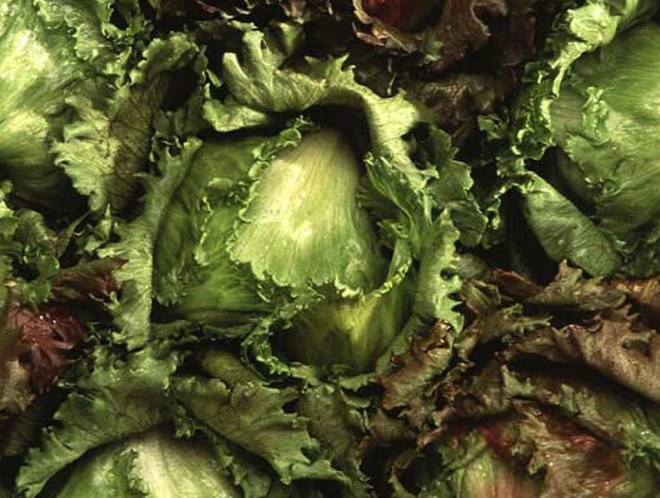
Long before that time though, in 1894, it should have come as no surprise to anyone who knows the U.S. as it is now that “iceberg lettuce” was invented in said country. “Created.” A word that suggests it was pulled out of thin air. And, who knows, maybe it was. Either way, the entity responsible was Burpee Seeds and Plants (yes, it’s not exactly an appetizing name for a company, but it is someone’s last name). Named “iceberg” because of how they were originally packed and transported—on crushed ice—by the dawn of the twentieth century, the seeds for iceberg lettuce were in the regular rotation of crop-growing in West Coast states that included California, Colorado, Arizona and Idaho. As such, maybe that’s the reason East Coast residents didn’t fuck with it much, still clinging to their “Boston lettuce” (a.k.a. Bibb lettuce a.k.a. butter lettuce). But, all these decades later, even East Coast residents couldn’t avoid the pervasiveness of the “iceberg” (and by 1922, this “breed” of lettuce was even being sold to hotels on the Eastern Seaboard that included the Waldorf-Astoria—the scandal if someone found that it was iceberg and not romaine lettuce being used in their signature salad!).
Really, how could they avoid it? After all, it’s the type of lettuce that Taco Bell used. And it was impossible for anyone—no matter what part of the U.S. they hailed from—to avoid the temptations of Taco Bell. Besides, it offered “lettuce” in so much of its various menu items, and surely that had to count for something on the “being healthy” front as an American. Brittany Tomlinson was just such an American going about the business of eating like one. That is to say, giving in to convenience rather than taking the time to make certain she was putting something genuinely “good for her” inside of her body (never mind the fact that it was often too expensive to do so). In a lot of ways, of course, Americans had no choice but to eat like shit (and now, thanks to Cyclospora cayetanensis, no choice but to eat actual shit). Not just because that was all that anyplace—grocery store, restaurant or otherwise—had on offer, but because they were constantly strapped for time.
Theirs was a culture that ensured there was never enough time, no matter how much technology and other advancements were supposed to make it so there was. But not really. That would be “dangerous” to the American “spirit.” The American “work ethic.” A myth that had been perpetuated ever since at least the days of Henry Ford, but, as far as any outsider could tell, Americans were lazy as fuck, and didn’t even know how to properly feed themselves anymore. With Brittany being just one of millions who would rather go to the Taco Bell drive-through “in a pinch” than take the trouble of, say, making and packing a lunch at home. A lunch that might potentially have far less artificial ingredients than what was going on at Taco Bell. But Brittany was not about to “go through all of that,” as she once explained to Rodrigo Montez, her only co-worker in the office who ever brought in a lunch. Indeed, this is what seemed to ostracize him from the start. Because he refused to be taken out to a restaurant by the others on his first day, which was the apparent tradition in that sad little company. Just one of thousands in the state. Which happened to be Michigan.
As it would turn out, “The Mitten State” would be among the hardest hit by the diarrhea outbreak thanks to this bum lettuce (no backside pun intended). With Brittany experiencing her first violent symptoms about a week after going to Taco Bell. Only she went more than one day of the week, so it was hard to know which “batch” really got to her first, but, whatever the case, she was doomed regardless due to the frequency with which she pulled up to that drive-through. Her other co-workers would often ask her to get them something too, so long as she was “already going.”
And so it was that Rodrigo was the last man standing (or rather, sitting) in the office. Still calmly eating his homemade lunches as if all hell wasn’t breaking loose outside the confines of his cubicle (because, yes, he worked in the kind of place that still believed in cubicles). While his boss kept calling (for she, too, had been felled by the “diarrhea lettuce”) to thank him profusely for picking up the slack while everyone else was gone, what she couldn’t have known—what no one could have known—was that he was one of the engineers behind the spread of this parasite. Part of a “shadow sect” of the CDC working to manipulate which diseases and outbreaks “caught on” and which didn’t. By pushing for the “lettuce problem” to balloon with such rapid force, Rodrigo and his real colleagues were working toward a larger aim. To instill within Americans a complete aversion to anything that might be deemed as even remotely healthy.
By further fortifying this already present aversion—so inherent anyway ever since the creation [that word again] of high fructose corn syrup)—the government wouldn’t need to outright declare that farming was becoming all but impossible, what with the never-ending climate change issues that made viable crops essentially a thing of the past. Thus, a “subtle” (read: insidious) pivot was being made to ensure that Americans would think they were willfully choosing a diet of donuts, fries and other ultimately ersatz “food groups.”
The kind of “food groups” that would still cause gnarly shits to be taken, but with far less frequency than what was happening right now. During what Rodrigo and his associates billed as the “bowel transition period.” Alas, he mused to himself as he rode his bike (another quality that ostracized him at work) back to his temporary apartment (he would soon be installing himself as a fake employee somewhere else) one evening, even after their bowels were all emptied, most Americans would still be full of shit.

