It seemed that, in life, every time something or someone got “back on track,” the universe saw fit to make it all go askew again. Almost as if to remind the masses who (or, perhaps more accurately, what) was really in charge. That kind of “reminding” had often been the case with many a recovered drug addict and, more globally, Big Sur. One of California’s most beloved and lauded locations for its scenic beauty, dramatic, craggy vistas and generally untamed nature. In fact, what really made Big Sur so appealing to people was how it had managed to stay “untouched” by corporate infiltration all these decades. And in no small part thanks to its inherent inaccessibility. Though, if people felt it was inaccessible now, they should have tried visiting it before 1937. Because up until then, when the Carmel–San Simeon Highway was completed, there was no viable way to “get to it.”
The Carmel–San Simeon Highway was ultimately the first part of what would become the famed “SR-1” (or California State Route 1). Of course, it was a long road (pun intended) to completing SR-1. With the Carmel–San Simeon Highway itself taking eighteen years to finish. For, in typical government bureaucracy fashion, funding ran out in 1926 and halted the construction process until 1928. But it seemed that even with a highway that might connect Big Sur to the “outside world,” some greater force wanted to ensure that access was never really guaranteed. For just when residents and visitors were lulled into a false enough sense of security about the viability of the road, there would always be a mudslide that caused a major and lengthy closure to the highway, restricting movements in and out of key areas. Or rather, key “attractions.” Like Esalen, the “intentional community” that had been founded in 1962 and ended up becoming an integral part of what the entire decade would come to represent: “New Age-y” self-discovery and self-reflection, a hippie lifestyle (because of the commune setup and the presumed drug-taking and “free love”) and the establishment of the “retreat” as an almost panacea-like concept that endures to this day.
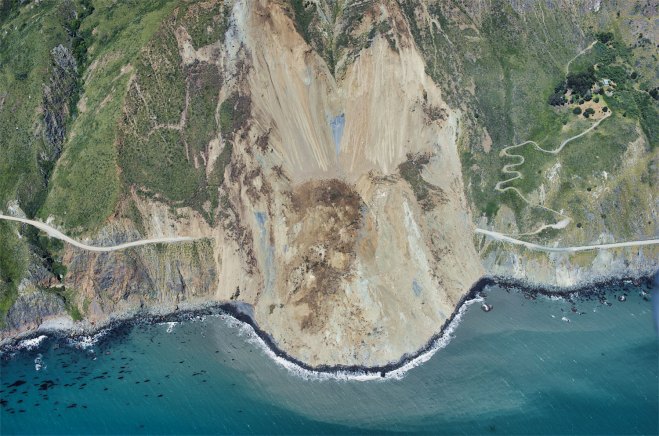
Over the years, Esalen and other “players” in the allure of Big Sur—like Nepenthe, Ventana and Post Ranch Inn—had seen their fair share of environmental obstacles to being situated in such a remote and prone-to-Mother-Nature’s-whimsy location. Indeed, the stretch of highway that connects the outside world to it had been closed over fifty times. Though, arguably, one of the most significant times was in May of 2017, with the Mud Creek landslide that effectively “buried” the highway. As six million cubic meters of rocks, dirt and other assorted rubble would be inclined to do. It crashed down in such a huge mass that it even managed to extend the coastline by fifteen acres. Needless to say, the undertaking that went into repairing it was monumental…and costly. Fifty-four million dollars costly. Yet it wasn’t the only casualty of a landslide that year. There was also the Pfeiffer Canyon Bridge, which, thanks to another landslide, got one of its supporting columns knocked down, taking most of the bridge down with it. Adding yet another “means of arriving” (or departing, for that matter) onto the “not available” list.
Bearing all of this in mind, it was no secret that the residents of Big Sur and all the way up to Carmel and Monterey had seen their fair share of Mother Nature’s wrath over the last century. So, in many ways, it took a lot to surprise them, or keep them from always rebuilding when Nature saw fit to destroy. As one L.A. Times article put it, “…most residents know by heart the years of each major assault—‘83, ‘98, ‘08, ‘16 and now ‘17—the fires and floods that continually shift the equation of what it means to live here.”
And yet, just when those residents thought that maybe the equation might stay “fixed” for a bit longer after the governor had announced only this year that another landslide and weather-beaten stretch of Highway 1 was reopened again (after three years of being closed), Nature saw fit to throw still another curveball. But not until that false sense of security was cultivated over the course of spring and a large bulk of summer, when it felt as if the area had finally started to get back into its “groove.” That the flow of traffic—literally—was bringing more bounty to and interest in Big Sur, which had suffered so many setbacks as the 2010s came to a close.
But now, as even the 2020s were drawing to their end, it seemed that “relief” for this fraught and wild corner of California could never be permanent. A raging fire sprouting up to prove as much. No “garden variety” kind either as, in the short span of four days, it had managed to burn through upwards of three thousand acres, causing the evacuation of the places that the town was so well-known for—the aforementioned Esalen, Nepenthe, Ventana and Post Ranch Inn. Places that many would argue “made” Big Sur what it is. For better or worse.
Some residents might tell you that the “worse” side of it was becoming another Disneyland-like attraction to the millions of visitors that descended upon the land every year. Their clout is what outweighed any of the needs or wants of the people that actually lived there year-round. For, as that same L.A. Times article also pointed out, “The frustration…comes with the reminder that to live in Big Sur means living like colonists, under the control of federal, state, county agencies.” Your life is not your own, because the decisions being made about it are not yours. And certainly, as Mother Nature would remind, nor is the property you think you own.
But even with the latest scourge, the “real ones” aren’t liable to leave in the aftermath of yet another disaster. Regardless of the latest one feeling like the worst yet. Because, through it all, they’ve stayed again and again, after every false hope that might have led them to believe “the center would hold” (to reference Joan Didion referencing W. B. Yeats). It’s the kind of devotion and commitment that romantics and monogamists can only dream of.

