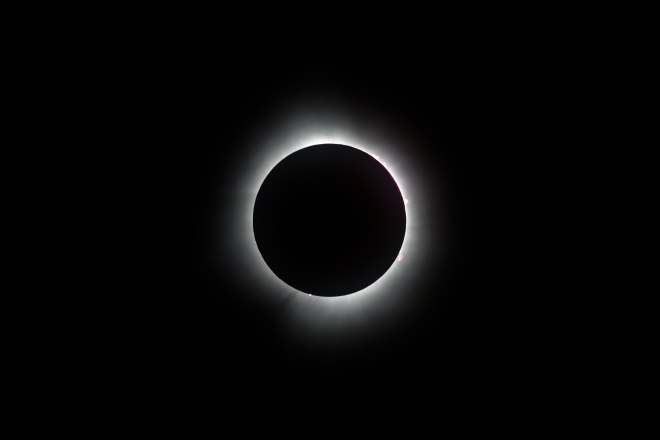
It felt almost insulting rather than “honoring” to keep hearing “Total Eclipse of the Heart” playing at random public places throughout the day. Julia went into milieus as diverse as a sporting goods store, a nail salon and a park where a vendor had a radio, and yet she heard the signature single blasting out at all of them. It made her seethe, Bonnie Tyler just died for fuck’s sake and she still can’t rest in peace when it comes to this song.
The song that was playing seemingly on repeat everywhere that Julia went on August 12th. The playing of “Total Eclipse of the Heart” was, to her, unnecessary overkill. Because, like everyone else in Europe, Julia had been made well-aware of the “event” that was happening later that day. The first (near) total eclipse in the continental EU since 1999. More specifically, since August 11, 1999.
So now that, almost exactly twenty-seven years later to the day, it was happening again, it was being made into a momentous occasion. And Julia wouldn’t deny that it was, indeed, very much that, it was just, well, when people got collectively “juiced up” like this about anything, it was an automatic turn-off for her.
Julia had always been of this nature. The sort of person who was disgusted by other people’s enthusiasm for things—especially when it seemed like enthusiasm that was performative as a result of thinking they should be enthusiastic about whatever it was just because others were. And, to Julia, what specifically made the present-day enthusiasm about eclipses even more ironic was that, in the ancient past, when people couldn’t understand what was happening, it was something to be afraid of, not excited about. They were the opposite of enthusiastic, which, as far as Julia was concerned, was how it should be. If only people still believed eclipses were somehow related to gods swallowing up the sun. Not even sure if the sun would ever come back again as a result.
Fear was a more honest form of reverence than what was happening today, which is that everyone “revered” the eclipse solely for what it could mean for their various photo and video opportunities. Not even just of the eclipse itself, but of people looking at the eclipse with their “solar viewing glasses.” A “tool,” as it were, that became yet another sign of how anything that was supposed to be “natural” and “free” ultimately fell into capitalism’s destructive, commodifying wake.
There were some, of course, who would still be happy to look directly into the sun, even though they could have afforded many, many pairs of solar viewers. Julia thought of one shining example of such a person who did that during the “Great American Eclipse” of August 21, 2017. She had still been living in the U.S. at that time and was subjected to the hullabaloo surrounding an eclipse then as well. For that particular one, the big “excitement stats” around it were that not since June of 1918 had a solar eclipse been visible throughout the entire U.S. and not since February of 1979 had a total solar eclipse been “an option for viewing” anywhere in the U.S. at all. So, once again, Julia found herself in a city that was all in a frenzy over the “event,” bum-rushing various shops that were selling solar viewers, thus, making it a point that “being in awe of the environment” still wasn’t synonymous with wanting to do much of anything to protect it.
Watching the hordes in the Paris of the August 2026 eclipse make a beeline for their own solar viewers was enough to bring back that same disdain she had felt in 2017. Thinking back to how she knew damn well it cost mere cents to manufacture these things, yet they could sell for upwards of twenty to forty dollars (especially if there was a scarcity), it made Julia’s blood boil anew. All this pomp and circumstance. All this waste. Not just because of solar viewers, but because of what always tended to happen when humans gathered in droves: consumption, followed by the mass creation of trash. It was the most antithetical show of “respect” for the wonders of Mother Nature that Julia could think of. At least today.
This was one of many reasons Julia was not “participating” in the “ooh-ing”-and-“ahhh-ing” that was to be heard throughout the city tonight. Not only that, but she didn’t live quite within its confines to make the conditions for watching the eclipse viable anyway. While Parisians (and, more likely, tourists) could just go out onto their balconies or to a public space like the Jardin du Luxembourg to see the marvel without much effort, Julia would have to leave her house in the middle of nowhere to try and find a worthwhile spot to see it. And that, in and of itself, made it seem decidedly unworthwhile. Requiring the kind of effort and general unenjoyableness that seeing the eclipse in the city did not. So, the next day, when several of her co-workers tried to make conversation with her near the coffee machine by asking if she saw the eclipse, all Julia could remind them was, “I think you’re forgetting how shitty where I live is.”
And it was true, they did forget. All the time. Because, for as often (too) as her co-workers tried to “engage” her, they could never seem to actually remember any of the details she deigned to offer. Which included the mention of living on the outskirts of Paris. Julia found that the people who actually lived in Paris tended to block out this detail as it was too unfathomable and abhorrent for them to imagine. She wished she couldn’t imagine it either, but the prospect of ever living inside the city wasn’t likely based on her budgetary constraints. She had racked up quite a lot of debt in the past few years and the wage at her job was a pittance, hence, homing in on “the ‘burbs” as a way to cut down on overhead. But alas, it was also a way to increase the cost when it came to protecting her mental health. For Julia was a “city rat” through and through. As someone naturally introverted and incapable of connecting with people, her best means for achieving a simulacrum of that was to merely walk out into the street of a city and “absorb” humanity that way.
Now that Julia had missed the eclipse (even though she was off-put by it in the first place), it was just another example of how she had failed to connect to the rest of the humanity through some kind of shared experience because of where she lived. Little by little, this would make her more stunted. More “off”-seeming to the average person. Her isolation was what amplified her aura of strangeness to people. But still, if the conditions for seeing the eclipse were more eclipsing, what could she do? Certainly not move. And certainly not share any of the same vexing enthusiasm for the phenomenon as everybody else.

