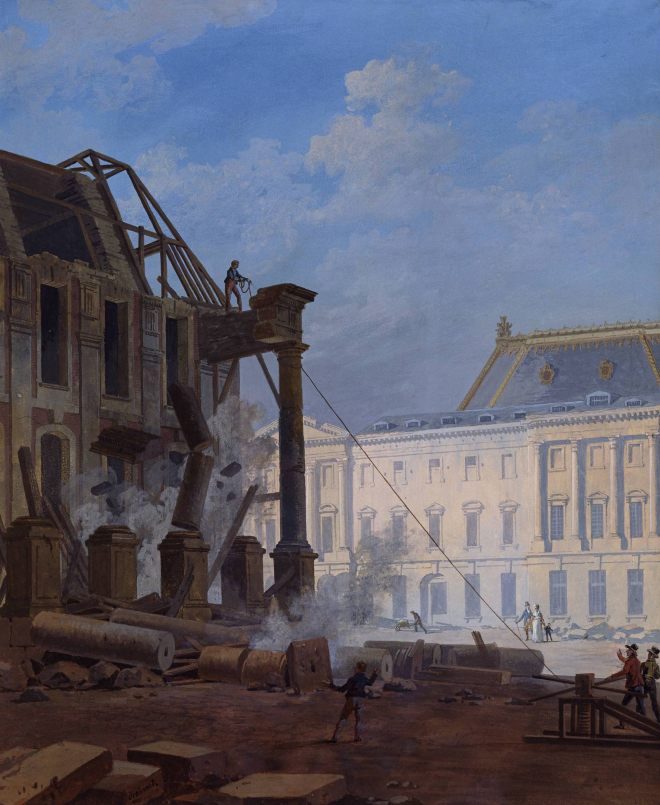
Naturally, it was already a bit questionable to be visiting the Palace of Versailles. There was something about the touristic “endeavor” that essentially shouted, “We haven’t learned our lesson at all about coveting wealth and power!” And yet, that’s exactly what Lauren and Sam chose to do as a key part of their first “couple trip.” Out of the country at least. Prior to that, the farthest they had gone together was on a weekend getaway to the Madonna Inn. Which, at the time, they had believed was the height of culture. Visiting France would be, to use an American parlance, a “whole different ball game.” One that Lauren and Sam clearly weren’t prepared for. Though, like most people who aren’t prepared, they had no idea that they weren’t. If they had been though, they might have decided to postpone or abandon the notion of visiting altogether.
Alas, having no clue (as is on-brand for many Americans) about the revolution, of sorts, being staged that day in Paris—the first day of their “official plans” to do something—Lauren and Sam stepped out into République to find the gathering storm of protesters. Not that anything—least of all mass dissatisfaction and dissent—would have deterred them from carrying on with their plans. After all, they had come all this way. A “little” disruption and discord was hardly going to stop them. And clearly, the Ministry of Culture, which oversaw the Public Establishment of the Palace, Museum and National Estate of Versailles, didn’t think they should be stopped. Or that anyone wanting to visit the “wreckage” of monarchy should. In fact, it was as if they were selling tickets to Versailles like it was “going out of style.” Which, obviously, it was. Since, without a doubt, “It is happening again,” as the Giant from Twin Peaks would say. The “it” being total rebellion against “the state.” The “fascist state” that had replaced monarchy but still ruled with a similar iron fist, and one that tightened around the collective’s neck if it didn’t pay up—and tout de suite.
Funnily enough, Louis XIII actually did pay up for some of Versailles. But only because most of the land belonged to the only “entity” more powerful than the monarchy: the Church. That is to say, Archbishop Jean-François de Gondi, who seemed keen enough to oblige the king in his interest in acquiring the land and seigneury of Versailles, having become enchanted with the hunting grounds upon first visiting in 1607. As for the de Gondi family, “ceding” (a.k.a. selling) the property to Louis XIII was something of a no-brainer in terms of gaining additional favor in his court. Plus, Jean-François de Gondi already “owed” Louis XIII this “favor” after the latter effectively made him the first archbishop of Paris by recommending to Pope Gregory XV that the Diocese of Paris, where de Gondi had been installed as the see, should be elevated to the status of a metropolitan archdiocese. Thus, Louis XIII seemed to be expecting a “back scratch” of his own in return. Even though he still had to pay sixty thousand livres for that back scratch.
None of these details regarding the property’s history were unearthed by Lauren and Sam, who seemed most interested in ogling the bedrooms like everyone else. A strange obsession that caused the kind of bottlenecked foot traffic that would compel any non-tourist to engage in a shooting spree. Luckily for them, they were “loud and proud” tourists. Unafraid to be embarrassing, to annoy or to generally look like badly-dressed, slack-jawed dolts. In other words, the overall summation of how most tourists came across to the people who actually lived in the city being “descended upon.” Only today, it was the French themselves who were descending upon all of Paris while everything was “business as usual” at the Palace of Versailles. Just as it had been so in 1789, when the French Revolution began, along with the first violent outbursts from the “hoi polloi” that it would become forever associated with.
It was as the “rabble” grew more restless, more discontented and, therefore, more vicious—lustful for several heads to be offered to the guillotine—that the royals and courtesans of Versailles grew simultaneously even less attuned to the commoners. Responding to their outcries, instead, with more profligacy. More decadence and proneness to pleasure, indulgence. Because perhaps it’s only “natural” for a political leader to double down before “the fall.” Though few would have called Louis XVI or Marie Antoinette much in the way of “leaders.” With the blame for high prices, food shortages and a pervasive plague of poverty falling squarely on their shoulders. Needless to say, it reeked of the very problems that had prompted the French to take to the streets while Lauren and Sam ooh’d and ahh’d over the Hall of Mirrors, the immaculately-landscaped gardens, the Petit Trianon. They knew nothing of this revolution, just as the monarchy, too, chose to remain blissfully unaware until their heads were being decapitated. Perhaps one of the few things that couldn’t be ignored by even the most skilled of denialists.
And, talking of denial, regardless of whether Lauren and Sam had decided to put two and two together, this revolution was, in part, their fault. They had voted for the person that, on a tantrum-based whim, chose to go to war with a country that had strategic control over a large amount of oil, as well as the strait that it was transported through. A country that had no problem making Lauren and Sam and all their fellow Americans sweat it out while they held fast to their oil supply. The result of that withholding was a primary component of the cost of living crisis, with inflation making everything at the grocery store and beyond skyrocket to untenable prices amid ever-stagnant wages.
But Lauren and Sam didn’t think much of these prices. In fact, they found them “quite reasonable” compared to what they were used to in the U.S. Granted, neither of them appeared to grasp that one euro was not the same as one dollar. Indeed, the euro had steadily depreciated in value ever since the destabilization sparked by the Russian invasion of Ukraine, which prompted it to lose its long-standing parity with the dollar by mid-2022. It had failed to recover. Just as the French commoners of today were failing to recover. And refusing to take it lying down and/or up the ass any longer.
Lauren and Sam couldn’t have been less in sync with these vibrations as they set out on their return to the hotel. Also failing to understand that maybe it wasn’t a good idea to try to go back to République. And after they kept fighting in every way possible to get to République again (not interpreting the blockades and closures as signs both literal and figurative), taking an alternate, inconveniently out-of-the-way train route and then walking most of the rest of the way, they finally saw that not only were the protests still in full swing, but that their hotel has been charred, practically burned to the ground. Before they could confer about what to do next, a sudden crowd surge caused both of them to be trampled. And since neither of them were expecting it—just as they had expected nothing else to go wrong when it came to this trip because they were Americans and that still “meant something”—their bodies were too slack to resist the full weight of the crowd bearing down on them. The full weight of the revolution stomping all over them. Almost as if everyone somehow sensed they had just come from Versailles.

