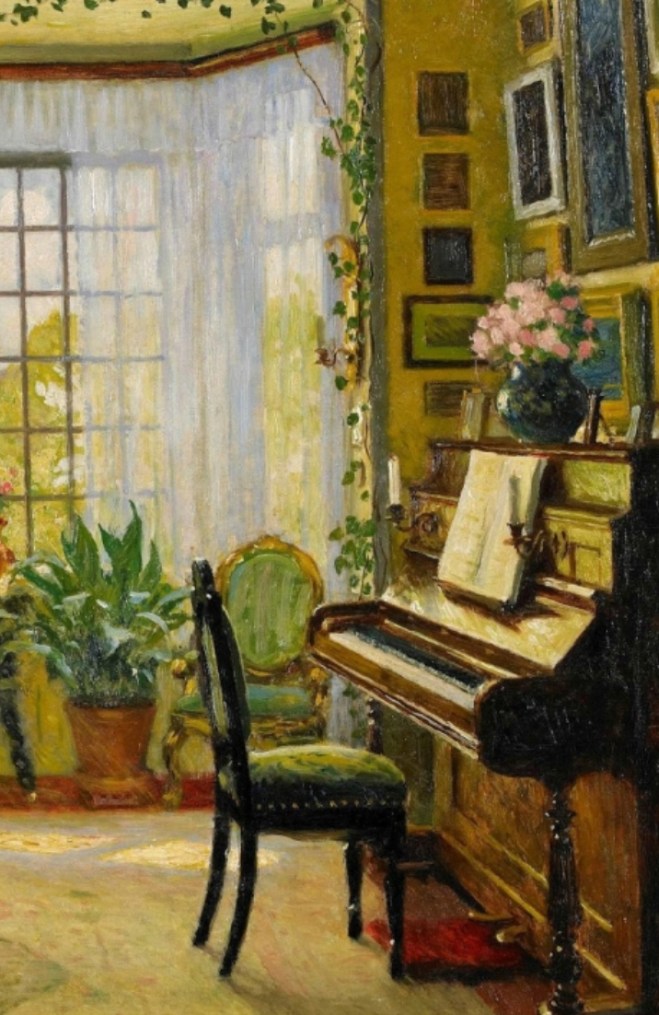
There is so often talk of the pain of leaving pets behind when one goes on a trip, but few ever talk about the pain of leaving plants. Those living, breathing beings that, believe it or not, can be just as sensitive as pets to the absence of their “owners.” Or at least that’s how Jamie interpreted their existence. Knowing full well that, of course, the real reason that plants “suffered” in the absence of their usual human in a house or apartment was due to perceptible shifts in the environment. The airflow, the lighting, the alterations in the levels of humidity and carbon dioxide—all of which contribute to either the health or detriment of one’s plants. Thus, their overall “mood.” A word that, of course, indicated a sentience far beyond what most “average” people believe plants are “capable” of.
And sure, although Jamie was well-aware that plants didn’t have a “brain,” per se, she still recognized them as being smarter and inherently more intuitive than most humans. That’s part of why she had outfitted her apartment in the fifth arrondissement with so many of them (her very own Jardin des Plantes, she would tell herself as she watered them with care and consideration). In addition to the fact that she was of the belief that stuffing her abode with some form of “additional life” might make her feel slightly less lonely. Then again, moving to Paris was supposed to help with that. Sure, it was a “big” city, but it was also, she had been informed, one that prided itself on community—if you knew which one to insert yourself in. Jamie had never quite known. Or rather, had never quite been assertive or outgoing enough to find “the right tribe.” Her shyness and fear of being “judged” (which automatically happened whenever anyone was “perceived”) preventing her from “putting herself out there” in the manner required to forge friendships not only in general, but certainly in a new city.
Of course, now that she had been living in Paris for the past ten years, it was hardly new anymore. Indeed, it had become rather small to her early on, even despite how often she still found herself discovering previously unearthed pockets of the city. And even despite feeling the crippling isolation that pervaded her every day, that should have made Paris seem much bigger than it was. But no, part of what kept her staying (aside from her “golden handcuffs” job at the embassy) was that Paris, as a city, was manageable. Not too overwhelming. A place that could become easily familiar while also continuing to surprise you even after years of living there.
Nonetheless, that didn’t mean that Jamie wasn’t inclined to leave every now and again. For, obviously, such familiarity could grow tiresome, oppressive. Which was why so many “bona fide” Parisians (which extended even to the people who weren’t born there, as far as Jamie was concerned) left at distinct intervals throughout the year, especially summer, when the city was effectively “surrendered” to the tourists who still didn’t seem to get the message that to travel to Paris during this season was to concede to being burned alive. Like Joan of Arc (granted, there wasn’t much “concession” there).
During these periods of respite from Paris, Jamie left her plants unattended, not even so much as offering them a bit of a lifeline by having a “friend” pop in (because, again, she didn’t have one) to check on them and see if they needed more water, or perhaps other types of “nourishment.” Whether that meant a kind word, some music played or even a positional readjustment to ensure their optimal exposure to the sunlight. This was part of why she could never, in good conscience, bear to leave for more than a week—a week and a half, tops. Because it would mean she was a negligent monster, turning her back on the only beings that had ever stood by her side through thick and thin. That had ever really “been there” (literally and figuratively) for her at all. And sure, she might have considered getting a pet (not necessarily one as “commitment-heavy” as a dog or a cat), but she didn’t feel quite “up” to that responsibility. That and, well, an animal was simply much too alive for her taste. She liked things to be quiet and tranquil. That’s what plants provided her with in ambience as much as company. Besides that, some part of her feared that she would also somehow be “rejected” by an animal as much as she had been by people, of all nationalities it appeared.
So she had her plants and her trips. And the job that sustained both. But with this latest trip, which found her going to the Faroe Islands for the first time, Jamie couldn’t have predicted that her standard “one week away” rule would be foiled by the unforeseen misfortune of getting into a car accident—predictably, her fault. After all, she wasn’t accustomed to the compromised visibility that resulted from the fog rolling in when one least expected it. Though, according to the Faroese, one should always expect it during certain times of year. Like the one Jamie chose to visit it because it was off-season, therefore “more affordable.” But what she had gotten in a discounted price, she made up for in being forced to stay there for much longer than she anticipated thanks to being shuttled to one of only three hospitals on the islands. Thus, Jamie racked up a total of four weeks away from her “charming apartment” in the fifth arrondissement. Where her plants, uncomprehending of why they had been abandoned, proceeded to wilt and wither away. Sure, they were resilient, but they could only endure so much time spent in the dark (for she had closed her blinds to prevent anyone from breaking or peeping in, as was one of her main paranoias when leaving for a vacation), and so much time without water. Particularly her monsteras and her ferns and her caladiums.
By the time she walked through the door, most of the life that had existed in the apartment had died. And with it, something inside of Jamie herself. Not least of which was the will to keep traveling. Or even to keep bothering with staying in Paris. Though her workplace was quite understanding about the accident and fully expected that she would continue in her role there now that she had recovered and returned to the city. But Jamie was no longer interested in remaining. The apartment felt too much like a crime scene to her. And so, she packed it all up and decided to rent out the place for some “passive income” while she moved to another European metropolis where she might try—for real this time—to install herself in a community and befriend actual people instead of only plants. Not that she could “befriend” the latter even if she wanted to. Because Jamie decided she would never buy another plant again after the transgression she had committed against them.

