In more “golden days” of coffee shop-frequenting, there was no need to worry over the theft of such valuable possessions as a laptop. For, although such technology might have existed, it wasn’t exactly “pervasive.” Unless you happened to be kind of a douchebag or a major nerd (or both—the two qualities can often coincide). And truthfully, the laptop’s accessibility as the 90s forged on is what killed the internet cafe. After all, who the hell wanted their browsing history (or any other assorted “activity”) tracked on a public computer if that didn’t have to be the case? Much better to have the government track you on your personal computer rather than a public one, no?
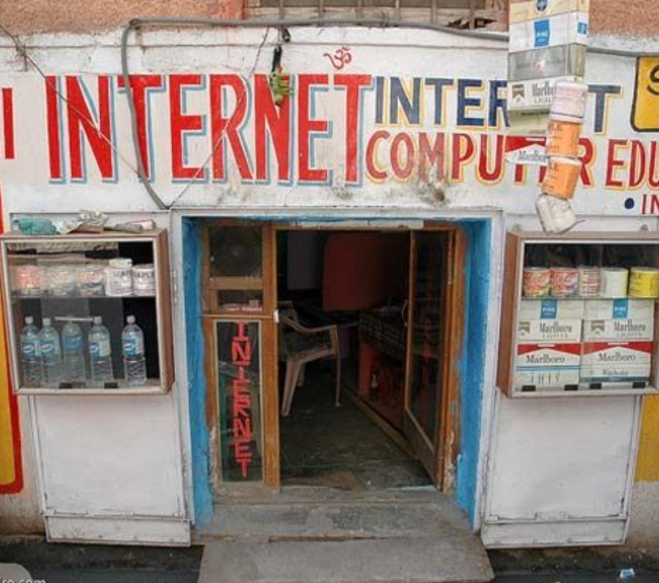
As for Quentin, who once actually owned a cafe (though it might not have had the same clout as London’s Cyberia) in the Haight-Ashbury neighborhood, it took a long time to convert to “laptop culture.” Especially since it’s what led him to losing Cafe Disaffecto (which, by the way, he firmly believed the Daria episode of the same name had stolen from him—or maybe he simply wasn’t as clever as he thought). It took him more years than it should have to admit defeat, wanting to believe that, at some point, the internet cafe could be viewed as a kind of “retro novelty” that might once again attract people. “Novelty” could still sell, couldn’t it? Turns out, no…and the internet cafe soon became the mark of “developing countries” with populations that couldn’t afford private connections (make of those Marxist allusions what you will).
And so, where once San Francisco seemed endlessly ahead of the curve with its internet cafes (including the implementation of the SFnet Coffeehouse Network), now it looked tawdry for any block to still have one. Therefore, the only “element” an internet cafe might attract post-internet normalization were the homeless and the broke. Or people who didn’t want to be bothered with trying to compete for the more limited computer selection at Kinko’s (which was still called that until FedEx bought it in 2004). Fucking Kinko’s. Which also, in its own way, helped to drive away the demand for an internet cafe. But it was the advent of 3G that really signaled the final nail in the coffin.
Finally, after every last penny had been doled out in service of keeping Cafe Disaffecto open, Quentin surrendered. He preferred the word “surrender” to “give up.” Though he often felt that way, wondering if there could have been something else that might have spared his cafe, he knew, in the end, he was but a victim of circumstance, of “progress.” A word that ultimately always equated with “convenience.” And when the people had access to anything that was more convenient, all previous principles and values went out the window—including the notion of supporting local businesses.
As of 2004, Quentin was no longer doing much of any business. What’s more, he had succumbed to buying one of those colorful, “clamshell” Macs that had taken the nation by storm…about four years earlier. To say he was resistant to quickly adapting to the times was, obviously, an understatement. At first, he was hesitant to buy an iBook, but then he figured, fuck it. The enemy had already won—why not fortify the personal computer’s triumph with yet another cash donation? 2004 also happened to be the year Quentin started to look seriously for a new job—in addition to applying for grad schools that might reignite his “employability” potential. A computer would be necessary for all such endeavors. Even though he was only too aware of how much of a challenge it was going to be to go from business owner to business owned.
But what choice did he have? Or any of us, when it came to deferring to technological advancement and all the jobs/entities it tended to “discontinue.” The only way to really “push back” was to risk becoming like the Unabomber (who, if we’re being honest, was definitely onto something). That’s not who or what Quentin wanted to be—even if he often related to such Luddite ideas. Or at least wished that technology could be finite. Instead of ever-evolving, as though feeding some arcane beast that humanity knew nothing about. But then, they knew only too well what beast they were feeding. It was one as ancient as industrialism, and was named Capitalismo. He was a monstrous beast indeed, and one who needed to be sated constantly. Enter the concept of obsolescence, which is the very thing that kept the relentless creation of “new” technology running like a locomotive on an ouroboros’ trajectory.
It didn’t seem so overt when the first Mac laptops came out, but, by 2011, when Quentin found himself living in L.A. (so was often mocked for sharing a name with Tarantino), the turnover was becoming prominent enough to make Quentin’s head spin. It felt as though no sooner would he buy the latest model than a newer, “better” one would emerge. And it was difficult not to notice how quickly outmoded his laptop would become, considering he now spent most of his days in the coffee shops of L.A., where everyone was hyper-attuned to keeping up with the “best” of everything. Quentin, thus, couldn’t avoid the feeling that he stood out like a sore, Luddite thumb with his 2008 MacBook in 2011. That was also what capitalism was meant to make you do: feel so out of step with what was current that you caved to buying the latest thing. While everyone else—most of them blatant aspiring screenwriters—had the latest editions, there Quentin was with his already antiquated, impotent “piece.”
That was one thing he couldn’t stand about L.A.: its collective obsession with image. Nonetheless, he was condemned to stay there indefinitely. Such was the curse of finding rather steady freelance work as a script doctor (having benefited from that MFA in Creative Writing more than most—particularly those who tried to make a “career” of literature). Sure, some might say he could essentially ghostwrite scripts from anywhere, but most of his clients preferred to meet in person at a moment’s notice to go over any aspects that weren’t (or were) working. Quentin also enjoyed the competitive edge it gave him, to be so available. In fact, he was surprised at how many people tried to make it in L.A. without actually being in L.A. And this long before the days of Zoom’s ubiquity made one’s location seem even more irrelevant. That certainly wasn’t the case in 2011 (when Zoom was, incidentally, founded, but not functional). And that’s why Quentin had his competitive edge before still more technology would also render the latest business of his endangered.
But that won’t come for several years yet. In the meantime, Quentin makes his way through the highways and byways of Los Angeles in search of a different coffee shop each day. He finds that it increases his potential for inspiration, being in varied milieus. And yet, despite this theory of “variation,” Quentin quickly realizes how disappointed he is by just how similar these places are. The “new cyber cafes.” Except it’s BYOC (Bring Your Own Computer), and the drinks tend to cost more than it once did to sit for three hours at a public computer. To boot, they were all filled with the same wannabes and faux pretentious film bros and would-be manic pixie dream girls. Many of whom tried to flirt with him. That is, when they weren’t asking him if he could just do them a “small favor” and “watch” their laptop while they went to the bathroom (presumably to barf or snort a powdery pick-me-up). To quote an L.A. icon, “As if.” What did they think he was, some kind of hall monitor?
In spite of his contempt, Quentin always gave them an assenting nod, as though he actually would. For it never even remotely occurred to him that any harm might come to these unattended laptops. What could possibly happen to them in the span of a piss? Maybe if someone was taking a shit, there would be enough time to kife a laptop, but few of the “precious” types in these cafes had the gall to do that in a public bathroom. Plus, most of the neighborhoods Quentin frequented were what could be described as “cush.” In other words, who would do something “untoward” here? (The Manson Family might answer, “Who wouldn’t?”).
The answer arrived one unusually gray for L.A. day. Quentin had taken up his standard position in the corner of a relatively new Los Feliz coffee shop called The Multiplex (Quentin supposed that was meant to be some kind of irony). He was working on remedying a particularly atrocious and cliche script about a hot babysitter who inevitably gets brutalized and murdered by page eighty-seven of the ninety-page screenplay. And most of the pages before that had no other action apart from, “CLOSE ON: Tiffany’s tits bouncing up and down as she rocks the baby.” It was going to be a long day. And the last thing he wanted was the seemingly endless interruptions from waifish women pseudo-coyly asking if he could watch their laptop. But instead of refusing (few people would dare to), he agreed quickly and eagerly, just to get them out of his sight.
By the time the fifth girl of the day inquired about it, his head nod and “pleasant smile” was on autopilot. So it was that he kept right on building new layers over what was originally nothing but a series of shots of Tiffany’s tits. While doing so, he barely registered that, out of the corner of his eye, a man with, let’s say, “tan skin” had sidled up to the latest laptop Quentin had been put “in charge of.” Not even trying to be “stealth” about it (and apparently he didn’t need to be), the thief closed the laptop, picked it up and unplugged the charger in the wall associated with it. All not only right in front of Quentin’s face (though, technically, to the side of it), but also numerous other unfazed patrons of The Multiplex. When the wisp that the laptop belonged to returned to find it missing, she let out a doleful, yet monotone (this was California, after all) shriek. She then immediately trained her eyes on Quentin, who could have kept working through her tirade had she not closed his laptop in a fit of anger to make him focus.
“I told you to watch my laptop! Where the fuck is it?” For the first time, Quentin truly looked at her, studied her—what she was “about.” And Jade, as he found her name was when she tried to report Quentin to the police for something made up like gross neglect, was “about” something deep-seated in the human condition.
Obviously, when the police showed up (as police usually did when called to “white neighborhoods”), the responding officer barely stifled a chortle upon hearing all the details of the robbery. Which Quentin had nothing to do with…even if Jade kept repeating how it was Quentin’s “responsibility” and that he had neglected his “duty.” All Quentin could do—as there was no “reasoning” with someone like this—was wait it out in his corner. For all of this to pass while he “cooperated.” Further probing revealed that The Multiplex didn’t have any indoor surveillance cameras (“But we’ll be sure to install them now,” the owner promised). This only sent Jade into a deeper tailspin, nearly getting arrested herself when she tried to assault Quentin for “being so fucking blasé” about the entire thing. It was only then that Quentin could finally pinpoint exactly what Jade was “about”: shifting blame onto everyone but herself for her own actions.
For was it not her choice to make a “character assessment” and trust a total stranger with a personal possession so dearly valued? (Granted, Quentin doubted that the world had suffered from the loss of any potential “great art” on that computer). There were so many people just like Jade, desperately trying to place fault on anyone else’s shoulders but their own. Well Quentin was goddamn sick of it. And he intended to do something about that sickness, was going to take assertive action to prevent having to witness this type of “Jade fiasco” ever again.
That’s how Quentin managed to take a professional track that made everything come so ironically full-circle: he saved up enough script doctor money and opened a cafe of his own again. It was called, what else, Cafe Luddite. And this time around, all computers were banned (taking it to the nth degree of simply offering no wi-fi). No risk of being asked to watch someone’s fucking laptop that way.
 Literary Bitch